Portuguese
  Spanish


Indigenous People Live Daily With Jararacas, Surucucus, and True Corals in One of the Regions With the Most Snakebite Accidents in the Country, Yet They Are Nearly Never Bitten; the Explanation Involves Animal Behavior, Constant Attention, and Practices Passed Down Through Generations
The Amazon is home to some of the most venomous snakes in the world, such as the jararaca, the surucucu, the true coral, and the Amazonian rattlesnake. These species possess venoms capable of causing tissue necrosis, hemorrhages, paralysis, kidney failure, and even death if medical attention is not prompt. Still, one fact draws the attention of researchers, doctors, and locals in the region: indigenous peoples living in the forest, often walking barefoot for miles, are rarely bitten.
According to data from the Ministry of Health, the Northern Region of Brazil has the highest incidence of snakebite accidents in the country, with about 30 to 40 cases per 100,000 inhabitants per year. Among rural workers, farmers, fishermen, and people who work directly in the forest, the risk is even greater. However, when observing indigenous communities that live permanently in this environment, the numbers drop drastically.
This information has been published in official data from the Ministry of Health and also analyzed in epidemiological studies conducted in the Amazon, including research conducted in areas such as the Upper Rio Negro, which compared indigenous and non-indigenous communities living in similar forest areas.
-
How to Prevent Brown Recluse Spider Bites: Common Hiding Spots and Free Tips to Reduce Risks

-
Natto: The Unusual Japanese Superfood Gaining Popularity on Social Media and Driving Record Exports
-
Brazilian Mayor Goes Undercover as Homeless for 24 Hours to Assess Public Services

-
15-Year-Old Entrepreneur Malu Lira Publishes 20 Children’s Books on Financial Education, Earns $500,000, and Expands Her Project to the Amazon Rainforest



When questioned, many experienced indigenous individuals state that they have never been bitten by poisonous snakes throughout their lives. In some villages, there are reports of people who do not even know someone from their own community who has suffered such an accident. Given such a hostile scenario, the question arises naturally: how is this possible?
The Real Danger of Venomous Snakes in the Amazon
The main family of venomous snakes in the Amazon is the Viperidae, which includes the jararacas and surucucus. Jararacas, usually measuring between 50 cm and 1 meter, can reach up to 1.5 meters in some species. They are responsible for the majority of snakebite accidents in the region, primarily due to their abundance and defensive behavior.
The venom of the jararaca is hemotoxic, causing tissue destruction, intense bleeding, and necrosis. In severe cases, it can lead to amputation of limbs or death without proper treatment. The surucucu, also known as jaca snake, is the largest venomous snake in the Americas, capable of reaching 3 to 4 meters in length. Its venom is both hemotoxic and neurotoxic, increasing the severity of bites.
Another relevant species is the true coral, easily recognized by its red, black, and yellow rings. Although smaller, at about 50 to 80 cm, it has an extremely potent neurotoxic venom, capable of causing muscle paralysis and respiratory failure. Fortunately, it is a shy snake, and most accidents occur when someone tries to handle it.
The Amazonian rattlesnake is also present in cerrado and savanna areas within the Amazon, although it is rare in dense forest. Its neurotoxic venom is potent, but its presence is less frequent in environments where many indigenous communities live.
Ancestral Knowledge and Reading Snake Behavior
What differentiates indigenous people is neither immunity nor luck. It is their deep knowledge of snake behavior. They know that these animals are ectothermic, meaning they rely on external heat to regulate their body temperature. Therefore, they become more active at certain times of the day.
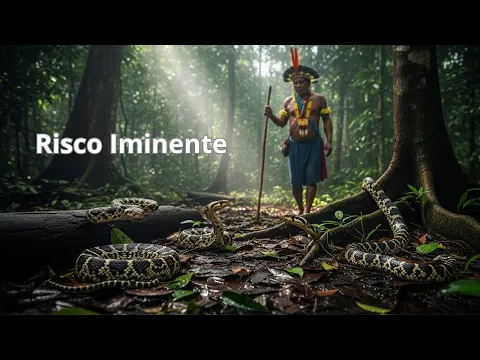

During the mornings and late afternoons, when the temperature is milder, snakes usually bask in the sun. In the middle of the day, they typically remain hidden in the shade. Some species hunt at night. Indigenous people adjust their activities based on these patterns, staying extra alert during high-risk times.
They also understand that venom is a valuable resource for the snake, primarily used to capture prey such as rodents, birds, and lizards. Thus, snakes do not attack humans without reason. Most bites occur when the animal feels threatened, cornered, or surprised.
Another crucial point is the understanding of attack distance. A snake can strike at approximately half its body length. Therefore, maintaining a safe distance is a simple yet extremely effective strategy. Additionally, indigenous people recognize alert signals, such as the rattle of the rattlesnake, the vibration of the surucucu’s tail against dry leaves, and the hissing sound emitted by some jararacas.
Movement Techniques and Reading the Environment

In addition to snake behavior, there is a detailed understanding of the preferred habitats of these animals. Piles of leaves, fallen trunks, exposed roots, holes in the ground, edges of streams, and rocky areas are classic shelter locations. Indigenous people avoid placing their hands or feet where they cannot see and use sticks to probe the vegetation before proceeding.
They also know that snake behavior changes with the seasons. During the rainy season, when low areas flood, snakes move to higher ground. In the drier season, they cluster near water sources. This knowledge directly influences how they navigate through the forest.
Another fundamental detail is that indigenous people do not walk silently. When talking, singing, or tapping their stick on the ground, they create vibrations that alert the snakes to their approach. Thus, the animal tends to flee, avoiding surprise encounters — which are the most dangerous.
The way they walk also makes a difference. Their steps are deliberate, attentive, and conscious. Rather than running or getting distracted, their gaze is always focused on the ground and the surrounding vegetation, including branches above, as some snakes are arboreal.
Identification, Protection, and Respect as a Survival Strategy
From childhood, indigenous people learn to quickly identify venomous and non-venomous snakes, recognizing patterns of color, head shape, and behavior. Studies show that indigenous individuals correctly identify around 90% of species, while non-indigenous rural workers are about 60%, and urban populations reach no more than 30%, an index close to chance.
Although traditionally many walked barefoot, it is now common to wear sandals, boots, leg guards, and long-sleeved clothing, especially during activities in dense vegetation. Since around 70 to 80% of bites occur on the feet and legs, this protection significantly reduces the risk.
More important than any equipment is the attitude of respect. Snakes are not seen as enemies but as part of the ecosystem. When encountering a snake, the indigenous person stops, slowly backs away, and gives space. Most accidents occur when people try to kill or capture the animal — something that indigenous communities avoid.
Even when rare accidents happen, there is a clear understanding of what not to do: no tourniquets, cuts, suction of venom, or ice. The priority is to keep the victim calm, immobilize the affected limb, and seek immediate medical attention, as antivenom is the only proven effective treatment.
Comparative studies reinforce this difference. In an analysis in the Upper Rio Negro, indigenous communities had about 5 accidents per 100,000 inhabitants per year, while non-indigenous communities in the same region reached 40 cases per 100,000, an eightfold difference. The decisive factor is practical knowledge, accumulated and passed down through generations.
And You? Have You Ever Been in a Similar Situation?

I myself almost got bitten by a snake while completing a loop in Paraty at the Saco do Mamanguá — and it only didn’t turn into an accident because attention, calm, and respect for the environment made all the difference. After that, I began to see the forest differently. Do you believe that knowledge and attitude save more lives than luck? Share your experience.