Portuguese
  Spanish


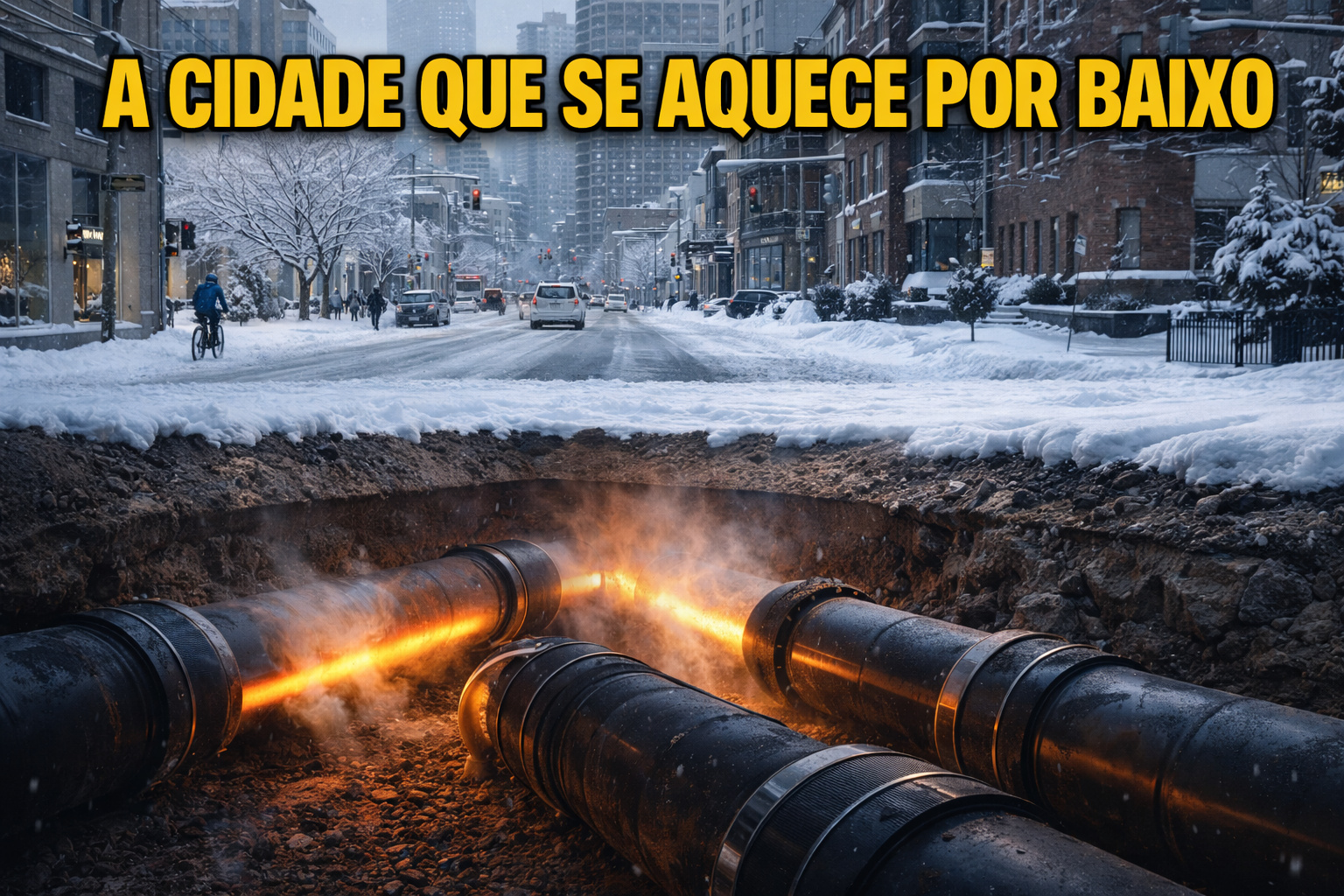


With More Than 18 Km of Underground Pipelines, the District Energy Heating System in Vancouver Distributes Hot Water Beneath Streets and Neighborhoods, Heating the City and Reducing Emissions in the Harsh Winter.
According to public documents from the City of Vancouver and reports from Creative Energy (formerly Central Heat), the capital of British Columbia operates one of the oldest and most advanced district heating systems in North America. The model began to be implemented in the 20th century, scaled up in the 1960s with the expansion of downtown, and received a technological boost in 2010 when the city inaugurated the False Creek Neighbourhood Energy Utility (NEU) to serve part of the Olympic Village for the Winter Games. This data is official, public, and widely cited in municipal and operator company reports.
Together, the systems total more than 18 kilometers of buried pipes that transport hot water beneath streets, avenues, and entire neighborhoods. This type of infrastructure is known as District Energy Heating and transforms something invisible to pedestrians — buried pipes — into a solution capable of heating dozens of buildings with significantly greater thermal efficiency than individual boilers.
Interestingly, part of the thermal energy comes from unconventional sources, including waste heat from treated sewage, which would otherwise be discarded into the environment.
-
Orphaned Youth Turns Dismissed Idea into Global Prestige with Innovative Wristwatch

-
English Skills Boost Career Opportunities in the Oil and Gas Industry

-
Brazil Secures Second Place at WorldSkills 2024 in Lyon, with 64 Young Professionals and 8 Medals, Including Gold from a Rio de Janeiro Hairdresser

-
3,000 Military Personnel from 10 Countries, Including US and Chinese Marines, Train Together in Brazil’s Savanna: Operation Formosa Becomes Largest Naval Ground Exercise Before First Cancellation Since 1988



Subsoil as Energy Infrastructure
The logic of district heating is simple to state but complex to execute: instead of each building having its own boiler, tank, and individual system, a thermal plant produces hot water on a large scale and sends it through a network of buried pipes. Properties connect to the network as if they were connecting to a “heat plumbing.”
The advantage lies in the scale. A large boiler operates with higher efficiency than dozens of small units, consumes less fuel per thermal unit, facilitates emissions control, and simplifies maintenance.
In the case of Vancouver, the central district has been using a system based on steam and hot water for decades to heat corporate buildings, hotels, residences, and public facilities. The more modern system — the False Creek NEU — employs a different approach: it recovers heat from treated sewage to heat entire residential neighborhoods.
Recovering Heat from Sewage: How It Works
According to technical materials from the city itself, the NEU system captures partially treated wastewater at the False Creek station, passes it through heat exchangers, and transfers the thermal energy to a secondary circuit that supplies the network.
The wastewater arrives at the equipment at a higher temperature than the drinking water in winter (even in the cold) because it comes from showers, washing machines, kitchens, and bathrooms. This “invisible” heat is wasted energy in cities without this type of engineering.
The process reduces the use of natural gas and enables a cleaner urban energy matrix. From a technical standpoint, heat is extracted by industrial heat pumps connected to plate exchangers. Later, the thermal fluid travels through the underground piping and enters buildings, where it heats radiators, fan-coils, or home systems.
How Many Kilometers and Where Does It Pass?
Summing up the available public data:
- False Creek NEU operates approximately 8.3 km of underground thermal pipes serving neighborhoods like the Olympic Village and adjacent residential areas.
- The Downtown district system, operated by Creative Energy, has approximately 10.5 km of underground piping, connecting units in the city center and providing steam and hot water to a wide range of buildings.
These values, when combined, exceed 18 km of network, which is significant for a consolidated urban area and mountainous region like Vancouver. And the most curious part: almost no one sees it. The infrastructure is buried beneath the streets, hidden in service tunnels, technical chambers, and underground galleries.
Energy Efficiency and Emission Reduction
The municipal government reports that the NEU system has reduced emissions compared to individual systems based solely on natural gas. The reduction comes from three factors:
- Thermal Scale — a large boiler has lower relative losses and higher efficiency.
- Utilization of Residual Heat — sewage turns into useful energy.
- Matrix Flexibility — the system can incorporate renewable energy, heat pumps, biomass, hydrogen in the future, etc.
The system also prepares the city for climate goals since it does not require every condominium to purchase new equipment or replace boilers. It is enough to decarbonize the central plant, and all connected buildings will follow the transition.
“Ground Heated City”: Direct Urban Impact
In countries with harsh winters, such as Canada, heating is not a luxury. It is critical infrastructure, like water and electricity. A centrally heated city presents invisible advantages:
- Fewer Technical Rooms inside buildings
- Fewer Chimneys and direct urban emissions
- Less Noise from individual equipment
- Release of Urban and Architectural Space
- Lower Operational Risk for end-users
- Greater Ease of Audit and Maintenance
The logic is similar to that of the heating district in Copenhagen, the networks of Paris, or Switzerland, but Vancouver adds the element of waste energy from sewage, which draws worldwide attention.
Engineering Designed to Last Decades
What impresses is the longevity. The heating infrastructure in downtown Vancouver has been operating for over half a century. Buried pipelines are installed with layers of special insulation, thermal protections, expansion joints, and anti-corrosion systems to withstand decades of thermal cycles. Unlike common water pipes, thermal networks need to handle:
- Thermal Expansion
- Continuous Internal Pressures
- Minimal Thermal Losses
- Protection Against Moist Soil and Coastal Salinity
- Compatibility with Future Expansions
It is silent urban engineering — and very expensive to replace — that requires long-term planning.
A Trend That Is Spreading
The Vancouver model has become a reference for other cities looking to reduce emissions without renovating millions of apartments, such as:
- Toronto, with district expansion projects
- Montreal, with a history of central heating
- Copenhagen, with a network serving more than 60% of the city
- Helsinki, with goals for clean thermal generation
- Paris, with expansion to new neighborhoods
The logic remains the same: if decarbonization comes from the network, the city moves faster than if it relies on replacing home equipment one by one.