






 Portuguese
  Spanish


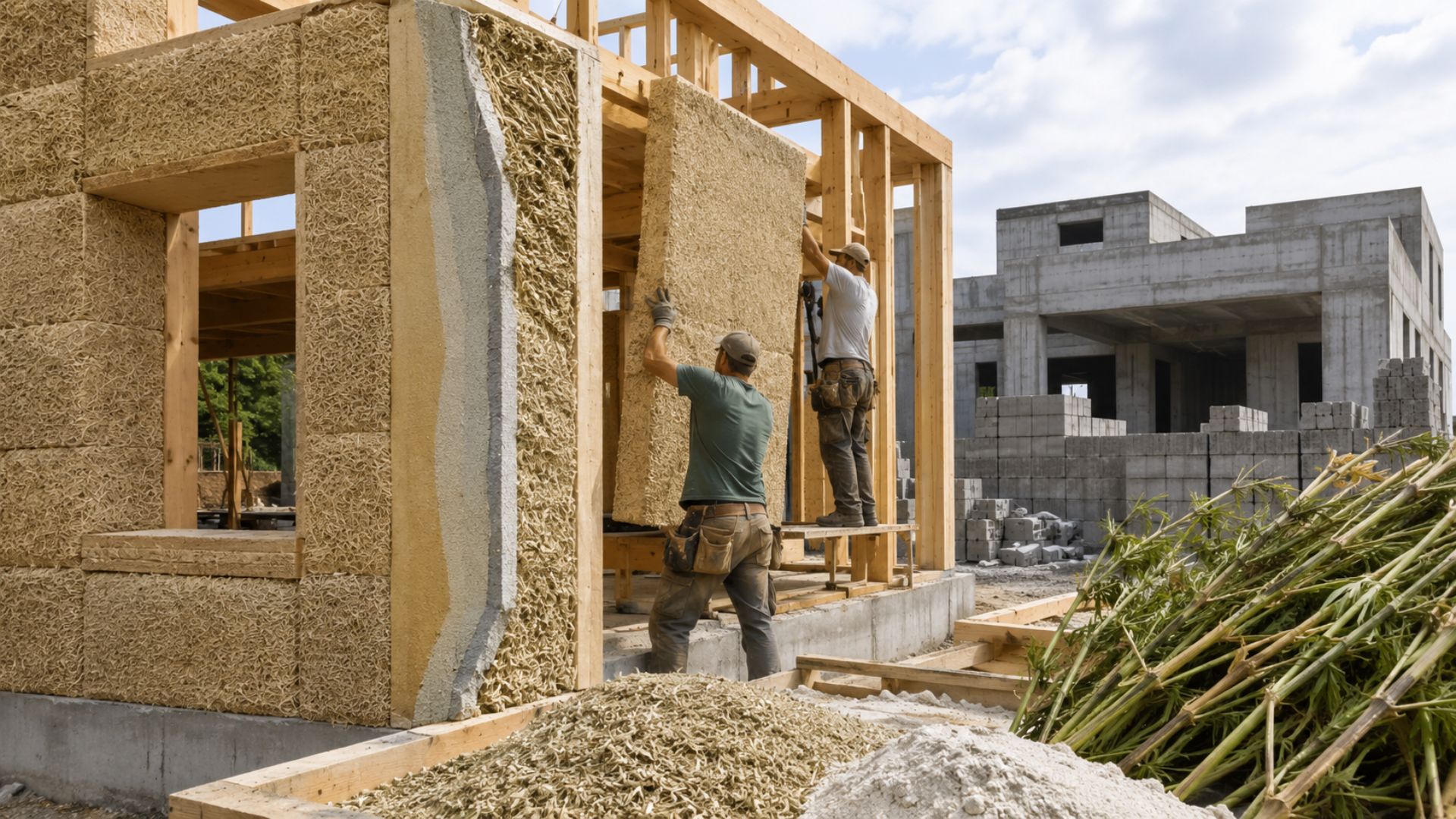


Hempcrete, a biocomposite made of industrial hemp and lime, has returned to the center of the sustainable construction debate after decades in the background. Invented in France in 1986, the material now appears in official codes of various countries and challenges traditional civil construction by reducing emissions and cutting costs with concrete.
In November 2024, Steve Allin, director of the International Hemp Building Association (IHBA), visited the commune of Nogent-sur-Seine, in the Aube region, in northeastern France, to reassess the Maison de la Turque, an old building where hempcrete was invented in 1986 by the French craftsman Charles Rasetti. Upon arriving at the property, he found the hemp and lime biocomposite in perfect condition behind the lime plaster facade, 38 years after the original application. The inspection fueled the current debate on the advancement of hempcrete in civil construction in various countries, reopening the discussion on why a low-carbon material took so many decades to return to the sector’s radar.
The story, according to the IHBA, begins in 1986, when Rasetti was hired to restore the Maison de la Turque, a house famous for appearing in works by the writer Gustave Flaubert in the 19th century. Faced with a weakened oak structure and without suitable material to fill the gaps without compromising the wall’s breathability, the craftsman mixed the woody core of industrial hemp with hydraulic lime and water. This marked what technical literature recognizes as the first documented use of modern hempcrete in construction. The invention, motivated by the practical need to save a historic property, gave rise to a technique that today is once again attracting attention in markets such as the United States, the United Kingdom, Australia, and more recently, Brazil.
How Hempcrete Was Born in a Rural Renovation in France

Rasetti’s choice in 1986 was not accidental. The Champagne region, where Nogent-sur-Seine is located, has been known for centuries for constructions with wooden structures filled with mixtures of lime, straw, and other light materials. The craftsman revived this regional logic by replacing traditional elements with hemp hurd, the woody core of the plant after the extraction of textile fibers. The result proved to be light, insulating, breathable, and compatible with the old carpentry, becoming an initial reference for what is now called sustainable construction.
-
Americans Build Entire Homes in a Day Using Compact Sand Foundations and Pre-Made Wooden Trusses, Reducing Construction Costs

-
China’s Largest Floating LNG Plant, NGUYA, Sets Sail for Congo: 2.4 Million Tons Annually for Italy’s Eni

-
Innovative Project Demonstrates How to Build a Modular, Eco-Friendly Cabin Using Recycled Timber Logs
-
Transform Your Bathroom with Paint, Mirrors, LED Lighting, and Accessories for a Quick, Cost-Effective Makeover


From there, the method was refined by other researchers and French builders throughout the 1990s. In 1989, the first new construction with hempcrete involving a wooden structure was erected in France, and shortly after, in 1990, Yves Kühn developed a construction process that allowed entire houses to be built with hempcrete using a system of movable forms. The technique ceased to be an artisanal curiosity and began to have standardization, industrial suppliers, and dedicated academic research, paving the way for the material’s entry into the regular construction industry market.
Why Industrial Hemp Left Construction in the United States

The delay of hempcrete in the Anglo-Saxon world has a name and date. Hemp production was banned in the United States in 1937 when the Marijuana Tax Act was passed. The law, although formally aimed at psychoactive cannabis, also reached industrial hemp, a variety of the same species used for fibers, food, and construction materials, but with negligible THC content. In a short time, the plant disappeared from American farms, and agricultural knowledge about its cultivation was lost.
In the vacuum left by industrial hemp, industrialized materials took center stage in the 20th-century construction industry, with Portland cement and the concrete produced from it standing out. Today, the scale of the environmental problem of this hegemony is widely documented: the cement sector accounts for a significant share of global greenhouse gas emissions, which has motivated public and private entities to seek alternatives with a lower carbon footprint, including hempcrete itself.
What Science Shows About Hempcrete’s Performance


Studies conducted in European universities, notably the University of Bath in the United Kingdom and the Université de Picardie Jules Verne in France, measured the thermal, acoustic, and fire resistance properties of hempcrete. It is a biocomposite formed by mixing the woody core of industrial hemp with a lime-based binder, with good thermal and acoustic insulation capacity, although with low mechanical performance, especially in compression. For this reason, the material does not replace structural concrete: it acts as a filler and insulator, always supported by a wooden or steel structure that supports the building.
Another point that studies confirm is the natural regulation of humidity. Hempcrete functions like a sponge that absorbs moisture from the air when the environment is humid and releases it again when it becomes dry, helping to stabilize the perceived temperature inside the room. This reduces the feeling of cold in humid climates and decreases the need for mechanical heating, which translates into lower energy consumption and healthier indoor environments in sustainable construction for residences.
Carbon sequestration and the role of the material in sustainable construction
The climatic effect of hempcrete is being measured with increasing precision. In sustainable construction, industrial hemp is combined with a lime-based binder to form hempcrete, a negative carbon biocomposite capable of sequestering more than 100 kilograms of CO₂ per square meter. Sequestration occurs on two fronts: hemp absorbs carbon dioxide while it grows, and the lime continues to absorb CO₂ over time through carbonation, a process in which it slowly reverts to calcium carbonate.
This behavior places hempcrete in a rare category within the construction industry: materials that, instead of emitting carbon throughout their lifecycle, remove more carbon from the atmosphere than they produce in their manufacture. One hectare of industrial hemp captures about 15 tons of CO₂, and hempcrete can continue sequestering carbon dioxide for decades after its application in the building. For architects and engineers seeking net-zero carbon goals, this attribute is, in many cases, the main technical argument of the biocomposite compared to concrete.
The regulatory hurdles that still limit progress
Despite the documented performance, hempcrete faced a central obstacle for years: the absence of technical standards that would allow its use in formal sustainable construction projects in various countries. Without recognized standards, architects and engineers had difficulty including the material in projects subject to approval, and insurers lacked data to price the risk compared to traditional options like concrete.
This scenario began to change in recent years. In 2022, ASTM International published the first standard for hempcrete insulation, the ASTM D8280 standard, and in 2023 the International Code Council approved its inclusion in the 2024 edition of the International Residential Code. The inclusion in the IRC, in the form of the “Appendix BL Hemp Lime (Hempcrete) Construction,” is expected to boost the expansion of the use and legitimacy of hemp lime in construction in the United States. American states like Montana, Washington, and California have already advanced with specific programs and approvals, opening the door to the private sector.
The return of hempcrete to official construction codes
In Europe, the progress is even more consolidated. In the United Kingdom, hemp lime was first used in 2000 for the construction of two test houses in Haverhill, designed by Modece Architects, with monitoring by the BRE for comparison with conventional housing. Shortly after, in 2009, the Renewable House was completed, pointed out as one of the most technologically advanced structures made with industrial hemp-based materials. The trajectory paved the British regulatory path for the material in civil construction.
In France, considered the birthplace of modern hempcrete, the material is already accepted as a recognized technical solution by the sector’s Professional Rules. The city of Croissy-Beaubourg, near Paris, received in 2022 the Pierre Chevet, considered the first public building in France constructed with hempcrete. The project, by the Lemoal Lemoal office, combines a wooden structure with hempcrete blocks and a facade protected by fiber cement panels, complying with French technical standards for public buildings. In the United States, the country’s first house with the system was completed in 2010, in Asheville, North Carolina, and the number of projects has been growing since then in states that allowed its use.
Hempcrete does not replace concrete in all functions and does not seek this role. It presents itself as a strategic alternative for walls, insulation, and environmental regulation within a load-bearing structure of wood or steel, with a low carbon footprint, good thermal response, and proven performance over decades of use. The question driving the sector now is whether it will scale quickly enough to impact the climate goals of global sustainable construction.
Do you believe that hempcrete has real room to grow in Brazil, considering our climate, the regulation of industrial hemp, and the structure of the civil construction sector? Leave your comment, tell us what you have seen about the topic, and share the article with those who are thinking of renovating or building in a more sustainable way.





Banned for 90 years. Invented 39 years ago. Does nobody proof read any more