Portuguese
  Spanish


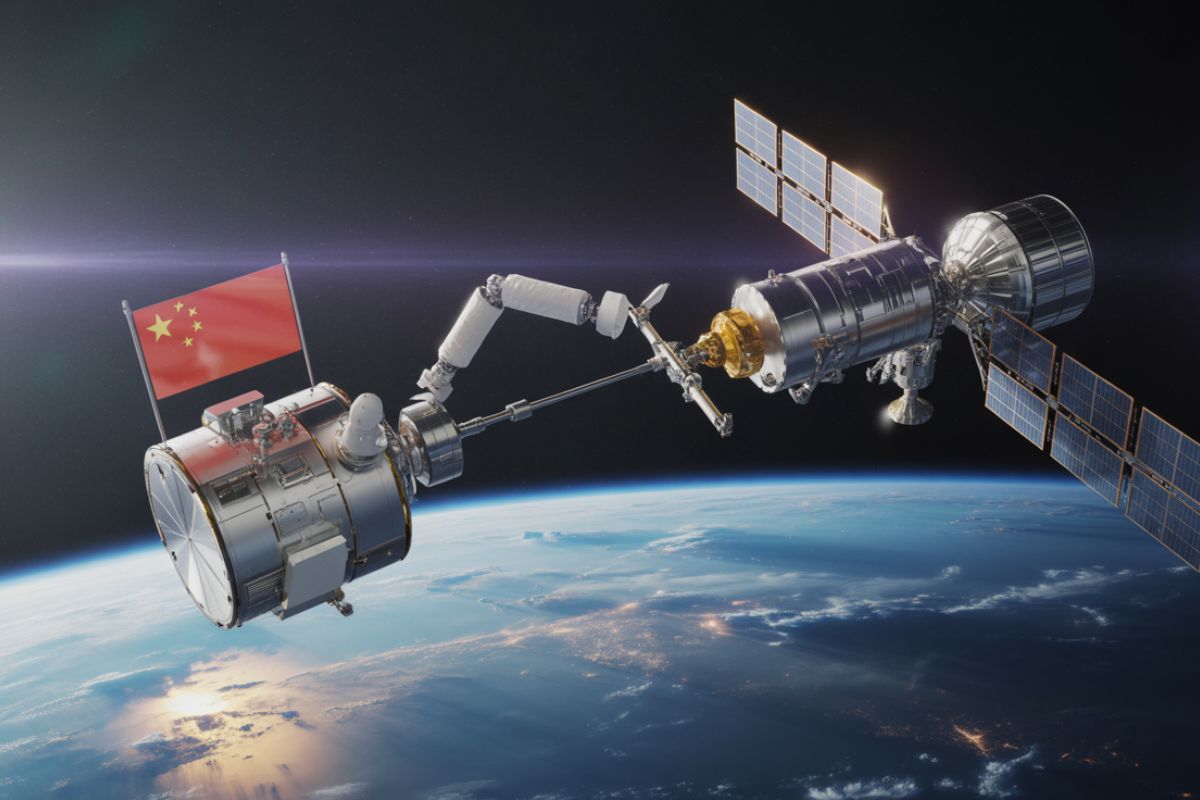


In A Maneuver At 36,000 Km Above Sea Level, China Tested Its First Space “Gas Station,” A Technology That Could Prolong The Lifespan Of Satellites Or Become A Weapon In The New Space Race.
A complex and secretive maneuver in Earth’s geostationary orbit raised alarms at the Pentagon: China has just successfully tested what may be considered the world’s first “space gas station”. The operation involved the rendezvous of two Chinese satellites, the Shijian-21 and Shijian-25, which were observed coming close enough to temporarily merge, an action interpreted by American experts as an in-orbit refueling test.
This capability, although presented by Beijing as a solution to extend the lifespan of its satellites and reduce space debris, has a much more concerning side for the West. The same technology that allows refueling a friendly satellite can also be used to deactivate, sabotage, or even capture an enemy satellite, giving China an unprecedented strategic advantage in the new Cold War unfolding in space.
What Are China’s “Do-It-All” Satellites?
The operation was led by two satellites from the mysterious Shijian series.
-
Ancient Maya City Discovered in Remote Mexican Area with 12-Meter Pyramid, Palaces, Canals, and 14 Preserved Monuments

-
Indigenous 8-Year-Old Girl Wins National Science Award for Solar-Powered Water Heater Invention Using Recycled Materials

-
14-Year-Old Girl Develops Solar-Powered Water Purification System for India, Eliminating Need for Electricity or Chemicals

-
Forgotten Canadian Machine Harnessed Waterfall Power to Supply Mines with Compressed Air for 70 Years Without Motors or Electricity



- Shijian-21 (SJ-21): Launched in 2021, its official mission is to test technologies to mitigate space debris. In practice, it functions as a “tugboat,” capable of docking with deactivated satellites and moving them to a “graveyard orbit.” This capability has already raised concerns in the U.S., which sees the SJ-21 as a potential anti-satellite weapon.
- Shijian-25 (SJ-25): Launched more recently, its stated function is to extend the lifespan of other satellites. It is essentially the “space gas station,” designed to perform precise approaches and transfer fuel.
The Maneuver That Startled The Pentagon
A few days ago, American space observers detected that the two satellites were operating at extremely close distances. The U.S. Space Force even positioned two of its own surveillance satellites (GSSAP) to closely monitor the action.
The images captured showed the two Shijian merging into a single bright point before separating, in what appears to have been a successful docking operation. If fuel transfer is confirmed, China will have surpassed the United States, which is planning its first military refueling mission only for next year.
Why Is A “Gas Station” In Space A Threat?
Orbital refueling technology is of “dual use,” meaning it can be used for peaceful or military purposes. The major concern for the U.S. is that China may use this capability to increase the aggressiveness of its satellites.
A satellite with the ability to be refueled can perform many more maneuvers in orbit without worrying about depleting its precious fuel. This makes it more agile, unpredictable, and harder to track. For the U.S. Space Force, this represents a huge challenge. As retired lieutenant general John Shaw said, “if tomorrow they can refuel freely and operate even more dynamically, the cost of maneuvering will be marginal for them.”
The New Cold War Is In Space
The development of the “space gas station” by China is not an isolated event. It is part of an intense technological and military competition among superpowers. While the U.S. develops its own “dynamic space operations,” China shows that it is not only keeping up but in some cases, leading the race.
Space has established itself as a war domain, where logistical capabilities, such as refueling, are as important as weapons. The maneuver of the Shijian satellites is proof that the competition for hegemony in Earth’s orbit is just beginning.
What do you think? The technology of a “space gas station” is an advancement for the peaceful exploration of space or the first step toward a war among satellites? Share your opinion in the comments.