






 Portuguese
  Spanish


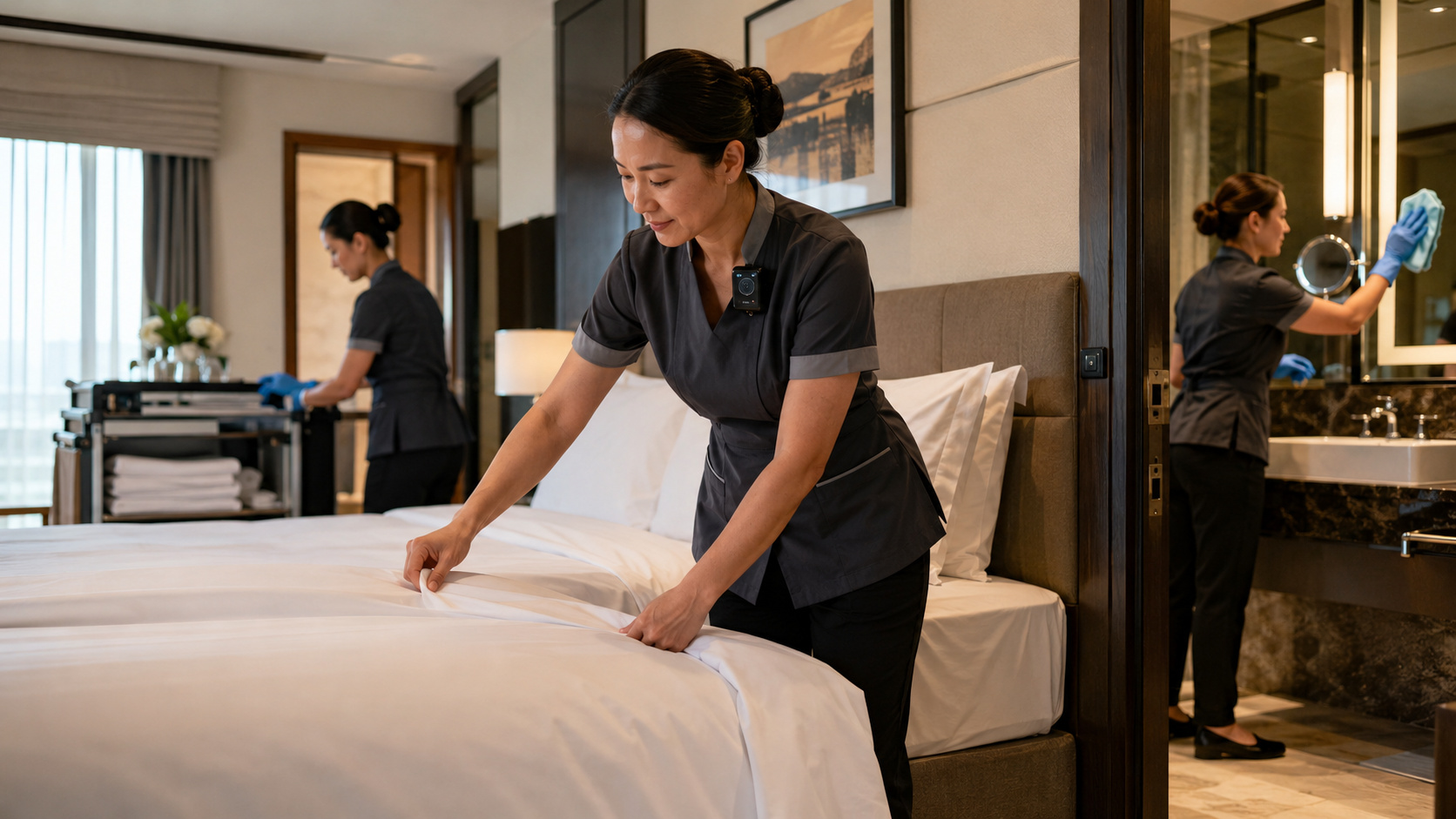

South Korean startup records employee movements to train humanoid robots capable of performing delicate tasks in hotels and services.
In 2026, inside the five-star Lotte Hotel Seoul in South Korea, experienced employees began working in an unusual way: with cameras attached to their heads, chests, and hands, recording every movement as they folded napkins, cleaned glasses, knives, and forks in a banquet hall. According to the Associated Press, in a report published on May 12, these gestures are not being recorded for traditional surveillance but to feed a database that could teach robots to accurately replicate human tasks.
The initiative is part of the work of the South Korean startup RLWRLD, pronounced “real world,” a company focused on developing foundational models for robotics and manipulation with five-fingered robotic hands. Instead of training artificial intelligence solely with texts and images from the internet, the company collects real movements from professionals in hotels, warehouses, and convenience stores, including workers from CJ and the Japanese chain Lawson, to transform human techniques into machine-readable data.
The proposal shows an important shift in the artificial intelligence race: after the explosion of chatbots and generative models, companies are now competing in the so-called “physical AI”, defined by the AP as machines equipped with AI and sensors capable of perceiving, deciding, and acting in real environments. In the case of RLWRLD, the goal is to create a software layer that works on robots used in factories, logistics centers, hotels, and, in the future, even inside homes. Employees use body cameras to transform human movements into data for robots.
-
Scientists Discover 125-Million-Year-Old “Pregnant Fossil” with Preserved Embryos and Microscopic Larvae Inside Mollusk in England

-
17-Year-Old Justin Bernstein Develops Bacteria to Produce Glass on Arctic Ice to Reflect Sunlight, Wins $50,000 U.S. Scholarship

-
The 19-Meter Rocket-Helicopter: A Private Industry Prototype That Challenged Space Race Logic

-
Brazilian Students Convert Seized Illegal TV Boxes into Linux-Powered Mini Computers for Schools and Social Projects Across São Paulo





The big problem for modern robots is no longer walking, but using hands like humans
In recent years, companies have shown humanoid robots capable of running, jumping, and walking on difficult terrains. The real obstacle now has become another: manual dexterity.
Manipulating fragile glasses, folding fabrics, organizing delicate objects, and controlling finger pressure requires extremely complex precision. According to executives at RLWRLD, replicating the capability of human hands has become a central priority for the next generation of robots.
This is precisely why the company started recording experienced workers in real hotel, logistics, and retail environments.
Luxury hotel became a laboratory to train humanoid robots
The Lotte Hotel Seoul became one of the first real environments used by the startup. Event sector employees began performing tasks while sensors and cameras captured details such as joint angles, force applied by the hands, finger positions, and movement sequences.
The data is then converted into comprehensible information for AI models specialized in robotic control. RLWRLD is not limited to just the hospitality sector.


According to the Associated Press, the startup also works with employees of the logistics company CJ, recording warehouse workers’ movements, as well as employees of the Japanese chain Lawson, where cameras track product organization and item handling in convenience stores. The idea is to build a gigantic library of human skills geared towards robotics.
Robots are learning the strength, pressure, and delicate movements of human hands
The captured data goes far beyond simple video. According to RLWRLD, the systems record extremely specific details such as pressure applied to objects, joint torque, motor sequence, and the intensity of the force used in each task.
This is crucial because robots need to learn not just “what to do,” but exactly “how to do” without breaking, dropping, or damaging objects.
The company recently unveiled the RLDX-1 model, described as an AI system specifically aimed at high-precision robotic manipulation.
According to RLWRLD, the model uses a multistream architecture capable of combining computer vision, context memory, movement, and force sensors to generate more natural physical actions. The goal is to create a kind of “universal brain” for industrial and domestic humanoids.
South Korea wants to become a world power in “physical AI”
The project is part of a much larger movement within South Korea. The South Korean government recently announced a program of about US$ 33 million to capture the skills of “technical masters” and create databases used in the training of industrial robotic systems.
The national strategy seeks to position the country as a leader in physical AI, leveraging the strength of the South Korean industry in electronics, semiconductors, and automation. Large South Korean companies have also started to enter this market strongly.

According to the Associated Press, Samsung Electronics plans to transform its factories into AI-driven environments by 2030, while Hyundai Motor Company intends to use humanoids from Boston Dynamics in its operations in the coming years.
This shows how the race for humanoid robots has moved out of laboratories and started entering directly into the industry.
Robots are still far from human speed in hotels
Despite technological advancement, those involved acknowledge the current limitations. Employees at Lotte Hotel stated that humanoids would still need several hours to clean a room that human workers can organize in about 40 minutes.
This shows that robots remain far from human efficiency in complex and unpredictable tasks. Even so, hotels have already started to study the future use of these machines.
According to those involved in the project, humanoids could take on approximately 30% to 40% of the tasks performed in internal service areas, especially repetitive activities of preparation, organization, and cleaning. Functions involving direct human interaction are still seen as much more difficult to automate.
Human knowledge has started to become raw material for AI
Perhaps the most important aspect of the story is precisely the transformation of human work into digital data.
Movements developed over years of experience are now captured, converted into computational information, and reused in machine training.
This has created a growing discussion about who really “owns” these skills when they start to feed commercial artificial intelligence systems.
The next big AI market may not be on the internet, but in the human body
During the first wave of generative AI, companies collected texts, images, and videos from the internet to train models. Now, the race begins to shift to another type of data: human physical movements in the real world.
Folding a napkin, cleaning a glass, making a bed, or organizing a shelf has become valuable information for companies trying to create robots capable of operating outside traditional factories.
The case of RLWRLD helps to show a profound change in the relationship between humans, work, and artificial intelligence.
Instead of just talking to chatbots, companies have started to record gestures, movements, and human physical skills to feed the next generation of machines.
In the end, what is happening today in South Korean hotels may represent the beginning of a new stage of AI: robots trained not only with words from the internet but with the very movements of the human body in the real world.




This is my testimony regarding how I finally joined the New World Order—the Illuminati—after trying for over two years, only to have scammers steal my money on multiple occasions. I had wanted to join the Illuminati for a long time, but scammers kept taking my money until earlier this year, when I met Lord Felix online. I contacted him, explained my situation, and he recommended that I register. I paid for the premium membership to begin the process and was initiated into the New World Order virtually. I received $1,000,000 USD in my bank account instantly following my online initiation ritual, and I will also earn $33,000 USD per month. I am euphoric! I promise to spread the word about Lord Felix’s excellent work. If you are interested in joining the Illuminati’s New World Order today, contact Lord Felix right now—rather than letting scammers steal your money under the pretext of helping you join. Contact Lord Felix via WhatsApp at +44 7353 027456.