Portuguese
  Spanish


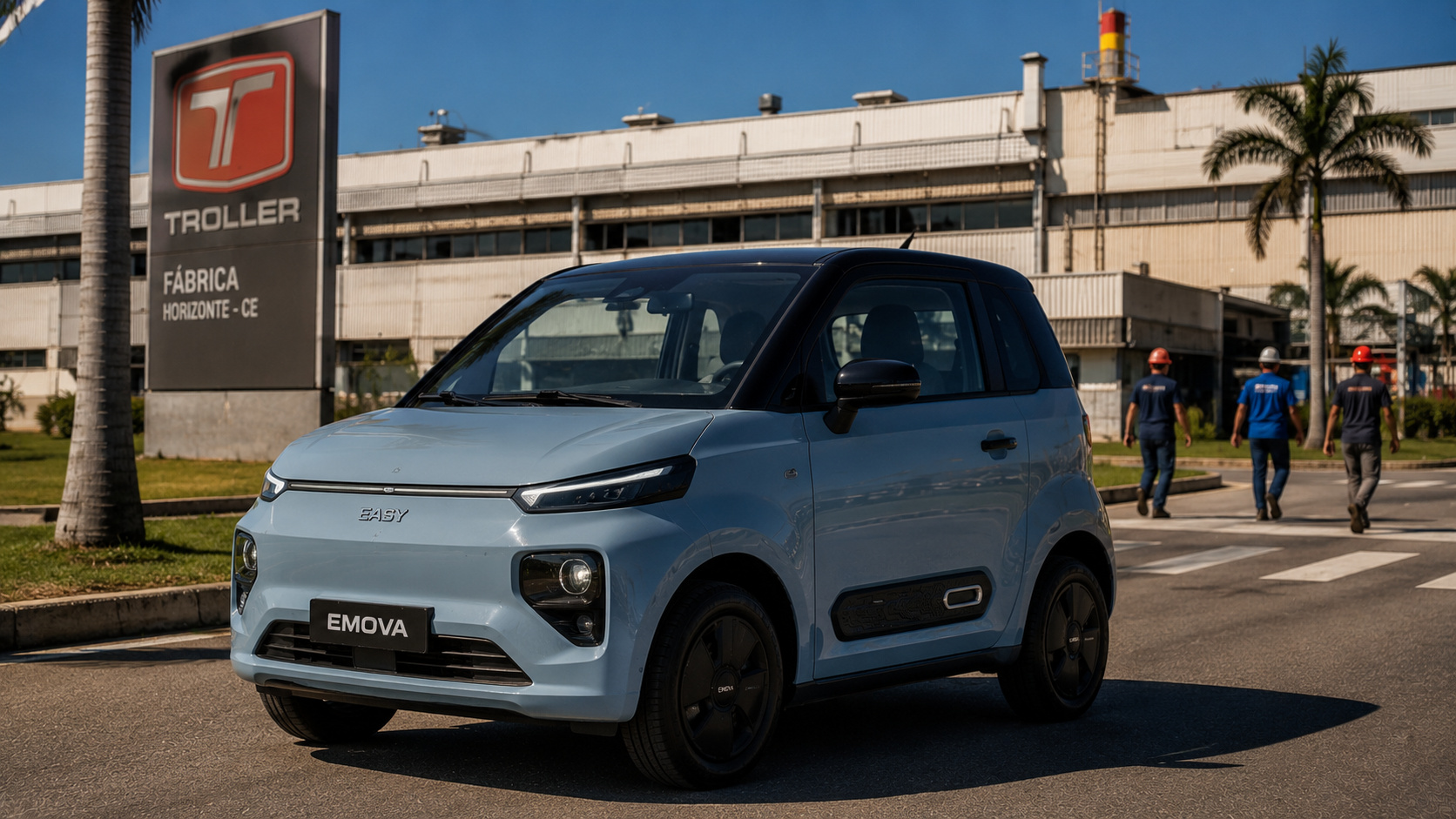

Negotiations involving the former Troller factory in Ceará could transform the affordable electric segment and expand Chinese presence in Brazil with cheaper urban models and national production
The Brazilian electric car market could undergo a significant transformation in the coming months. This is because E-Motors confirmed that it is negotiating the national assembly of the Emova Easy and Emova Urban models at the Automotive Plant of Ceará (PACE), located in Horizonte, in the Metropolitan Region of Fortaleza. Currently, the same factory already produces the Chevrolet Spark EUV and, in the future, is also expected to assemble the Captiva EV.
The information was disclosed by “Mundo do Automóvel para PCD,” which detailed the negotiations involving E-Motors, Comexport — responsible for the plant’s operation — and the Chinese JMEV, manufacturer of the electric vehicles.
Furthermore, the potential agreement draws attention mainly because of the Emova Easy, a model that currently holds the position of the cheapest electric car in Brazil. The subcompact enters the national market starting at R$ 69,990 and focuses precisely on accessibility, low operational cost, and urban mobility to win over Brazilian consumers.
-
Electric and Hybrid Cars Set to Transform Brazilian Streets: A New Era Begins

-
Chinese Giant Invests $1.3 Billion in Brazil to Produce 50,000 Cars Annually, Create Jobs, Develop Local Suppliers, and Manufacture Electric, Hybrid, and Combustion Models by 2027

-
Unprecedented achievement in India: a colossal 650-ton, nearly 3,000 hp excavator is transformed into 100% electric, marking a new phase in heavy mining.
-
Frightened by the speed of Chinese manufacturers, Renault decided to mimic the pace, made the new electric Twingo in just 21 months, wants to repeat the feat with 36 models by 2030, and along the way, will cut up to 2,400 engineering positions.

The movement occurs at a strategic moment for the automotive sector. While Chinese brands rapidly expand their presence in Brazil, traditional manufacturers are accelerating their investments in electrification to not lose ground in a segment that grows year after year.
Emova Easy bets on low price to popularize electric cars in Brazil
Unlike most electric cars currently sold in the country, the Emova Easy does not focus on luxury or large dimensions. On the contrary. The model aims to occupy precisely the base of the Brazilian automotive market.
While a good portion of the electric vehicles sold today in Brazil cost over R$ 150,000, the Emova Easy comes with a much more accessible proposal. The main focus is on urban use and short daily commutes.
According to information released by E-Motors, the model has a range of 201 km, a maximum speed of 100 km/h, and a power of 30 kW. Additionally, the vehicle can accommodate up to four occupants.
Currently, the Emova Easy has two versions available in the Brazilian market:
- Emova Easy Standard — R$ 69,990
- Emova Easy Comfort — R$ 75,990
Meanwhile, the Emova Urban appears with a promotional launch price of R$ 99,990.
Additionally, the brand’s strategy may open space for a new category of urban electric entry-level vehicles in Brazil. Until recently, electrified cars were seen as models far from the reality of most Brazilian consumers.
Now, however, the arrival of vehicles below R$ 70,000 is gradually changing this perception.
Another important point involves precisely local production. If negotiations advance, assembly should begin in the SKD system, an acronym for Semi Knocked Down.
In practice, vehicles arrive partially disassembled in Brazil and go through the final assembly stages within the Ceará factory. This system is already used by several Chinese manufacturers as a strategy to reduce logistics costs and accelerate future nationalization processes.
National production can increase competitiveness against BYD and GWM
The possible manufacturing of the Emova Easy in Ceará could also strengthen E-Motors’ competitiveness in an increasingly competitive market.
Currently, Chinese manufacturers like BYD and GWM are rapidly expanding their presence in Brazil. At the same time, traditional automakers are also accelerating their electrification plans.
In this scenario, local production can represent important advantages for E-Motors. Among them are cost reduction, greater availability of parts, improvement in after-sales, and more competitive prices.
According to the disclosed information, the talks are still in the initial stage. However, Comexport itself confirmed that it is following the negotiations involving the operation of the Ceará Automotive Plant.
Additionally, the Ceará factory is becoming an important strategic hub for electrified vehicles in Brazil. The location already hosts the production of the Chevrolet Spark EUV and is expected to start the assembly of the Captiva EV in the future.
With this, Ceará could gain even more relevance within the national electric car market.
Another important point involves the commercial expansion of E-Motors in the country. The company recently opened its first dealership in Pedro Leopoldo, in Minas Gerais.
Additionally, the brand stated that it intends to open five more stores in the next 60 days and reach about 30 dealerships within a year.
Initially, maintenance services will be performed by accredited partner workshops. The company also reported having a national stock of parts such as:
- headlights
- mirrors
- taillights
- windows
In this way, E-Motors tries to reduce one of the biggest concerns of Brazilian consumers regarding Chinese electric cars: availability of parts and technical assistance.
Brazilian urban electric market begins to take on a new shape
The arrival of the Emova Easy could represent an important milestone for the national automotive market. This is because electric cars still face resistance from some consumers due to the high price.
However, cheaper models are beginning to change this scenario. Furthermore, the gradual popularization of urban electrics may accelerate investments in infrastructure, charging, and national production.
The information was released by “Mundo do Automóvel para PCD”, which highlighted that E-Motors is also preparing new launches for Brazil.
Among them are the Elight electric sedan and the Ewind SUV, both expected to start homologation in 2026.
Meanwhile, the after-sales service of the Emova Easy offers a three-year warranty for the vehicle and eight years for the battery, something considered competitive within the urban electric segment.
With the possibility of national manufacturing, lower prices, and expansion of the commercial network, the Emova Easy could end up becoming one of the first truly affordable electric cars for a larger portion of Brazilian consumers.
Would you have the courage to switch from a traditional combustion car to an entry-level urban electric costing less than R$ 70 mil?