Portuguese
  Spanish


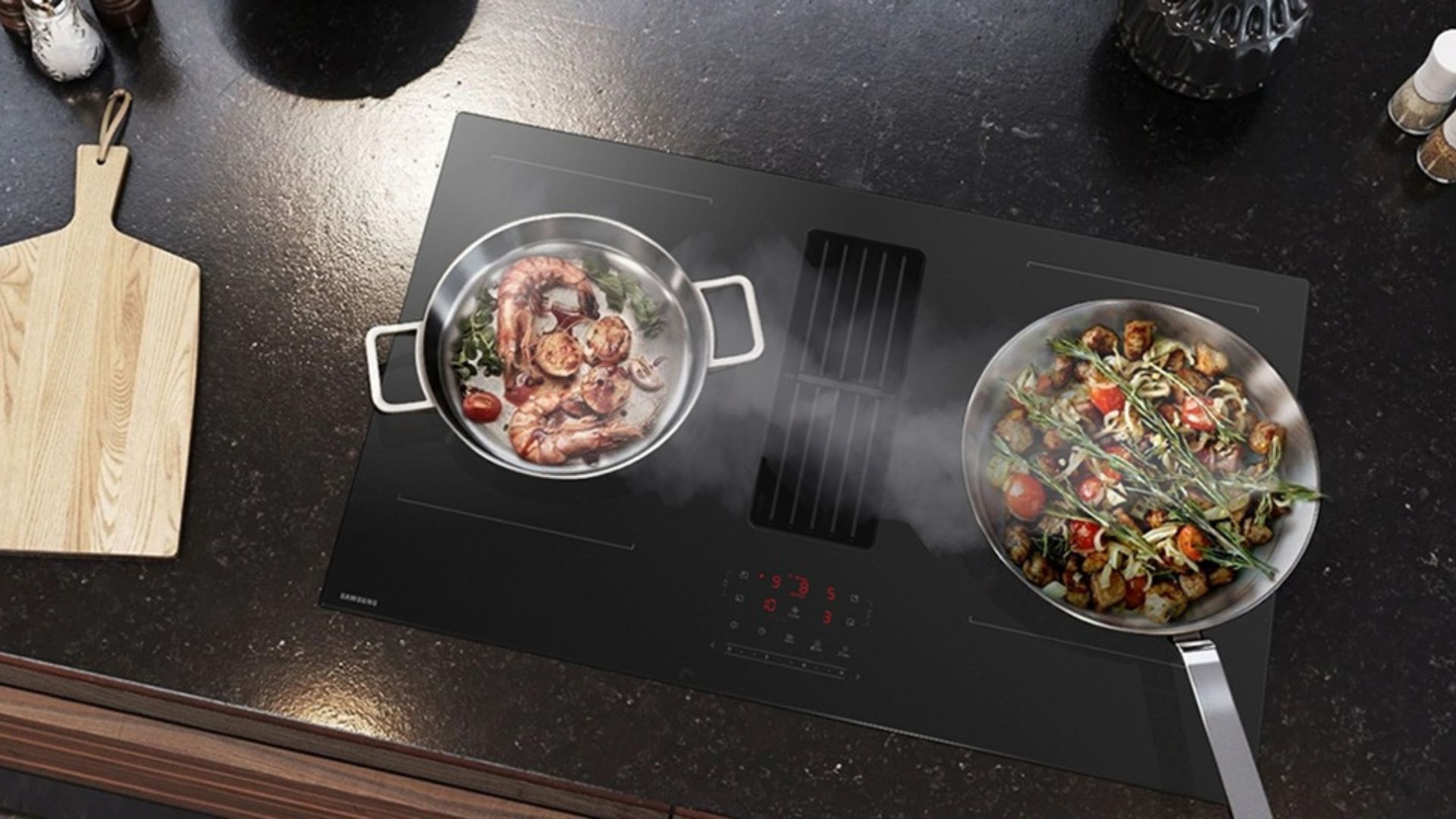


Samsung induction cooktop integrates 720 m³/h extractor, Anti-Scratch Mohs 8 glass, and Flex Zone Plus for open kitchens.
According to the Samsung Newsroom, the Extractor Induction Hob was unveiled at IFA 2025 in Berlin as the centerpiece of Samsung’s new line of premium built-in appliances for open kitchens. The equipment integrates a turbo slim fan directly into the cooktop surface, with an exhaust duct installed below or behind the countertop.
In Boost mode, the suction power reaches 720 m³/h, above most conventional hoods installed over the stove. The cooking surface uses Anti-Scratch glass with Mohs hardness 8, the same as a masonry drill bit, according to Intertek tests by ASTM C1895 standard.
The Flex Zone Plus system covers an area of 36.5 cm by 21 cm, with four induction coils per zone, capable of automatically detecting the size, shape, and position of the pan. The launch in the European market is scheduled for the first half of 2026.
-
Texas Teens Win $50,000 at World’s Largest Science Fair for Developing Non-Surgical Brain-Controlled Bionic Prosthesis with 98% Accuracy

-
Samsung Galaxy A27 Launches with 6.7-inch Super AMOLED Display, Full HD+ Resolution, Android 16, Six Years of Updates, Snapdragon 6 Gen 3, and Dust and Splash Resistance; Available for Pre-order in the US for $350

-
Five Brazilian Students Invent Drug Test Pen That Detects Date Rape Drugs in Seconds
-
Viedma Glacier Retreat in Patagonia Uncovers 900-Meter-Deep Basin, Making Viedma the Deepest Lake in the Americas


Samsung induction cooktop with integrated extractor targets open kitchens and minimalist countertops
The Extractor Induction Hob was developed to solve a common problem in open kitchens: the difficulty of installing a conventional hood without compromising the look, circulation, and design of the countertop. Instead of hanging equipment over the island or stove, Samsung integrated the extraction directly into the cooktop.


The proposal combines two functions in a single appliance: induction cooking and the capture of smoke, steam, grease, and odors on the preparation surface itself. The suction duct is positioned between the cooking zones, exactly where vapors begin to form.
This design especially suits planned kitchens, gourmet islands, and environments integrated with the living room, where smoke and frying smells spread quickly. For those seeking a clean appearance and fewer suspended appliances, the system eliminates the traditional hood as a visible piece of the project.
Conventional hood loses efficiency because smoke and steam disperse before capture
The conventional hood relies on natural convection, that is, the movement of hot air rising towards the filter. The problem is that smoke rarely rises in a straight line to the suction opening, especially in open kitchens with drafts and high ceilings.
The greater the distance between the pan and the hood, the greater the chance of lateral dispersion. Some of the grease and vapor escapes before reaching the filter, impregnating cabinets, ceilings, walls, and nearby surfaces with odor and residues over time.
The downward system of the Extractor Induction Hob changes this logic. Instead of waiting for the smoke to rise, the cooktop captures the vapors at the source, before they spread throughout the environment and lose concentration.
Integrated exhaust of 720 m³/h in Boost mode surpasses many conventional domestic hoods
The suction capacity of an exhaust system is measured in cubic meters per hour, or m³/h. This number indicates the volume of air the motor can process in 60 minutes, removing smoke, vapor, suspended grease, and odors from the kitchen.

An intermediate domestic hood usually operates between 400 and 600 m³/h. More powerful models can reach 700 or 800 m³/h, but generally require a larger structure, robust ducts, and more complex installation.
The Extractor Induction Hob reaches 720 m³/h in Boost mode using a slim turbo fan integrated into the body of the cooktop. In practice, this power is more useful in frying, grilling, intense stir-frying, and preparations that generate smoke quickly.
Flex Zone Plus uses four induction coils per zone and automatically detects the pan
The Flex Zone Plus is the main technical difference between the new Samsung cooktop and a conventional induction cooktop. In common models, each cooking zone usually has a circular coil, requiring the pan to be well-centered to heat efficiently.
When the pan is off-center, smaller than the coil, or has a rectangular or square shape, efficiency may decrease and cold spots may appear. This limits the use of long frying pans, baking trays, and utensils outside the traditional circular standard.
In Samsung’s system, each zone uses four induction coils distributed over a continuous area of 36.5 cm by 21 cm. The equipment identifies the size, position, and shape of the utensil and activates only the necessary coils to heat the correct area.
Pan can be placed in any position within the induction zone without loss of efficiency
The flexibility of positioning is one of the most practical advantages of the Flex Zone Plus. The user does not need to align the pan exactly over a marked circle on the glass, as is the case with many traditional induction cooktops.
A small frying pan positioned in the right corner of the zone can activate only the coils on that side. Meanwhile, a long frying pan or a rectangular baking tray can activate all the coils in the zone, distributing heat more evenly.
This feature enhances the user experience in modern kitchens, where different types of utensils are used in the same preparation. The technology transforms the cooking zone into an adaptable surface, not a fixed heating point.
Anti-Scratch Glass Mohs 8 promises more resistance against scratches and wear on the cooktop
The surface of the Extractor Induction Hob uses Anti-Scratch glass with Mohs 8 hardness, according to Intertek tests by ASTM C1895 standard. For comparison, common ceramic glass usually ranks around Mohs 5.

The Mohs scale measures scratch resistance. The higher the number, the greater the material’s ability to resist scratches caused by friction, utensils, hard particles, or frequent use on the surface.
This point is relevant because induction cooktops are exposed to heavy pans, constant movement of utensils, and daily cleaning. A more resistant glass helps preserve a premium appearance and durability in high-use kitchens.
Superhydrophobic coating facilitates cleaning and reduces residue adherence
In addition to scratch resistance, Samsung states that the cooktop uses a superhydrophobic coating. This type of surface repels liquids and makes it difficult for residues to adhere, making cleaning easier after food preparation.
In conventional cooktops, splashes of grease, sauce, and water can dry on the glass and require more effort to remove. The coating’s purpose is to reduce this problem, making the surface less prone to persistent stains.
The combination of resistant glass and repellent layer reinforces the product’s premium positioning. The goal is not only to cook and extract smoke but to keep the countertop looking clean with less visual maintenance in daily use.
Induction cooktop with integrated extraction requires planning before kitchen construction
The installation of this type of equipment needs to be defined before the cabinetry and countertop assembly. Unlike a simple cooktop, the model with an integrated extractor requires lower space for the motor, filters, ducts, and air outlet.
In kitchens with an island, planning is even more important because the duct may need to pass through the floor or a technical structure below the countertop. Without this care, the equipment may not fit into the existing project.
Therefore, the purchase requires prior consultation with a specialized installer. The product simplifies the kitchen’s appearance but transfers part of the complexity to inside the countertop and to the project planning.
Samsung Extractor Induction Hob arrives first in Europe and still has no date for Brazil
The commercial launch of the Extractor Induction Hob is scheduled for the first half of 2026 in the European market. Samsung has not yet confirmed a date for its arrival in Brazil or prices for other markets.
In Brazil, the penetration of induction cooktops is still lower than in Europe, and many kitchens are still designed for built-in gas stoves. Even so, the product has potential in premium renovations, apartments with integrated kitchens, and projects seeking a minimalist appearance.
The proposal is clear: to combine an induction cooktop, powerful extractor, durable glass, easy cleaning, and flexible zones into a single built-in appliance. For open kitchens, the Samsung Extractor Induction Hob points to a trend where the hood is no longer a suspended piece and becomes part of the countertop itself.