Portuguese
  Spanish


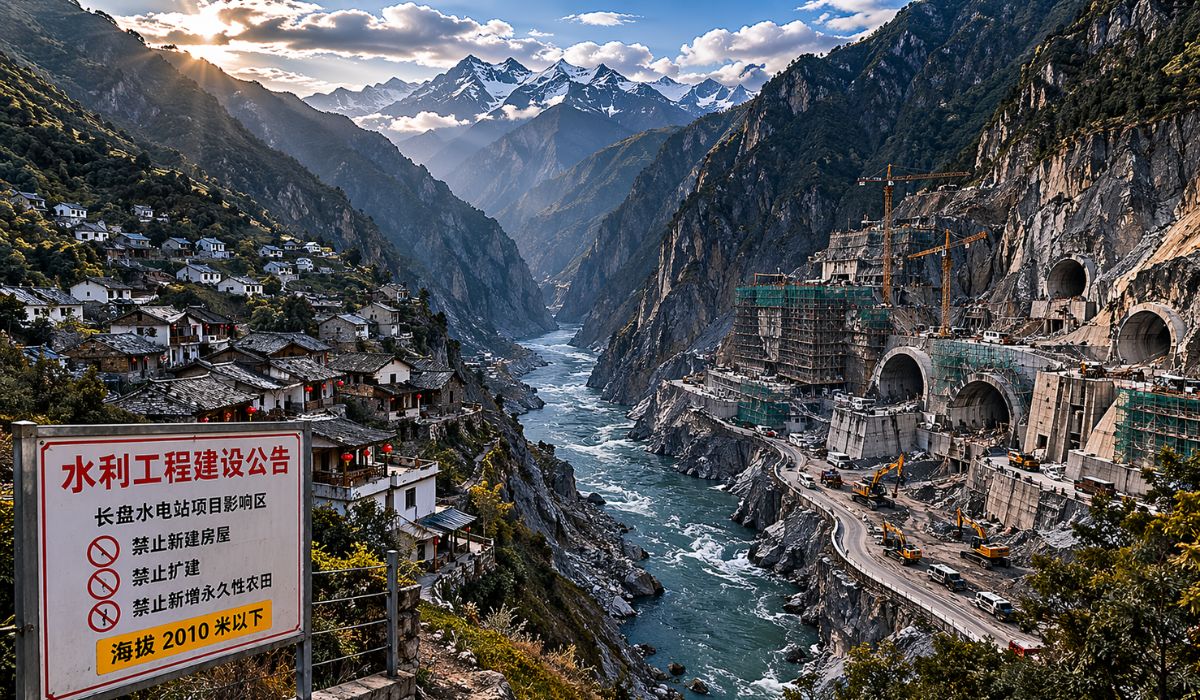

Official posters, territorial restrictions, and scientific studies reposition Tiger Leaping Gorge at the center of a dispute involving energy, geology, and traditional communities in one of the best-known landscapes of the upper reaches of the Yangtze.
Posters affixed in villages in northwest Yunnan have begun to mark the routine of residents in one of the best-known regions of the upper reaches of the Yangtze.
Since September 13, 2024, a notice from the provincial government prohibits new constructions and restricts residents’ access to areas associated with the Longpan hydropower project, in the stretch of the river called Jinsha in China.
According to the rules published by the authorities, the territorial reference is an altitude of 2,010 meters.
-
European Parliament Approves Digital Euro, Aiming to Challenge Visa and Mastercard’s Dominance and Transform Payments Across Europe by 2029

-
Israel finds Hezbollah militarized tunnel over 200 meters long under village, with 4 missile launch shafts, 12 chambers, anti-tank missiles, drones, and weapons depots at a depth of 25 meters.

-
Ukraine launches largest drone attack on Moscow since 2022, Russia claims to have intercepted nearly 200 aircraft near the capital, Kapotnya refinery targeted again, and offensive reignites alert about war reaching the Russian energy heart just a few kilometers from the Kremlin.

-
Truck drivers, freight, and fines from 2022 take center stage in politics: Chamber approves MP with amnesty, mandatory tracking by CIOT, million-dollar penalties, and new minimum wage for those who spend more than 24 hours on the road.


Below this level, properties, crops, and villages could be affected by the reservoir if the project advances.
Estimates published by international media and local documents indicate that the potential impact could exceed 100,000 people.
This number helps to illustrate why the discussion about the dam has returned to the center of regional debate.
More than just an electricity generation project, it involves population resettlement, land use, natural heritage, and geological risk in an area already known for its environmental complexity.
In Longpan, the topic appears in daily life in a discreet but constant manner.
In the late afternoon, four elderly women from the Naxi ethnic group often play cards in front of a senior center, with the Jade Dragon Snow Mountain in the background and the river flowing far below.
Recent field reports have noted that, among residents of villages in the region, official notices and measurements related to the project have increasingly entered conversations in recent months.
Yangtze, Jinsha, and Tiger Leaping Gorge
Before crossing China to flow into Shanghai, the Yangtze is known as Jinsha in this stretch, a term translated as “river of golden sands.”
It is here that the watercourse enters the mountainous corridor known as Tiger Leaping Gorge, in the southwest of the country.
According to UNESCO, the broader region of the Three Parallel Rivers of Yunnan features deep valleys, glacial peaks above 6,000 meters, and gorges with significant elevation changes.
This physical configuration is at the center of the dispute.
For the energy sector, the combination of flow, elevation change, and valley narrowing increases hydropower interest.
For researchers and conservation agencies, the terrain, biodiversity, and geological sensitivity make the location especially delicate.
The area also concentrates communities of ethnic minorities, such as Naxi and Tibetans, which adds a social dimension to the debate about potential resettlement.
The very formation of the gorge helps explain this multiple interest.
Scientific studies relate the landscape of the region to the collision between the Indian and Eurasian plates and the elevation of the Himalayas and the Tibetan Plateau.
In the field of geology, the valley is treated as an area of great relevance for observing processes of active tectonics, erosion, and fluvial dynamics in mountainous terrain.
Construction Restrictions and Altitude of 2,010 Meters
The text released by the Yunnan government directly addresses the territory affected by the project.
The notice prohibits new houses, expansions, perennial crops, cemeteries, and other uses in areas designated for the work, resettlement, and flooding.
It also restricts migration to these locations, with specific administrative exceptions, such as the return of former military personnel, individuals released from the prison system, marriages, and graduates returning to their hometown without formal placement.
In practice, the measure prevents new occupants from claiming future compensation.
The official notice also informs that those who settle after the publication will not be included in the resettlement policies linked to the project.
This type of restriction usually precedes large infrastructure works in China and acts as a freeze on the territory before a broader operational definition.
A similar movement occurred in the portion of the project located in Sichuan.
On November 22, 2024, local authorities announced equivalent restrictions for the area of Derong, also related to the future influence zone of the reservoir.
As a result, the two administrative sides of the valley began to adopt similar control mechanisms over construction, circulation, and occupation.
Longpan Dam and the Resumption of the Project
The Longpan Dam is not a new project.
In 2004, the central government approved a first version of the project for the Tiger Leaping Gorge region.
At that time, the proposal envisioned a large reservoir and the mass displacement of residents along approximately 200 kilometers upstream.
The reaction from local communities and environmental groups was intense, and the plan ended up being shelved in 2007.
The resumption of the topic now occurs in a different context.
China has expanded its capacity for generating what is considered clean energy while maintaining the goal of strengthening energy security and reducing dependence on coal.
In this environment, large hydropower plants have regained space in public documents and business planning, especially in regions with high hydraulic potential.
Financial documents released in 2025 and 2026 by Huadian Yunnan, a state-owned company linked to the electric sector, mention the Longpan-Liangjiaren complex among the main projects planned by the company and record preliminary disbursements.
This type of reference does not, by itself, equate to a definitive confirmation of construction, but indicates that the preparatory stage is ongoing from an administrative and financial standpoint.
A final and unequivocal confirmation of definitive approval by Beijing for the full execution of the Longpan dam has not yet been found in a widely accessible public source.
What has been documented so far is the resumption of the preparation of the institutional ground: land use restrictions, physical measurements, financial planning, and project framing in recent documents.
Cadastral measurements and uncertainty about resettlement
In 2025, international reports noted the progress of teams responsible for cadastral surveys in villages that may be affected.
In Jinjiang, one of the mentioned locations, residents reportedly prevented surveyors from entering homes at the beginning of the year, according to reports published by the press.
The central concern in these cases is that the measurement materializes a removal without sufficient public detail regarding destination, compensation, and resettlement conditions.
This point helps explain the local reaction.
For rural mountain communities, land represents not only housing but also a source of income, family organization, and community ties.
When the debate enters the registration phase, apprehension tends to grow because the possibility of displacement ceases to be abstract and begins to affect practical decisions regarding planting, renovations, inheritance, and permanence.
Scientific studies on geology and landslides in Yunnan
In addition to the social dimension, Tiger Leaping Gorge is closely monitored by researchers due to the physical characteristics of the terrain.
In February 2025, a study published in the journal Natural Hazards and Earth System Sciences described the northwest of Yunnan as an area with a complex combination of geological faults, potential for multiple ruptures, and a strong relationship between seismic activity and the occurrence of landslides.
Another study, published in 2024 in the journal Hydraulic Engineering, classified sections of the upper Jinsha River as areas of elevated or very high threat for natural damming caused by landslides.
In practical terms, this means that the regional risk is not limited to the engineering of a planned dam.
The very dynamics of the relief, in a scenario of earthquakes and mass movements, is treated by the scientific literature as a relevant factor for land management.
This set of elements helps to explain why the area is observed from different perspectives at the same time.
For the electric sector, the valley’s elevation represents generation potential.
For the scientific community, the same relief concentrates active and sensitive geological processes.
For the residents, the advancement of the project may redefine land use and the fate of communities that have been established there for generations.