Portuguese
  Spanish


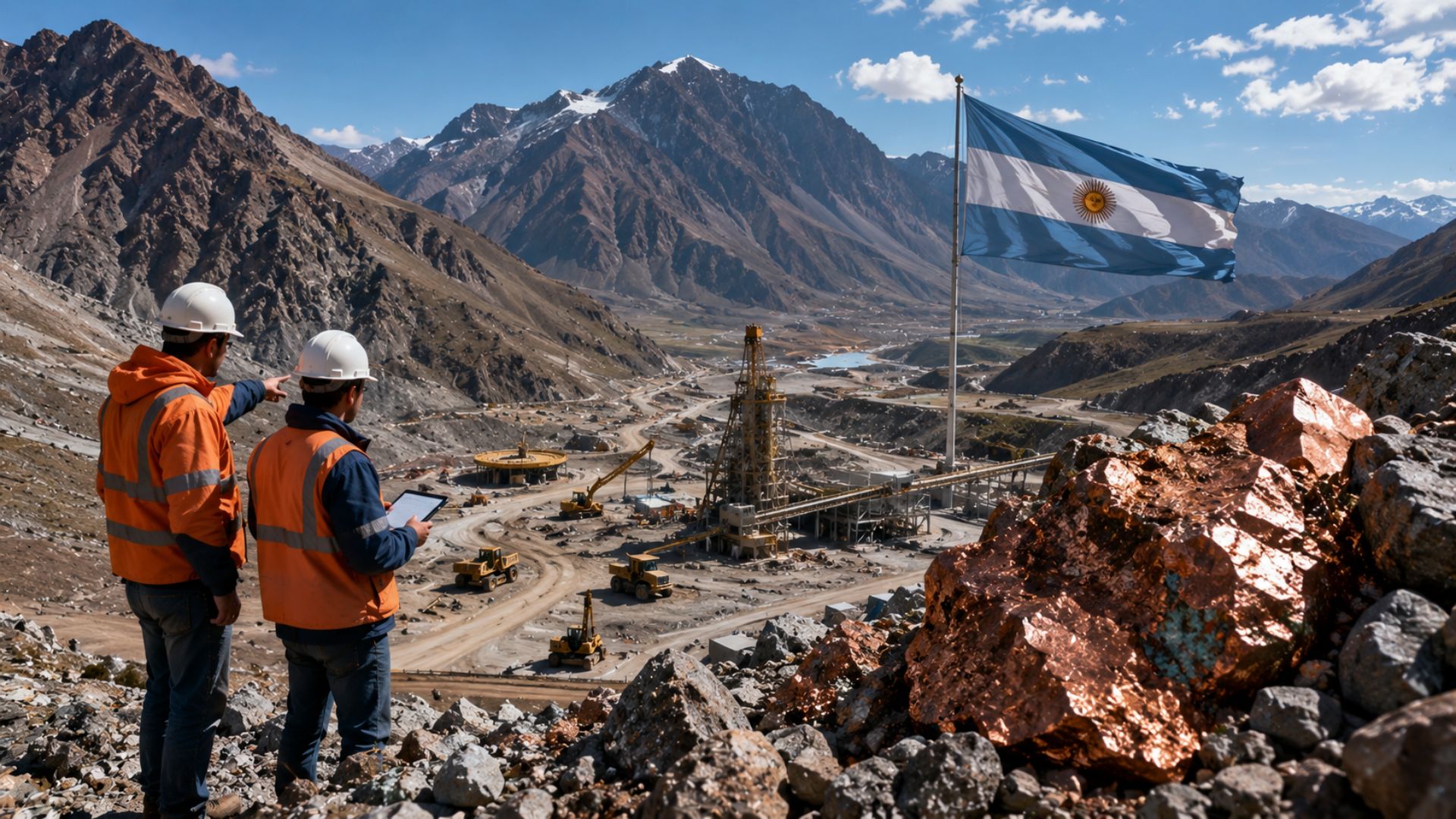


Without commercial-scale copper production currently, Argentina wants to join the group of the ten largest global producers of the metal by 2035. The country bets on the rich deposits of the Andes and a billion-dollar incentive package from the government of Javier Milei to unlock mining megaprojects that have been stalled for decades.
After decades of having meat, grains, and oil as the heart of its economy, Argentina now targets a new engine of wealth: copper and lithium mining in the Andes mountains. The ambitious goal is to transform the country, which today practically does not produce copper on a commercial scale, into one of the ten largest global producers of the metal by 2035, according to projections from industry analysts. To achieve this, President Javier Milei’s government launched a broad package of fiscal, exchange rate, and regulatory incentives in 2024 aimed at unlocking large-scale projects that have been stalled for years.
The numbers show the size of the intended leap. Mining currently accounts for about 1% of Argentina’s Gross Domestic Product, but the sector’s exports already hit a record of about 6 billion dollars in 2025, an increase of more than 29% compared to the previous year, driven mainly by gold. The big bet, however, is copper, an essential metal for the global energy transition, whose annual export could reach something between 17 and 18.7 billion dollars by 2035, according to estimates from banks and consultancies that monitor Argentina.
Why Argentina bets on the Andes copper

Copper is one of the most coveted metals in the world at the moment, precisely because it is an essential component of electrification, present in electric cars, solar panels, wind turbines, and transmission networks. Global demand is growing at an accelerated pace, and there is a fear of supply shortages in the coming years, which opens a window of opportunity for new producers. Argentina enters this race with estimated reserves of around 116 million tons of copper resources in the Andean provinces.
-
Brazilian Homebuyers Still Fall for Illegal “Drawer Contracts,” Risking Foreclosure and Long Legal Battles Without Deeds.

-
World’s Largest Pencil Factory, Producing 2 Billion Annually, Operates in a Brazilian University Town with Its Own Sustainable Forest

-
World’s Largest Banknote Printer is a British Private Company Producing Currency for Over 69 Nations
-
Europe’s Largest Hydrogen Truck Fleet Begins Operation with 125 Vehicles Emitting Only Water Vapor




The paradox is that, despite this geological wealth, the country has practically not produced copper on a commercial scale since the closure of the Bajo de la Alumbrera mine in 2018. Meanwhile, neighboring Chile, on the other side of the Andes, is a consolidated power in the metal, exporting tens of billions of dollars a year. It is this gap that Argentina wants to fill, taking advantage of the fact that the same geological formations that enrich Chile extend to the Argentine side of the mountain range.
The Milei government’s incentive package
The central instrument of this strategy is the RIGI, the Spanish acronym for Regime of Incentive for Large Investments, launched by the Milei government in 2024. The program offers fiscal, tax, exchange rate, and legal stability for 30 years to projects with a minimum investment of 200 million dollars in sectors such as mining, energy, oil, and gas, among others. The idea is to provide security to foreign investors in a country historically marked by economic instability, exchange controls, and abrupt rule changes.
The results are already showing. So far, the RIGI has approved about 10 projects totaling approximately 25.5 billion dollars in committed investments, and the regime has been extended until July 2027. Global mining giants like Lundin Mining, Glencore, First Quantum, and the Canadian McEwen are among the companies that have approached the Argentine deposits. For Argentina, attracting this capital is essential to enable the transport and energy infrastructure necessary to export the ore, which is as costly as the extraction itself.
Los Azules and the megaprojects that will lead the turnaround


The most emblematic project of this new phase is Los Azules, by the Canadian McEwen Copper, located in Calingasta, in the province of San Juan, about 3,500 meters above sea level in the Andes. In September 2025, the Argentine government approved the project’s entry into the RIGI, with an investment of 2.67 billion dollars. Los Azules will be the first venture in the history of Argentine mining to produce high-purity copper cathodes, ready for direct industrial use.
According to the company, copper production at Los Azules is expected to begin in 2029, and the project has the potential to generate more than 30 billion dollars in export revenue over its lifetime, with the promise of operating with renewable energy and minimizing environmental and water impacts. The main copper projects in Argentina are concentrated in the northwestern and western provinces, such as San Juan, Salta, Jujuy, and Catamarca, regions that are expected to become the new mining hub of the country in the coming decades.
The challenge of infrastructure and logistics
Removing copper from the ground is only part of the problem. The remote location of the deposits, high in the Andes, requires the construction of transportation and energy infrastructure as costly as the mineral extraction itself. It’s no use extracting copper and lithium if these materials cannot reach the ports for export, making roads, railways, transmission lines, and power plants an indispensable part of the equation for Argentina.
This is one of the biggest bottlenecks the country needs to overcome to meet its goals. Large-scale copper projects, especially the porphyry type that characterize the Andean region, usually take ten to fifteen years between discovery and first commercial production, going through exploration, feasibility studies, environmental assessment, and community consultation. Therefore, the window until 2035 is considered tight, and any delay in infrastructure can compromise the ambitious schedule set by Argentina.
Environmental and Social Controversies
The race for copper does not happen without resistance. One of the most controversial points is the Milei government’s proposal to review the Glacier Law, legislation that protects glaciers and restricts mineral exploration around them. Critics, including environmentalists and scientists, argue that loosening this law threatens crucial freshwater reserves in the Andes, in a region where water resources are scarce and strategic.
Thousands of people have already taken to the streets in protest, with slogans like water is not for sale, arguing that legislation should not prioritize short-term economic gains at the expense of long-term water security. The RIGI model itself is criticized by part of Argentine society, which sees the incentives as deepening the extractivist model, prioritizing foreign capital instead of local development and environmental sustainability, a debate that tends to intensify as projects progress.
What Argentina’s Turnaround Means for Brazil and the World
The success or failure of Argentina’s bet has implications far beyond its borders. In a world that needs copper in increasingly larger quantities to decarbonize the economy, a new major producer can help balance global supply and contain the rise in metal prices. Argentina positions itself as a key player in Western supply chains, at a time of geopolitical reorganization of critical mineral production.
For Brazil, a neighbor and partner in Mercosur, Argentina’s transformation into a copper and lithium powerhouse can open opportunities for logistical integration, supply of equipment and services, as well as energy cooperation. At the same time, it represents a concrete example of how regulatory reforms and legal security can unlock entire sectors, a lesson that often fuels debates about the business environment in different Latin American countries, including Brazil’s own economy.
Argentina is experiencing a decisive moment. The country has the reserves, the project pipeline, and the interest of global investors to become a new copper powerhouse by 2035. But the path involves overcoming infrastructure bottlenecks, ensuring political stability between election cycles, and balancing economic development with legitimate environmental and social concerns. If successful, it will transform decades of dormant potential into one of the biggest economic turnarounds in recent South American history.
Do you believe that Argentina will indeed manage to become a global copper powerhouse by 2035, or will environmental and infrastructure challenges hinder this? Do you think Brazil should follow a similar path to attract mining investments? Leave your comment, share your thoughts on this transformation in the neighboring country, and share the article with those who follow the economy, mining, and the geopolitics of critical minerals.