Portuguese
  Spanish


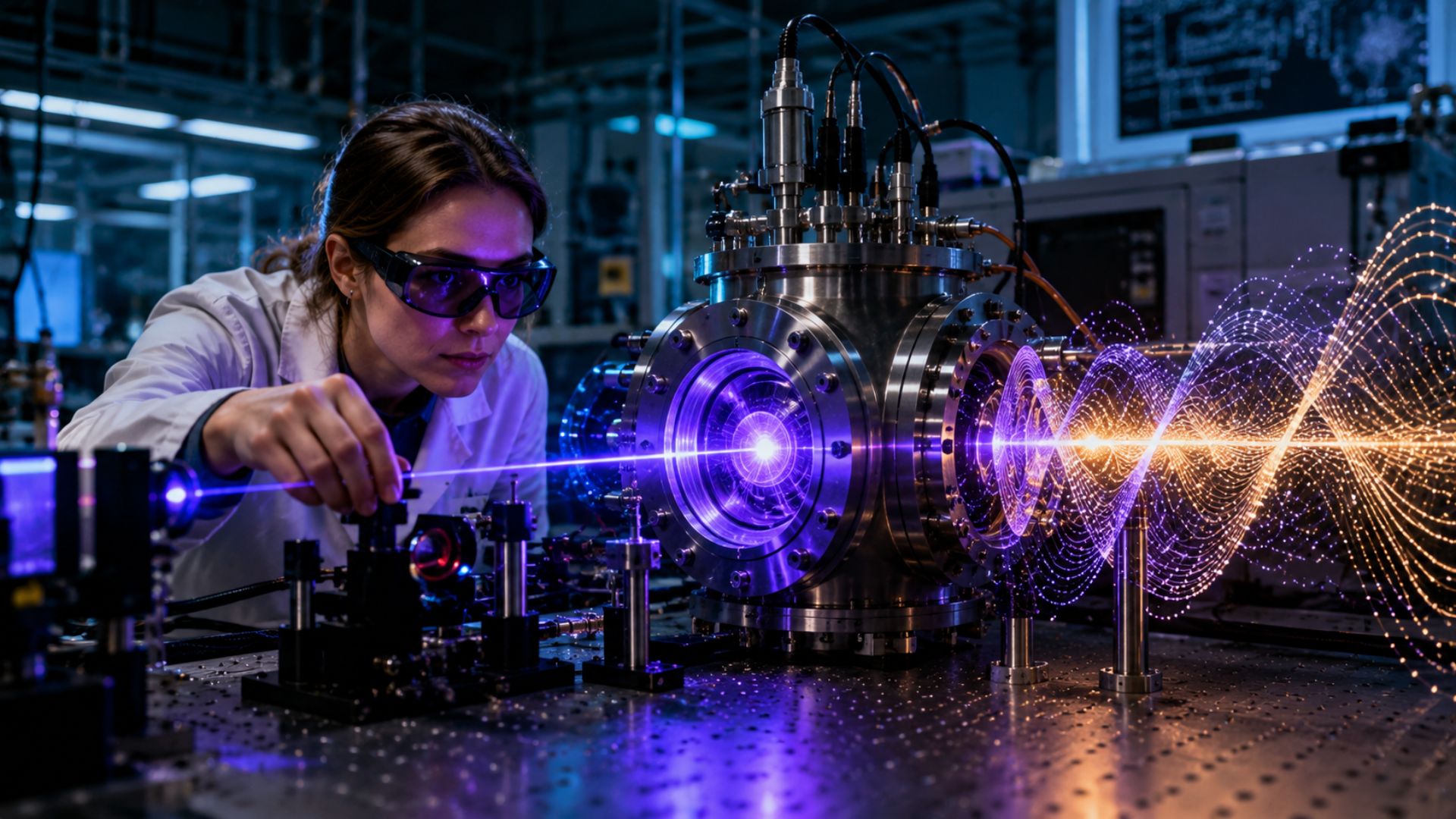

For now, it only works on the laboratory bench, and the scientists themselves talk about “if we can scale it up.” But the idea is to replace the electron, which heats up and wastes energy, with light doing the math. And the amount of energy the experiment used is astonishingly small.
The university is the University of Pennsylvania, in the United States, the same that built the ENIAC, the first general-purpose electronic computer, in the 1940s. And the particle in question is a hybrid light and matter quasi-particle called an exciton-polariton. The study was published in the scientific journal Physical Review Letters on April 8, 2026.
According to the scientific news portal ScienceDaily, on May 18, 2026, the team managed to make light switch signals on and off, the most basic operation of a computer, using only about 4 femtojoules, or 4 quadrillionths of a joule. It’s less energy than needed to lightly power a tiny LED.
The problem that hinders light in computers
To understand the magnitude of this, it’s worth knowing why no one has yet made a computer solely of light. Today’s chips work by moving electrons, and electrons have charge. Charge generates heat, encounters resistance, and becomes increasingly difficult to control as the chip fills with transistors. That’s why computers heat up and consume energy.
-
World’s Largest Particle Accelerator Begins Four-Year Hiatus for Magnet Overhaul, Aiming to Hunt Dark Matter by 2030

-
“Sahara Dust Turns Rain Red, Startling Residents Across Europe”
-
Stanford Scientists Develop 20-Cent Paper Centrifuge Inspired by Ancient Toy, Spins at 125,000 RPM Without Electricity, Separates Plasma in 1.5 Minutes, Aiding Diagnostics in Remote Areas

-
World’s Largest Vaccine Manufacturer, Immunizing Two-Thirds of Global Infants, Originated in a Pune Horse Farm





Light would be the perfect candidate to solve part of this. Photons, the particles of light, have no charge or rest mass, so they travel fast and with almost no loss, which is why they already dominate telecommunications. The problem is the flip side of this advantage: since light hardly interacts with anything, it is terrible at the task of switching signals on and off, the on-off that every calculation needs. In short, light is great for carrying information and bad for making decisions.
The particle that combines the best of both
That’s where the team, led by physicist Bo Zhen, invented a middle ground. They coupled photons to electrons within an ultra-thin semiconductor material, just a few atoms thick, placed in a nanometric cavity. From this mixture emerges the quasi-particle, the exciton-polariton, which inherits the speed of light and, at the same time, the ability of matter to interact.
With this particle of light and matter, light finally managed to switch signals on its own, without needing to turn into electricity along the way. And using those 4 femtojoules, a ridiculously low value. It is the first time that a particle of light and matter interacts strongly enough to perform this type of calculation so economically.
Why this interests artificial intelligence
Here is why the subject matters now. Many experimental optical chips already perform certain calculations with light at extremely high speed. The bottleneck appears in the stages called nonlinear, the decision-making ones, where these systems need to convert the light back into an electronic signal, slower and more energy-hungry. Each back and forth eats away the advantage of optical computing.
The new particle promises to skip this conversion and keep everything in light from start to finish. For artificial intelligence, which today consumes absurd amounts of electricity in huge server warehouses, this is enormous. Reducing the energy consumption of large artificial intelligence systems is one of the sector’s biggest challenges, and optical computing fits right into this point. Researchers also mention uses such as directly processing the light coming from a camera, without constantly translating the signal, and even supporting basic quantum computing functions on the chip.
The honest message: still a lab bench, not a store chip
Now a reality check, because too much enthusiasm can be misleading. This is a laboratory proof of concept, not a product. The speed numbers circulating, such as calculations up to a thousand times faster, come from controlled lab bench conditions, and the team itself conditions everything on being able to scale up. Between a nice experiment and a chip inside your computer, there are often years of work, and not every lab promise makes it there.
Even so, the door that opens is real. 80 years ago, the University of Pennsylvania inaugurated the electron era with the ENIAC, and now it points to a path that might go beyond it. If the energy consumption calculation is confirmed outside the lab, the next turning point for artificial intelligence may come not from more electrons, but from light. And it makes a certain poetic sense that the nod to this future comes precisely from the University of Pennsylvania, where the past of computing also began.