






 Portuguese
  Spanish


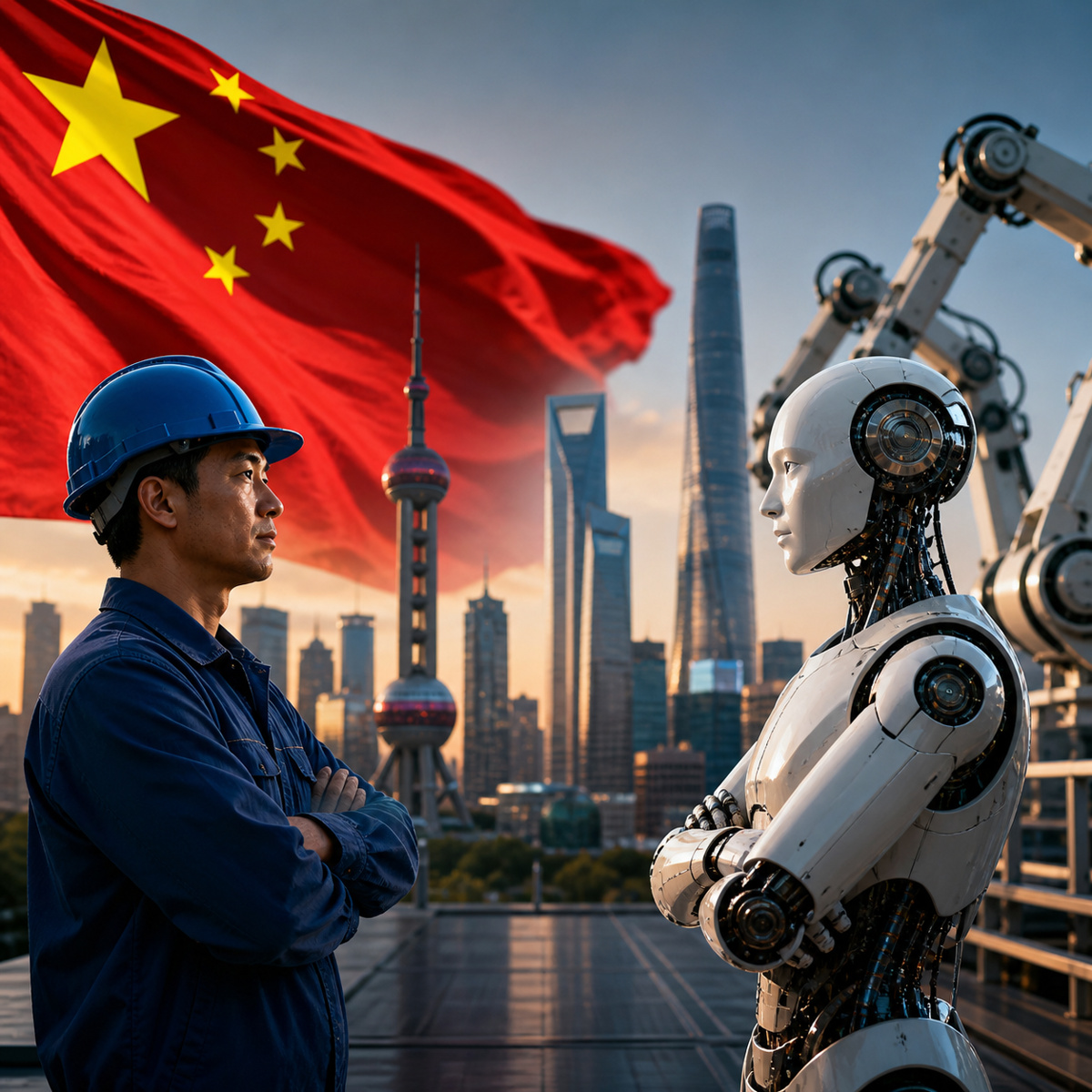

China Court’s Decision Limits AI Use in Companies, Prevents Replacing Employees, and Creates New Rules Against Layoffs in the Global Market
The recent decision by the Hangzhou Intermediate People’s Court has opened a new chapter in the relationship between technology and labor. The understanding was clear: companies cannot promote layoffs simply to replace employees with artificial intelligence systems with the sole focus on cost reduction.
The case’s repercussions were amplified after its disclosure by the Xinhua News Agency, reinforcing the institutional weight of the decision. The case gained international relevance because it emerges at a time of accelerating automation on a global scale.
The China Court’s decision reinforces an important limit: technological innovation cannot automatically override labor rights. In the initial analyses, experts highlighted that the impact could cross borders and influence legislation in other countries.
-
At 14 years old, she worked in a factory in Hong Kong, studied economics abroad, and then entered the Chinese real estate market, which helped change the landscape of Beijing.

-
While NATO secured more than $10 billion in missiles and space surveillance at a single forum, Brazil still spends 1.1% of its GDP on defense and is stalling its own anti-aircraft system.

-
Corn ethanol attracts R$ 23 billion in 21 new plants and prepares for a nearly 50% jump in Brazilian production by 2027, even with high interest rates.
-
A newly opened terminal in the middle of the Amazon has begun transporting soy and corn through Amapá, eyeing the queue of ships that is congesting the ports in the South.


China Court Sets Unprecedented Brake on Replacing Employees with Artificial Intelligence
The lawsuit involved a professional identified as Zhou, hired in 2022 to work as a quality assurance supervisor at a technology company. His role consisted of reviewing responses generated by automated systems and filtering content deemed sensitive.
With the advancement of artificial intelligence, the tasks performed by Zhou began to be executed by the company’s internal systems. Faced with this, the organization attempted to replace human employees with technology, offering the worker a new position with a salary reduction of approximately 40%.
The proposal included a demotion and a significant loss of income. Zhou refused. Subsequently, he was dismissed under the argument of restructuring and reduced personnel needs. This point was essential for the unfolding of the case in the China Court.


When Artificial Intelligence Does Not Justify Layoffs According to Chinese Justice
Upon analyzing the case, the China Court concluded that the justification presented by the company did not meet the legal criteria required for contract termination. Chinese labor law stipulates that relevant changes in objective conditions must make the continuation of the contract impossible — which was not proven.
For the magistrates, the adoption of artificial intelligence represents a strategic choice by the company, not an inevitable imposition. Therefore, using this argument to promote layoffs is not valid.
The decision highlighted some fundamental points:
- Technology does not automatically characterize an operational crisis;
- Digital replacement does not eliminate the need for legal justification;
- The pursuit of efficiency cannot ignore labor rights.
This understanding strengthens the China Court’s position as an agent of balance between innovation and social protection.
The Zhou Case and the Attempt to Replace Employees with Technology
Zhou initially received compensation after his dismissal. However, he considered the amount inadequate given the situation and decided to appeal. The case was analyzed in different instances until it reached the Hangzhou Intermediate People’s Court, which upheld the decision favorable to the worker.
The company argued that restructuring was necessary to keep up with technological evolution. Nevertheless, the China Court assessed that there was no proof of a real need for layoffs, only the intention to replace employees with artificial intelligence.
The fact that the proposed salary reduction was 40% also weighed on the decision. For the judges, the suggested change was not reasonable and indicated an attempt to force the worker’s departure.
China’s Court strengthens labor protection in the age of artificial intelligence
Experts like Wang Xuyang, a lawyer cited in analyses on the topic, highlighted that automation cannot be used as an automatic justification for dismissals. In his view, companies need to adopt more responsible measures before resorting to layoffs.
Among the recommended alternatives are:
- Professional reskilling programs
- Reassignment of roles within the company
- Transparent negotiation with workers
This approach indicates that China’s Court seeks to encourage a more balanced transition to the era of artificial intelligence, avoiding abrupt social impacts.
Recent precedents show limits to replacing employees with artificial intelligence
The analyzed case is not isolated. In 2024, a data mapping sector worker in Beijing also obtained a favorable decision after being replaced by automated systems.
On that occasion, arbitration concluded that the adoption of artificial intelligence was a business choice and not an inevitable circumstance, such as natural disasters or political changes. Thus, the layoffs were considered unjustified.
These precedents reinforce a clear trend within China’s Court:
- Companies cannot use technology as an automatic justification
- Corporate social responsibility is being expanded
- Labor law keeps pace with digital evolution
This set of decisions creates a solid legal basis for dealing with the advancement of automation.
Between innovation and rights: the role of China’s Court in the new global scenario
China is one of the main hubs for artificial intelligence development in the world. Companies in the country invest heavily in automation to increase efficiency and competitiveness. At the same time, they face economic challenges that pressure for cost reduction.
In this context, the risk of layoffs motivated by technological replacement grows. It is precisely at this point that China’s Court assumes a relevant role, establishing clear limits.
The decision shows that modernizing processes does not simply mean replacing employees. There is a fine line between innovation and social responsibility, and the court made it clear that this line cannot be crossed without legal criteria.
Impacts on the labor market and possible international repercussions
The decision by China’s Court is already generating debates outside the country. Experts in labor law and technology believe that the case could influence public policies and judicial decisions in other regions.
In a global scenario marked by the expansion of artificial intelligence, governments face similar challenges:
- How to protect jobs without hindering innovation
- How to adapt old legislation to new technologies
- How to avoid inequalities generated by automation
The Chinese response, at least in this case, points to a path of balance. Instead of hindering technological advancement, China’s Court seeks to ensure that it happens responsibly.
What this decision reveals about the future of work
The judgment involving Zhou shows that the future of work will not be defined solely by technology, but also by the rules that guide its use. The attempt to replace employees with artificial intelligence without legal criteria met resistance in the judicial system.
This movement may indicate a global trend: the need to create clear limits for the use of automation in the corporate environment. Companies will continue to invest in technology, but will need to consider the human impact of these decisions.
At the same time, workers may need to adapt to new roles, developing skills complementary to artificial intelligence. The scenario points to transformation, not total replacement.
A new balance between technology and dignity at work
The Chinese Court’s decision goes beyond an isolated case. It sets a precedent that reinforces the importance of balancing technological efficiency and human rights.
By preventing dismissals based solely on the intention to replace employees with artificial intelligence, the Chinese Judiciary sends a clear message to the market: innovation cannot be synonymous with discarding workers.
Zhou’s case, which began in 2022 and was marked by a 40% salary reduction proposal, shows how corporate decisions can deeply impact the lives of professionals. By reversing this situation, the Chinese Court reaffirms that progress must be accompanied by responsibility.
This episode is likely to remain at the center of discussions about work and technology in the coming years, influencing companies, governments, and workers worldwide.


