Portuguese
  Spanish


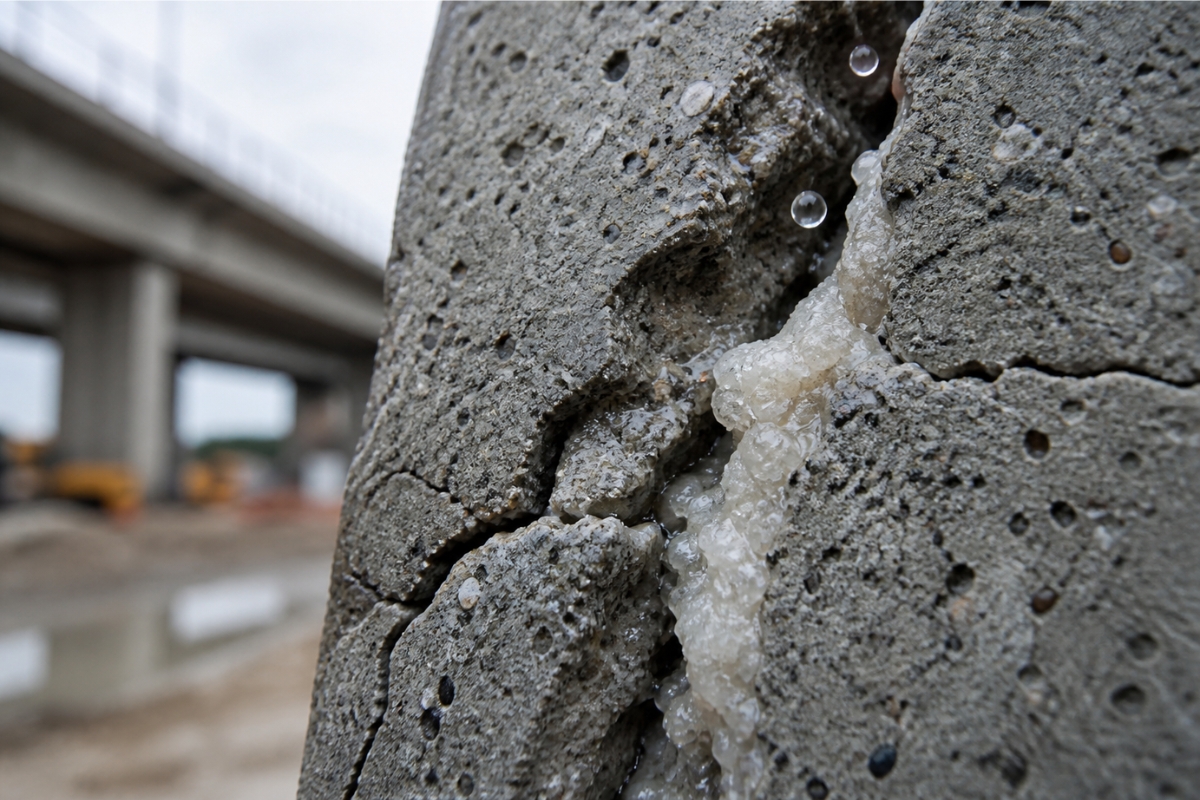

A concrete that reacts on its own when it starts to crack has become one of the most appealing bets in civil construction. The idea seems straight out of a futuristic laboratory, but it’s part of a real process with bacteria capable of forming minerals within the fissures.
When water enters through the crack, the microorganisms awaken and initiate a reaction that produces calcium carbonate, a substance similar to limestone. This material fills the open space and helps block the passage of moisture.
The most striking point is the 21-day period to close small fissures under controlled conditions. This promise impacts maintenance, construction costs, and durability, three points that weigh heavily on the pockets of construction companies, governments, and property owners.
-
Giant 3,600-ton Crane Breaks Two World Records by Installing World’s Largest Single-Piece Forged and Welded Hydrogenation Reactor, Weighing 3,037 Tons, in Chinese Petrochemical Plant in Just Six Days

-
$80 Million Bridge in Brazil Cuts Travel Time from 30 Minutes to 1 Minute, but Audit Reveals Major Flaws
-
Man Builds Stone Bed with Granite Rocks and Hand-Sawn Cedar Beams, Home Extension Garners Over 437,000 Views on Bonus Bolts Channel

-
Brazilian Researcher Develops Color-Changing Roof Tile to Reduce Air Conditioning Use by Up to 15%



Cracks up to 1 millimeter can be closed when water activates bacteria


Microbial concrete acts as a hidden defense within the structure. Bacteria are incorporated into the material along with nutrients and remain inactive until moisture reaches a fissure.
When this happens, mineral formation begins, filling the open gap. The effect is most relevant in small cracks, especially those up to 1 millimeter, a limit cited by companies already working with concrete capable of repairing fissures with limestone.
This type of repair doesn’t turn a damaged structure into a new one, but it can prevent an initial fissure from becoming a larger problem. In bridges, buildings, tunnels, and structures exposed to the elements, this difference can represent years of preserved service life.
21-day closure puts living concrete at the center of civil construction
The image of self-regenerating concrete draws attention because it changes the logic of maintenance. Instead of relying solely on external repairs, the material itself springs into action when water reveals the damage.
Recent tests indicate complete closure of small fissures in about 21 days, provided conditions are favorable. Humidity, temperature, type of bacteria, and mixture composition directly influence the result.
This speed should not be treated as a guarantee for every project, but it shows significant progress. Concrete ceases to be merely a resistant mass and begins to act as an active system against degradation.
According to ClickARQ, a Brazilian portal on architecture, design, and construction, microbial concrete is presented with the ability to close fissures in 21 days, reduce cement usage by 30%, and achieve an estimated service life of 150 years.
The reduction in cement consumption is one of the most sensitive points. Cement has a strong environmental impact, and any significant drop in its use can alter the calculation of civil construction’s impact.
Still, the gain depends on the actual application. The technology uses specific additives, nutrients, and processes, so the environmental benefit needs to be evaluated in each project, especially when the scale moves from the laboratory to the construction site.

150-year service life increases pressure for longer-lasting materials
The projected 150-year service life places concrete with bacteria in a category of high interest for infrastructure. Longer-lasting structures require fewer repairs, fewer closures, and less material consumption over time.
This number depends on design, execution, and environment. Coastal regions, industrial areas, and structures in constant contact with water are scenarios where small fissures can accelerate internal damage.
If bacterial repair can reduce the entry of moisture and corrosive agents, the impact may appear in the long term. The material gains importance not only for its innovation but for the promise of curbing invisible costs that accumulate over decades.
Less maintenance can change bridges, buildings, and public works
The most explosive effect for the sector lies in maintenance costs. A small crack may seem simple, but it opens the way for infiltration, rust in the internal steel, and loss of resistance over the years.
By closing fissures early on, microbial concrete can reduce expensive interventions and delay major renovations. This is important for bridges, viaducts, tunnels, garages, facades, and high-traffic structures.
The technology still needs to overcome price, standardization, and large-scale proof. Nevertheless, it already puts pressure on traditional materials and opens space for a new generation of smart concrete.
The concrete with bacteria draws attention because it tackles one of the oldest problems in civil construction. Small cracks cease to be merely signs of wear and begin to activate an internal repair mechanism.
With 21 days as a reference period, a promise of 30% less cement, and an estimated lifespan of 150 years, the innovation gains traction in the debate about durable infrastructure. If it advances at scale, it could change the cost of works and reposition civil construction.