Portuguese
  Spanish


Port of Pecém breaks records, expands route with China, and aims for a new logistics phase for imports, exports, and industry in Ceará.
In 2025, the Port of Pecém consolidated a logistics turnaround that had been gaining strength since the previous year: the Ceará terminal had already surpassed the mark of 500 thousand containers in 2024 for the first time, reached 555 thousand TEUs that year, and then advanced to 706,509 TEUs in 2025, according to data released by the Ceará State Government and the Secretariat of Economic Development.
The data that transforms this record into strategy is the new direct connection with China. Since April 2025, the so-called Santana Service began linking Asia to the Port of Pecém in about 30 days, halving a journey that previously could take approximately 60 days, according to the Pecém Complex.
The logic is simple and powerful: Ceará wants to receive Asian products more quickly, but also to use the ships to transport Brazilian cargo on the return journey. In the 2024 balance sheet, the Port of Pecém reported that 600 thousand tons of iron ore were exported to China, showing that the route is not only for importing but also for opening up space for the outflow of Brazilian products.
-
Brazil to Introduce B16 Diesel with Increased Soybean Oil Content for Trucks by 2026
-
Brazil’s July Bolsa Família Payments May Include Extra $150 and $50 for Families with Children, Pregnant Women, and Updated CadÚnico Registration

-
Brazilian Woman Buys €1 House in Sicily, Clears 50 Truckloads of Debris, and Transforms Ancient Ruin into Inspiring Life Project by 2026

-
Havan Competitor Expands in Brazil with 170 Stores, Offering Everything from Stationery to Asian Food and Focusing on Affordable Products to Attract Shoppers



Port of Pecém surpasses 500 thousand containers and enters a new phase of Ceará’s foreign trade
The Port of Pecém closed 2024 with 19.6 million tons handled, a 13% increase compared to 2023. In the same year, the terminal reached 555 thousand TEUs, a 15% growth over the 482,930 TEUs registered in the previous year.
The number is important because it marks the first time Pecém surpassed the 500 thousand container barrier. In port logistics, this scale changes a terminal’s commercial weight, as it increases predictability, attracts routes, and strengthens negotiations with international shipowners.
The progress did not stop in 2024. In 2025, the Port of Pecém broke a new record, handling 706,509 TEUs, a 27% increase over the previous year, in addition to reaching 20,961,514 tons in total movement, according to the SDE.
New China-Pecém route reduces travel to 30 days and transforms Ceará into Asia’s gateway to Brazil
The new maritime route between China and the Port of Pecém began in April 2025 and placed the Ceará terminal in a more competitive position. According to the Pecém Complex, ships departing from China began arriving in Ceará in about 30 days.


Previously, the journey could take approximately 60 days, according to a statement by the president of the Pecém Complex, Max Quintino. The reduction in transit time benefits importers, exporters, and industries that depend on inputs, equipment, parts, and products with greater predictability.
The route passes through China, South Korea, Panama, Dominican Republic, Pecém, Suape, Salvador, Santos, India, and Singapore, returning to China. This design places Ceará within a long-haul maritime chain directly connected to the Asian market.
Ceará’s logistical insight is to use the same route to import Asian products and export Brazilian cargo
The most strategic point of the route is not just the arrival of Chinese products. The big differential is to create a round-trip flow, preventing ships from carrying only imports and returning with underutilized space.
The Pecém Complex highlighted that Ceará producers and business owners can import and export with greater agility and competitiveness. Among the products cited as opportunities are granite, marble, cashew nuts, carnauba wax, fruits, footwear, textiles, and e-commerce products.
This is the point that can change the game for Ceará. When the terminal receives equipment, machinery, and Asian products, but also ships Northeastern cargo to other markets, the route ceases to be merely an import channel and becomes a tool for commercial integration.
600 thousand tons exported to China show that Pecém already has cargo to sustain the return trip
In its 2024 balance sheet, the Port of Pecém reported that solid bulk handling grew by 21%. Within this segment, iron ore cargo exceeded 5.3 million tons.
Of this total, 600 thousand tons were exported to China, according to the Government of Ceará. This data is central because it shows that Pecém does not only rely on the promise of imports from Asia, but already has export volume connected to the Chinese market.
Exports to China strengthen the narrative of a balanced route. Instead of receiving containers and operating without relevant counterpart on the return, the terminal now competes for a more sophisticated role: bringing Asian products and shipping Brazilian cargo at scale.
Port of Pecém grows in long-haul shipping and reinforces its position as an international logistics hub
In 2025, long-haul operations, involving international routes, totaled 9.6 million tons at the Port of Pecém. The number represented a 19% growth compared to the previous year, according to the Secretariat of Economic Development.
In international dispatches, the main products were mineral fuels, cast iron, and ores. In shipments, cast iron, ores, salt, and fruits appeared, showing that the port’s agenda involves both industrial cargo and products related to agribusiness.

This advance in long-haul shipping is decisive for Ceará because it reduces dependence on indirect connections. The more international routes pass through Pecém, the greater the chance for the State to attract industry, distribution centers, and commercial operations aimed at the North and Northeast.
Chinese products, machinery, and industrial inputs can accelerate Ceará’s integration with global supply chains
The new route with China opens space for the faster arrival of machinery, inputs, and industrial products. The Pecém Complex itself states that industries in Ceará and its area of influence will be able to import equipment and inputs from the Asian market through the terminal.
This detail is important because the impact is not limited to retail or e-commerce. For an industry, receiving machines, components, and materials with shorter transit times can reduce bottlenecks, improve planning, and increase competitiveness.
The Xinhua agency also reported that the route is operated by MSC in collaboration with APM Terminals and connects Pecém to Asian ports such as Yantian, Ningbo, Shanghai, Qingdao, Busan, Mundra, and Singapore.
Route with Asia could increase Port of Pecém’s movement by 10%
The Pecém Complex expects the new route to have a 10% impact on the port’s current movement. The estimate considers the arrival of at least 1,200 containers per week on Chinese vessels.
This number helps explain why the route became a strategic piece. If the projection is confirmed, Pecém not only maintains recent growth but also expands its capacity to compete with more traditional ports for the entry of Asian cargo into Brazil.
In practice, the route increases the terminal’s power of attraction. Companies that previously depended on longer flows, passing through other Brazilian ports, now see Ceará as a direct alternative to supply regional markets.
E-commerce, fruits, meats, cashew nuts, and granite enter the radar of the new connection between Ceará and China
Xinhua reported that, among the imported products benefiting from the route, are mineral fuels, iron, ore, machinery, electrical materials, and plastics. On the export side, granite, marble, cashew nuts, carnauba wax, fruits, meats, footwear, textiles, and e-commerce products were mentioned.
This set shows the breadth of the new connection. Pecém can handle everything from heavy industrial cargo to perishable products, whose logistical value depends on time, predictability, and lower risk of delay.
The same report pointed out that Chinese digital platforms like Shopee and AliExpress may also benefit, as Pecém becomes the first stop for ships in Brazil. The cited estimate is an increase of up to 20% in the volume of imports destined for e-commerce.
Record of containers shows that Ceará wants to stop being a peripheral route and compete for national prominence
The performance of the Port of Pecém in 2024 and 2025 shows a change of scale. The terminal went from 482,930 TEUs in 2023 to 555,000 TEUs in 2024 and then to 706,509 TEUs in 2025.
This sequence indicates that the record of 500,000 containers was not an isolated point. It became the basis for a new phase of expansion, driven by international routes, increased long-haul, and greater integration with Asia.
For Ceará, the impact goes beyond the port. A stronger international route can attract storage, distribution, industry, logistics services, foreign trade operators, and companies interested in reducing arrival time to the northeastern market.
Investments in the Pecém Complex increase the port’s weight in the industry, energy, and logistics of the Northeast
The SDE reported that the Pecém Complex has a series of investments planned for the coming years. Among them are the Storage Terminal, of R$ 600 million, with operations expected to start in 2027, and the Transnordestina terminal, of R$ 1.3 billion, expected for 2028.
The Transnordestina terminal intends to move 6 million tons in its first year of operation. This project is relevant because it connects port logic to a railway infrastructure capable of expanding Pecém’s reach in the interior of the Northeast.
The SDE also mentions the Northeast Gas Terminal, with an investment of R$ 1 billion and operations expected from 2030, in addition to data center and green hydrogen projects within the Pecém Complex.
Why the China-Pecém route can reshape foreign trade in the North and Northeast
The new route reduces a historical disadvantage for companies in the North and Northeast: the dependence on flows that first pass through ports in the Southeast. According to Xinhua, before the new route, goods from Asia arrived in Santos and then proceeded to the Northeast by coastal navigation.
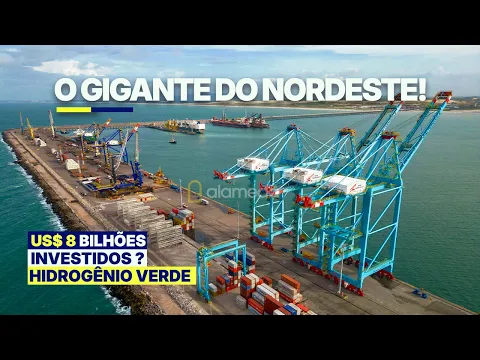
With Pecém receiving ships directly, cargo can enter closer to the consumer and industrial markets of the region. This reduces steps, shortens deadlines, and strengthens Ceará’s position as a logistics platform.
The advantage is even greater for perishable products. Xinhua reported that for products exported from Ceará, the delivery time will be reduced by 14 days, especially benefiting fruits and meats.