






 Portuguese
  Spanish


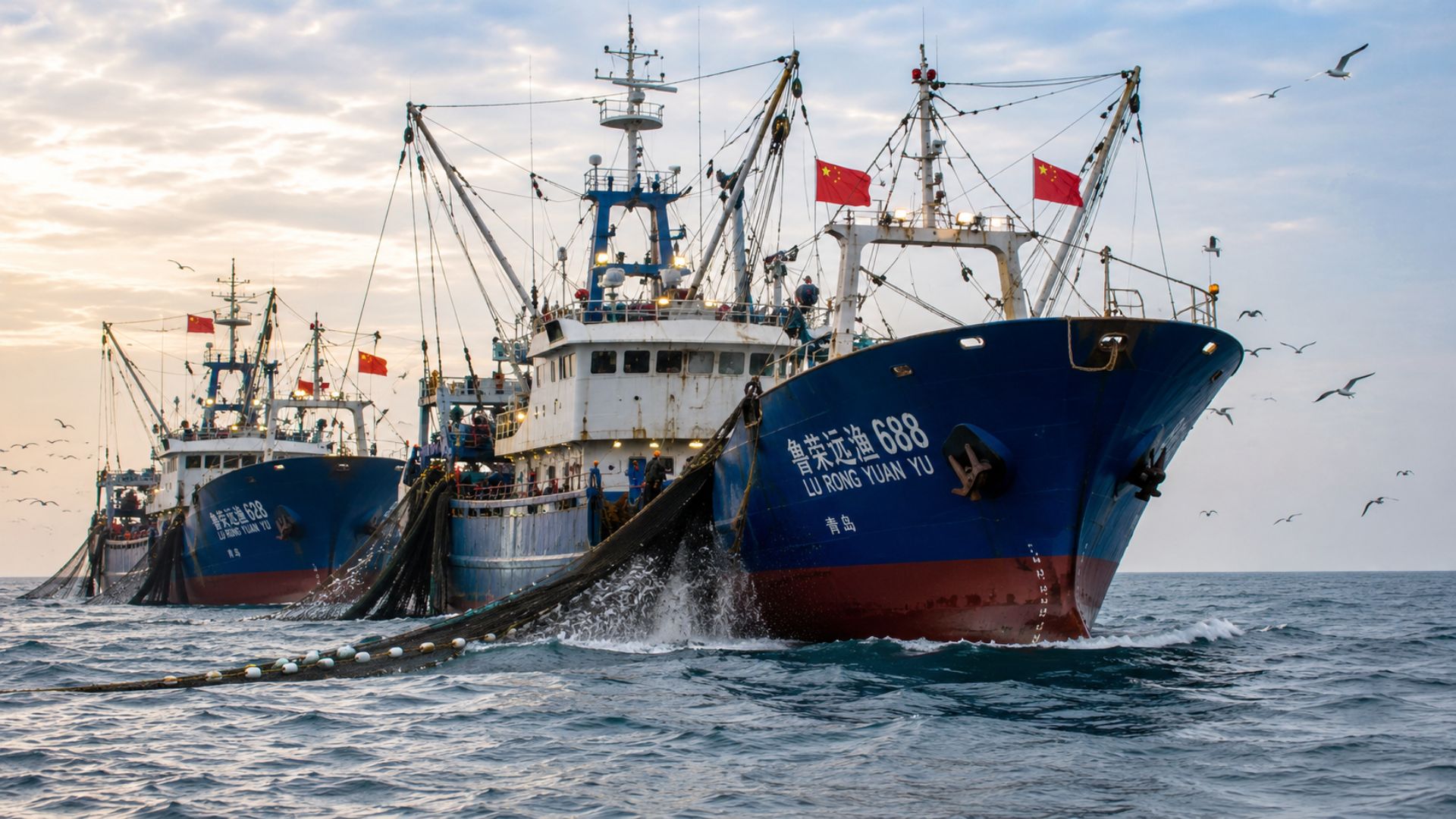


The advance of illegal fishing in West Africa pressures coastal communities, reduces marine stocks, increases economic losses, and places Senegal at the center of an international crisis linked to the activities of foreign industrial vessels, irregular migration, and food insecurity in one of the regions most dependent on artisanal fishing.
The growing presence of foreign industrial vessels, especially boats linked to China, has deepened the fishing crisis in Senegal and increased the effects on income, food, and migration in various coastal communities that directly depend on fishing activities for survival.
According to information cited by the Africa Defense Forum and the Eurasia Review, illegal, unreported, and unregulated fishing causes losses of nearly US$ 300 million per year in Senegal, affecting an economic chain that goes far beyond artisanal fishermen.
In addition to reducing the income of those who live off the sea, the decrease in fish stocks also affects traders, fish processors, port workers, and families that depend on the sector in a country where fish remains essential for food security.
-
Boeing Buys Back Spirit AeroSystems for $8.3 Billion After 737 Mid-Flight Door Incident

-
Nike’s Old Shoes Recycled into Courts, Tracks, Playgrounds, Gym Floors, and New Footwear in Program Transforming 67,000 Tons of Sports Waste into a Global Industry

-
Canadian Woman Who Donated Savings to Haiti Earthquake Victims at Age 5 Wins $48 Million in Lottery 13 Years Later
-
118-Year-Old Brazilian Man, Living in a Care Home for 55 Years, May Become World’s Oldest Man Pending Guinness Validation


Over the past 15 years, Senegalese fishermen have reported an increasingly sharp decline in the catch of popular species, such as sardines and mackerels, a scenario that has changed the routine of traditional artisanal fishing communities.
In regions where a few weeks were once enough to ensure good income, many workers now face longer working hours and smaller returns, while the costs of fuel, boat maintenance, and equipment continue to rise steadily.
Illegal fishing causes billion-dollar losses in West Africa
While international demand for fish remains high, industrial fleets continue to advance over West African waters, a region identified by the Financial Transparency Coalition as one of the areas most affected by illegal fishing on a global scale.

Data cited by international organizations show that more than 40% of illegal fishing occurrences by industrial vessels between 2010 and 2022 were recorded in the region, highlighting the growing pressure on local marine resources.
Senegal alone accumulates estimated annual losses of US$ 300 million, a value considered significant for an economy where thousands of families depend directly on fishing activities to maintain income and food supply.
Throughout West Africa, losses attributed to illegal fishing reach billions of dollars per year, although calculations vary according to the methodology used, the period analyzed, and the type of operation included in the surveys.
China frequently appears in reports for having the largest distant-water fishing fleet on the planet.
International reports, such as the IUU Fishing Risk Index, place the country among the main risk hotspots in practices associated with illegal, unreported, and unregulated fishing.
Among the practices pointed out by environmental entities and international investigations are the use of unauthorized nets, bottom trawling, irregular transshipment at sea, and the use of flags of convenience to hinder inspection.
These operations reduce transparency regarding the origin, volume, and destination of the fish.
Industrial trawling reduces fish stocks in Senegal
Among the practices most criticized by marine conservation specialists is bottom trawling, considered highly destructive as it compromises ecosystems important for the reproduction and development of various marine species.
By scraping the ocean floor, this type of operation captures not only target species but also non-commercial animals, in addition to causing environmental damage that reduces the recovery capacity of fish stocks over the years.
In the routine of artisanal fishermen, the impacts appear immediately in the volume of catches and the reduction of income obtained after long journeys at sea, especially in coastal cities that heavily depend on traditional fishing.
Reports collected by international media in places like Rufisque and Joal-Fadiouth describe longer journeys, lower financial returns, and increased dependence on informal credit to keep boats, engines, and basic equipment operational.
The reduction in fish also pressures domestic consumption.
In Senegal, fish is one of the main sources of animal protein, especially in lower-income communities.
When supply falls, prices rise, and family nutrition becomes more vulnerable.
The social effect also appears in irregular migration.
A report by the Associated Press, based on a report by the Environmental Justice Foundation, linked foreign overfishing to income loss in coastal communities and the increase in risky journeys towards the Canary Islands, in Spain.
Senegal government increases pressure against foreign vessels
In light of the increasing reports, the Senegalese government has faced more intense demands for transparency in the granting of licenses, control of landings, and inspection of foreign vessels operating off the country’s coast.
In 2024, the European Union decided not to renew its fishing agreement with Senegal after pointing out failures in monitoring maritime activities and the local capacity to combat practices related to illegal fishing.
This increased pressure on Senegalese authorities, who were already being criticized by artisanal fishermen and environmental organizations concerned about the rapid reduction of marine stocks in the region.
Amid this scenario, President Bassirou Diomaye Faye promised to review existing agreements and expand audits in the fishing sector, which is frequently questioned due to the activities of foreign industrial fleets.
In March 2026, Senegal and Spain signed a memorandum of understanding for maritime cooperation and combating illegal fishing.
The agreement provides support in surveillance, traceability, inspection, and strengthening of fisheries governance, according to a statement from the Spanish government and information from the Ecofin Agency.
Technology has also become part of the monitoring routine.
Trackers, satellite images, vessel identification systems, and records made by fishermen with smartphones help to identify suspicious movements, although the effectiveness depends on a quick response from authorities.
Fishing crisis affects income, food, and migration
Although Chinese boats appear at the center of some of the complaints, experts and international organizations state that the fishing crisis in Senegal involves different nationalities, as well as internal problems related to surveillance and management of marine resources.
Recent reports also mention vessels controlled by foreign groups registered under other flags, a strategy often used to complicate tracking operations and reduce transparency about the origin and destination of the fish.
In 2025, the Environmental Justice Foundation stated that 57% of the assessed fish stocks in Senegal were in a state of collapse, while 43.7% of licensed vessels were controlled by foreigners, mainly of Spanish and Chinese origin.
The numbers reinforce the structural dimension of the crisis and show how the pressure on marine resources has begun to affect not only the environment but also the economic and social stability of coastal communities.
Artisanal fishing has also grown in recent years, partly because it requires less formal training and continues to be one of the few economic alternatives in several coastal communities.
Even so, local fishermen claim they cannot compete with larger capacity industrial ships.
Without effective control over licenses, catches, transshipments, and landings, the pressure on stocks tends to continue affecting income, food, and social stability on the Senegalese coast.
The dispute over fish has ceased to be just an environmental issue and has become a central topic in the economic and migratory debate of West Africa.


