






 Portuguese
  Spanish


Space technology pointed where to dig even before the first shovel touched the ground. Under agricultural fields emerged buildings that rose several stories, grain warehouses, and a ceremonial road. More than temples and pharaohs, the find reveals how ordinary people lived in a dense metropolis of ancient Egypt.
A city that had been lost for centuries reappeared on the map thanks to technology. Using high-resolution satellite images, archaeologists rediscovered the Egyptian city of Imet, buried for centuries in the eastern Nile Delta, revealing rare multi-story houses, granaries, and a sacred road linked to the cobra goddess Wadjet, in a settlement from about 2,400 years ago.
The discovery was announced in June 2025 by a joint Egyptian-British mission, conducted by the University of Manchester, UK, under the direction of Egyptologist Nicky Nielsen, in partnership with Sadat City University, Egypt, and released by the country’s Ministry of Tourism and Antiquities. The excavations took place at the archaeological site of Tell el-Fara’in, also known as Tell Nabasha, in the eastern Nile Delta. Next, we explain how the city was found, what its ruins reveal about daily life, and why this find is so important for archaeology.
How the satellite revealed the Egyptian city of Imet
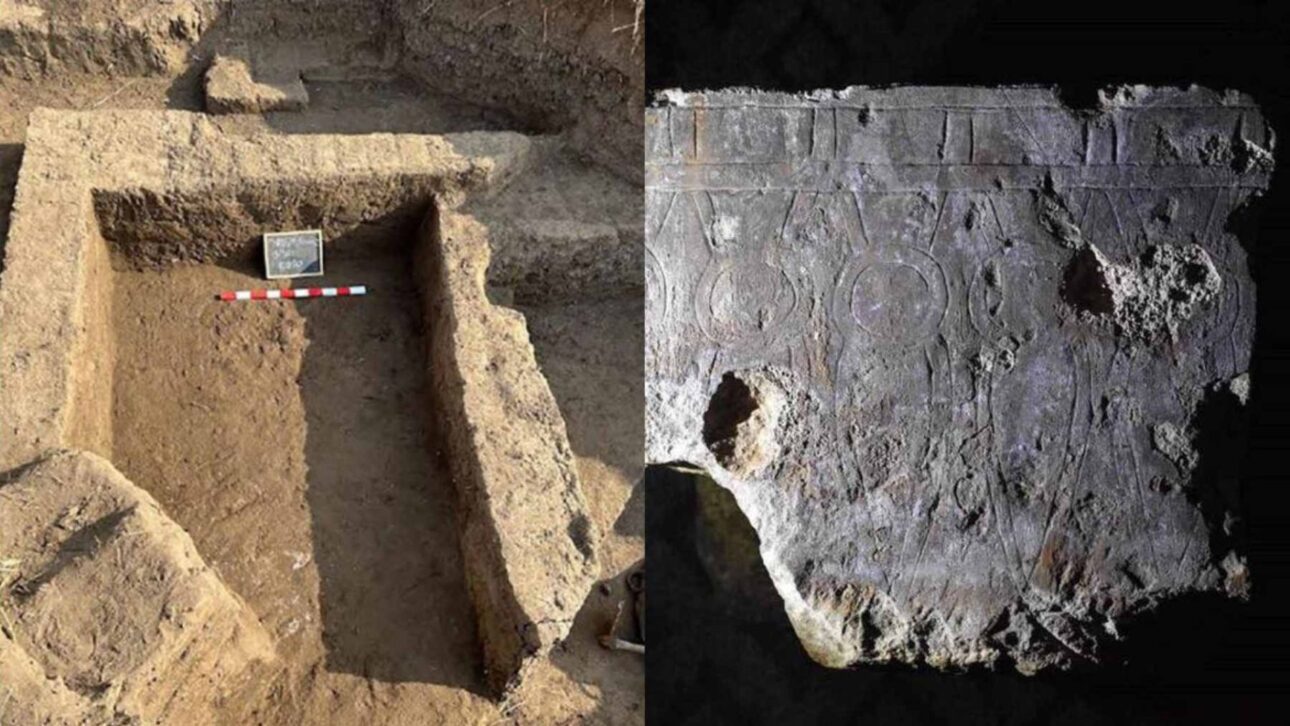
Before starting the excavations, Dr. Nicky Nielsen and his team used high-resolution satellite images and remote sensing techniques to identify clusters of ancient mud bricks, signs that there was architecture buried beneath the surface, which guided exactly where to dig.
-
Nikon Project Uses Dog’s Heartbeat to Capture Photos, Revealing What Truly Makes Dogs Happy

-
In Los Angeles, Young Adult Opts for Garage Living with Bed, Kitchen, and Bathroom to Avoid Rent, Highlighting Comfort and Organization Challenges in Compact Housing
-
Brazil Faces Crisis as New Data Reveals Alarming Rates of Youth Unemployment and School Dropouts, with Joblessness More Than Double the National Average and High Informality Among Teens

-
Former Flamengo player and coach Filipe Luís gives up $1.4 million Rio mansion with 5 suites, private soccer field, and pool with hot tub to pursue a dream.


Imet was not an unknown name to Egyptologists, but much of its urban life had disappeared under agricultural fields, canals, and modern villages.
Unlike the tombs in the desert and the stone temples, the Delta cities, built of mud bricks, tend to dissolve into the landscape.
When archaeologists began to excavate, the patterns seen from above transformed into walls, floors, and living spaces, bringing the city back to life.
The rare multi-story houses
The most striking find changed the way of understanding the city.
The researchers found a set of tower houses, multi-story buildings constructed with mud bricks and supported by exceptionally thick foundations, showing that the inhabitants of Imet built upwards, not just spreading across the Delta plain, an uncommon solution in ancient Egypt.
The explanation lies in the lack of space.
In a flat landscape, shaped by agriculture, floods, and settlement pressure, stacking dwellings over work and storage areas helped families live close to food production, animals, and religious centers.
According to Dr. Nielsen, these tower houses are mainly found in the Nile Delta, between the so-called Late Period and the Roman era, and are rare in other parts of Egypt, indicating that Imet was a prosperous and densely built city.
The daily life of ordinary people
Archaeologists found evidence of grain processing, warehouses, and spaces used to house animals, suggesting that housing, food work, and livestock care were closely linked in the daily life of the Egyptian city of Imet, a concrete portrait of its inhabitants’ routine.
It’s easy to imagine the scene: narrow passages between mud brick walls, grains being handled nearby, animals kept close, and families moving between work areas on the ground floor and living rooms on the upper floors.
This perspective is important because Ancient Egypt is often told through pyramids, kings, and royal tombs, while Imet focuses on the ordinary people who cooked, stored grains, repaired tools, and kept the city alive.
The sacred road of the cobra goddess Wadjet
Religion was part of the urban fabric of the city.
Imet had a close connection with Wadjet, the cobra goddess associated with Lower Egypt, and archaeologists discovered a ceremonial road linked to her cult, alongside granaries and other urban remnants, revealing how the sacred coexisted with the everyday in the same space.
But the religious landscape changed over time.
In the temple area, the team found a large building with a limestone plaster floor and huge mudbrick pillars that, according to Egyptian authorities, appears to have been built over the ancient processional road.
This suggests that the ceremonial route fell into disuse around the mid-Ptolemaic period, indicating that religious practices transformed after the conquest of Egypt by Alexander the Great.
Small objects that tell great stories
Archaeology does not live by great constructions alone.
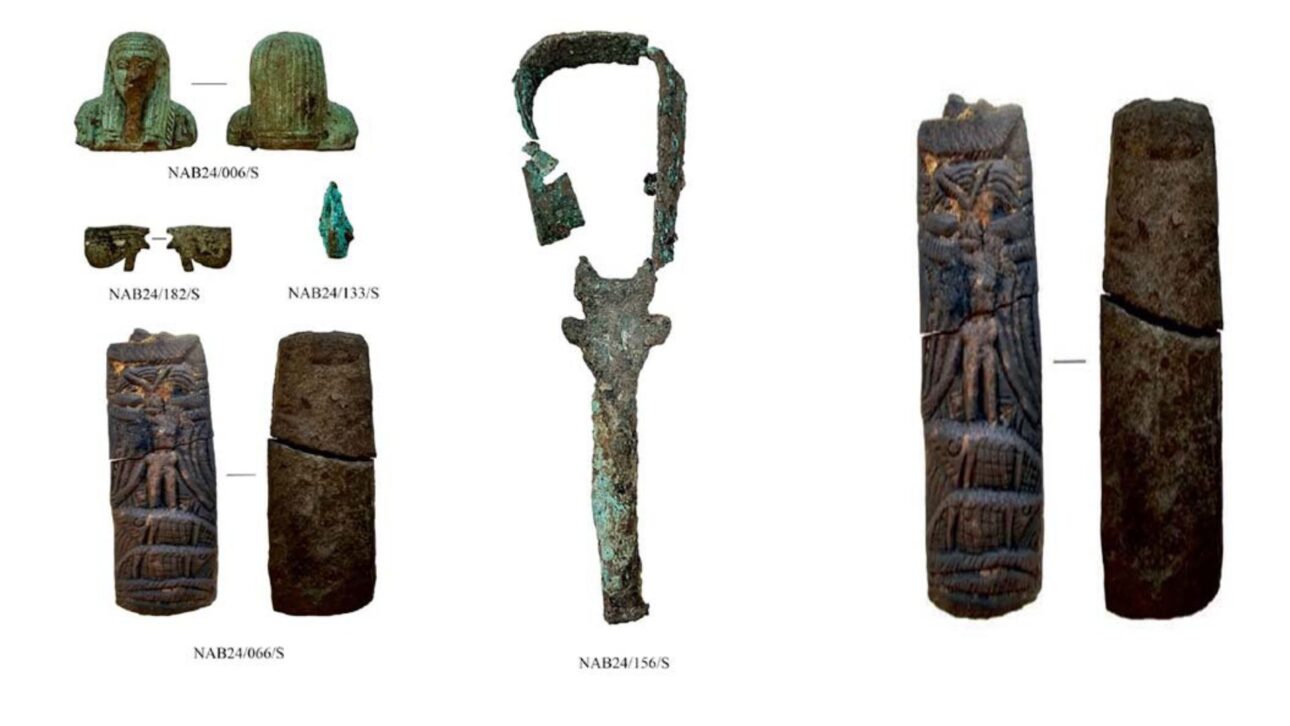
Among the most revealing finds is a green faience ushabti, a funerary figurine linked to beliefs about the afterlife, dated to the 26th Egyptian dynasty, as well as a stone stele showing the child god Harpocrates on crocodiles, with protective images, objects that bring the modern visitor closer to the spirituality of those people.
Archaeologists also found a bronze sistrum, a sacred musical instrument decorated with the twin heads of the goddess Hathor, linked to music and domestic ritual.
These small objects make the city less distant: a house could house a cult instrument, a figurine could represent hopes about death, and a protective image could be close to everyday concerns, such as illnesses, childbirth, and the safety of children.
Why the discovery is so important
The value of Imet goes far beyond curiosity.
The rediscovery shows that ancient Egyptian cities were not mere settings for temples and rulers, but populous and adaptable places, where people made practical choices about land, food, religion, and family life, helping to rewrite the urban history of the Nile Delta in the Late Period.
The find also reminds us how much of Egypt’s past may still be hidden beneath common landscapes, like a farm field or a small mound.
For Dr. Nielsen, Imet emerges as a key site for rethinking the archaeology of the Egyptian Late Period.
Ultimately, the city’s story is one of survival through engineering: thick walls supported the upper floors, narrow streets concentrated activity, and even sacred roads transformed as the city changed around them.
The rediscovery of the Egyptian city of Imet, revealed through the combination of satellite images and excavation in the Nile Delta, is a fascinating example of how modern technology is helping to unearth forgotten chapters of history.
More than treasures and monuments, what emerges from there is the portrait of the real life of a people, their vertical houses, their grains, their animals, and their gods. Discoveries like this remind us that, beneath the seemingly ordinary soil, entire cities still lie waiting for the right tools to bring them back to light.
And you, had you heard of the Egyptian city of Imet or imagined that ancient Egypt had multi-story buildings? What fascinates you most about this type of archaeological discovery? Leave your comment, share your opinion, and help spread the word to those interested in history, archaeology, and the mysteries of ancient civilizations.


That’s more gold and ancient artifacts for the colonisers to rape from Egypt and claim as their own. Fools !!!
Fascinating. The Egyptian cities are missing in the architecture history. This gap should be filled.