Portuguese
  Spanish


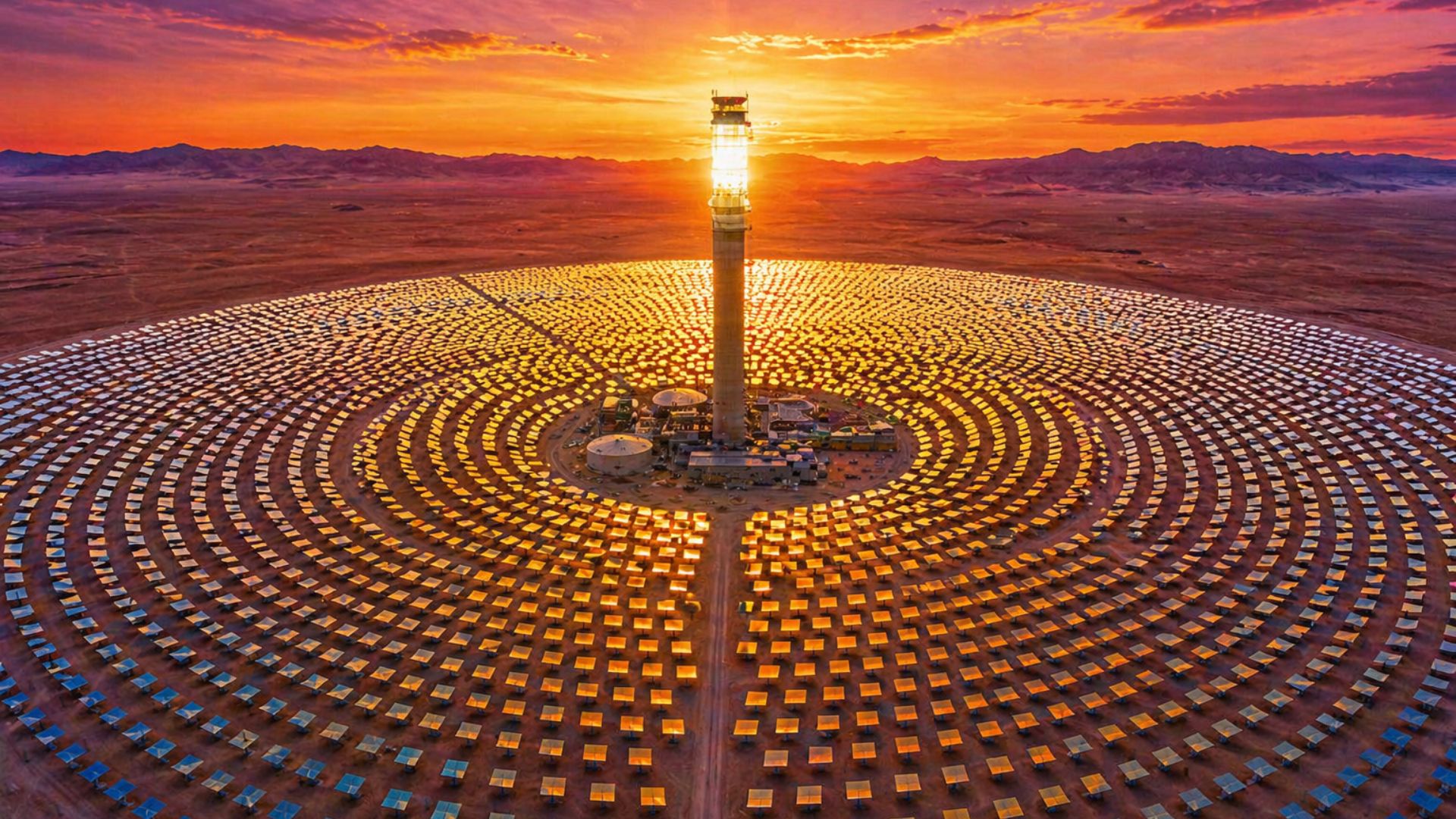

Extreme altitude project combines solar thermal and photovoltaic generation to ensure continuous clean energy supply on the Tibetan Plateau, with molten salt storage and logistical challenges imposed by severe climate, low atmospheric pressure, and a short annual construction window.
China General Nuclear Power Group has started construction of a 50 MW solar thermal power plant installed at an altitude of 4,550 meters in Damxung, Lhasa City, Xizang Autonomous Region.
The plant integrates a renewable complex that also includes a 400 MW photovoltaic unit.
The project combines photovoltaic generation and parabolic trough solar thermal technology, a model in which mirrors concentrate solar radiation to produce heat.
-
Brazilian Engineer Who Grew Up Without Electricity Develops Software, Expands AltoQi to 67,000 Clients, Aiming for $21 Million by Digitizing Brazil’s Construction Industry

-
Spain Launches World’s Largest Floating Dry Dock: 56-Meter Giant Produces Massive Concrete Structures in A Coruña Using Technology Proven in Brazil

-
AI-powered toys that talk, recognize faces, and collect data face scrutiny from Brazilian government over children’s privacy concerns

-
4,000-Year-Old Child’s Skull Unveils Ancient Burial in 7,500-Year-Old Norwegian Rock Shelter, Impressing Archaeologists




According to Xinhua, the system will use thermal oil as a transfer fluid and will have molten salt storage with a capacity for up to six hours.
This structure will allow the thermal power plant to produce electricity even without direct sunlight, including at night.
The solution was planned to reduce fluctuations in photovoltaic generation and harness solar energy that might otherwise not be sent to the grid.
Solar thermal technology and energy storage
The solar thermal stage will have a mirror field of 242,000 square meters, responsible for capturing and concentrating sunlight.
The heat generated will be transferred to thermal oil and then stored in molten salt, a technology used to extend electricity production beyond the period of peak insolation.

Unlike photovoltaic panels, which convert light directly into electricity, the solar thermal power plant transforms radiation into heat before generating energy.
This difference explains the project’s role within the complex, as thermal storage helps compensate for natural solar variations.
The photovoltaic part, with a projected capacity of 400 MW, began construction in September 2025.
With the new solar thermal front, the undertaking will operate as a hybrid system, designed to deliver clean energy with greater predictability.
High-altitude construction challenges
The location is one of the main challenges of the project.
Damxung is located in a cold, elevated area with low oxygen levels, a condition that affects both workers and the operation of machinery and equipment.
According to Xinhua, the annual construction period at the site runs only from April to October.
This reduced window forces teams to concentrate important stages into a few months, with logistical planning adapted to the climate and altitude.
To maintain activities on the construction site, heating systems, oxygen supply, and a hyperbaric chamber were installed.
The structure aims to protect the health of workers in an environment where thin air can compromise physical performance and operational safety.
Generation capacity and environmental impact

The project is invested in and developed by CGN New Energy (Damxung) Co., Ltd. The announced forecast is that the integrated complex will be fully operational by 2027.
When operational, the official expectation is an annual generation of approximately 719 million kWh.
According to the Chinese agency, this volume could save approximately 216.9 thousand tons of equivalent coal and reduce 652.3 thousand tons of carbon dioxide.
In addition to electricity generation, the project has already had a local economic impact. Xinhua reported that the project created more than 2,000 jobs and generated over 5.2 million yuan in regional revenue through the use of labor and equipment.
Expansion of renewable energy in Xizang
The Damxung power plant is part of a broader strategy to harness solar, wind, and hydro resources in Xizang.
The region, despite environmental challenges, has been treated as a relevant area for the expansion of integrated clean energy bases.
According to the regional government’s work report cited by Xinhua, Xizang aims to increase its installed generation capacity from 13 million kW in 2025 to 20 million kW in 2026.
The goal involves projects that combine different renewable sources at strategic points in the territory.
In this context, the Damxung complex brings together three central elements for China’s electrical expansion in extreme areas: large solar capacity, thermal storage, and grid integration.
The proposal is to transform the high radiation of the Tibetan plateau into a more stable supply, without relying solely on the instantaneous production of solar panels.
The construction also shows how hard-to-reach regions have been incorporated into energy infrastructure plans.
In areas previously associated mainly with cold, altitude, and complex logistics, the availability of natural resources has become a strategic factor for large-scale projects.