Portuguese
  Spanish


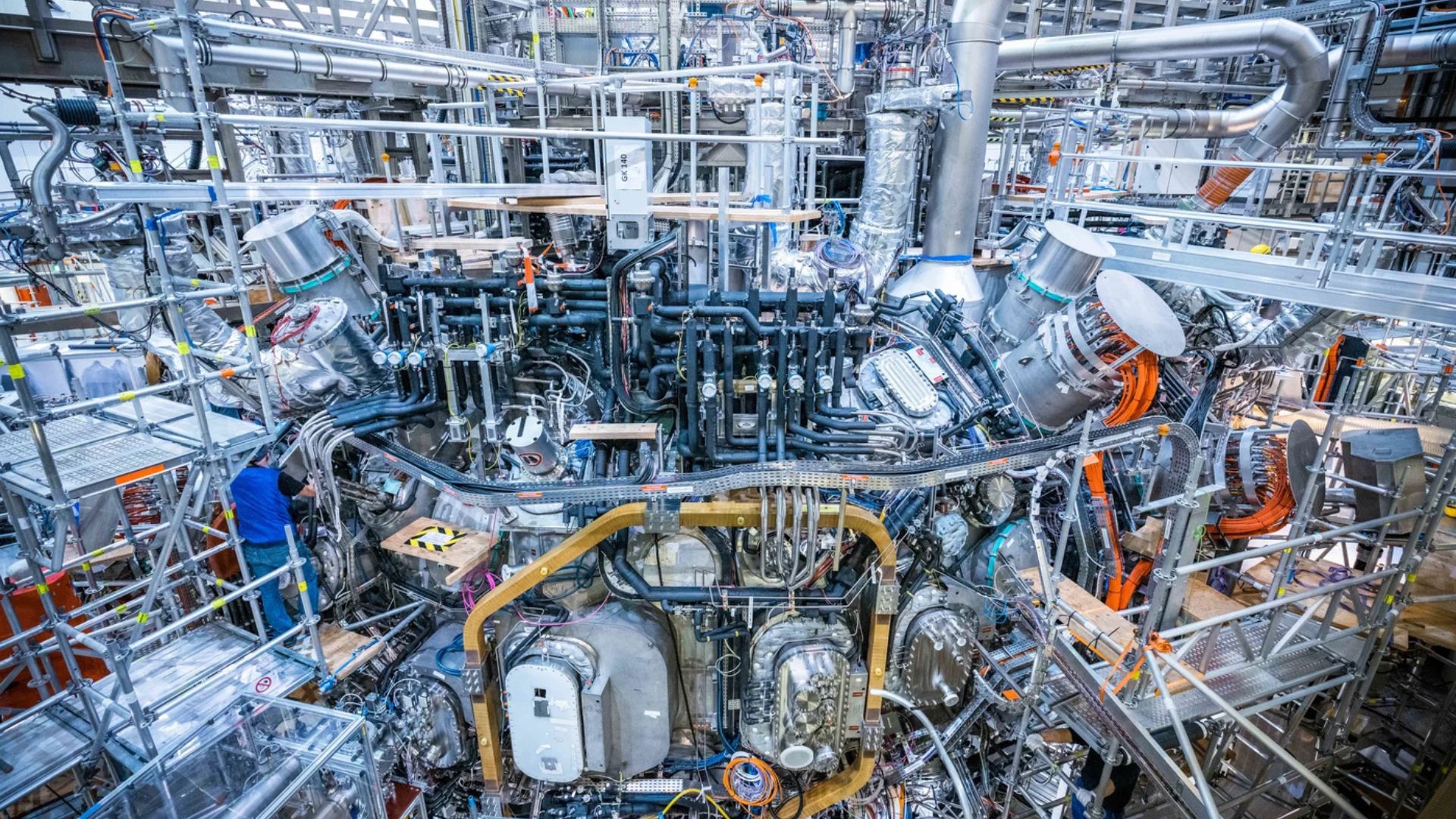


Wendelstein 7-X uses superconducting magnets to confine plasma at millions of degrees and test an alternative route to nuclear fusion.
In the city of Greifswald, Germany, the Wendelstein 7-X attempts to answer one of the most difficult questions of modern science: whether it is possible to control on Earth a plasma hot enough to mimic the process that powers the stars. The experiment by the Max Planck Institute for Plasma Physics is considered the largest stellarator in the world and uses a complex set of superconducting coils to keep the plasma trapped without touching the walls of the machine.
The proposal is not to generate commercial electricity now, but to test if the stellarator design can work as a path for future nuclear fusion reactors in continuous operation. The most ambitious technical goal is to achieve plasma discharges of up to 30 minutes, something essential to prove that this type of machine can sustain the process for long periods.
Wendelstein 7-X is the largest stellarator in the world and was created to test an alternative to tokamak reactors
The Wendelstein 7-X belongs to a family of fusion machines called stellarators. Unlike tokamaks, which dominate much of nuclear fusion research, the stellarator uses a much more complex three-dimensional magnetic geometry to try to keep the plasma stable for longer.
-
The Trap of Modern Technology: How Screen Overload and Digital Connections Can Impact Your Mental Health and Well-being

-
Wyoming Couple Grows Tropical Fruits Year-Round in -40°C Using Geothermal Greenhouse, Demonstrating Earth’s Heat Can Produce Oranges and Lemons in Snow Without Traditional Heating

-
Ship Returns from Brazilian Coast with Thirty Newly Discovered Life Forms
-
Nigerian Professor Invents Electricity-Free Refrigerator Using Clay Pots and Wet Sand, Extending Shelf Life of Vegetables to 27 Days; 7,000 Units Distributed in Energy-Deprived Villages



This difference is important because future fusion reactors need to operate continuously, not just in short pulses. The Wendelstein 7-X was built precisely to test if the stellarator architecture can offer this long-term stability.
The German experiment is not a power plant. It is a scientific validation machine, created to demonstrate whether the physical concept can serve as a basis for future larger installations closer to a power station.
The machine uses 50 non-planar superconducting coils to create a “magnetic cage” in the shape of a knot
The heart of the Wendelstein 7-X lies in its 50 non-planar superconducting magnetic coils. They do not have a simple circular shape because they need to generate a twisted, computer-optimized magnetic field capable of following the complex geometry of the plasma.


These coils function like an invisible cage. The plasma is trapped by magnetic fields because it is too hot to touch any solid material without destroying the machine’s internal walls.
Besides these main coils, the structure also uses auxiliary magnetic components and cryogenic systems to keep the magnets in a superconducting state. This condition allows for the transport of intense currents with extremely low electrical resistance.
The plasma needs to be hotter than the center of the Sun for nuclear fusion to be studied in the laboratory
Nuclear fusion occurs when light atomic nuclei unite and release energy. This is the process that powers stars like the Sun, but reproducing it in the laboratory requires gigantic temperatures because the plasma does not have the help of the extreme gravity present in the stellar interior.
In the Wendelstein 7-X, the plasma has already reached ion temperatures around 40 million degrees Celsius, according to a report released by the European Physical Society on the first decade of the project. This number shows the extreme level necessary to keep energetic particles in a regime relevant for fusion research.
The challenge is not just to heat the plasma. The real problem is to keep it confined, stable, and dense enough for a prolonged time without losing energy too quickly to the chamber walls.
The twisted shape of the stellarator tries to solve one of the biggest problems of fusion: keeping the plasma stable for a long time
In a fusion reactor, the plasma needs to remain trapped by magnetic fields long enough for the reactions to become useful. When there is instability, turbulence, or excessive particle loss, the system’s efficiency drops rapidly.
The stellarator tries to avoid some of these problems by using a magnetic geometry created from the start to favor continuous operation. This is the great promise of the Wendelstein 7-X compared to tokamaks, which normally rely on currents induced in the plasma itself.

The disadvantage is the much more difficult construction. The coils need to have highly precise, almost sculptural shapes, because any geometric error can impair the magnetic confinement.
In 2023, the Wendelstein 7-X maintained plasma for more than eight minutes and set a record for stellarators
One of the most important milestones of the project occurred in February 2023. The Wendelstein 7-X managed to maintain plasma for more than eight minutes, with energy conversion of 1.3 gigajoules, setting a world record for stellarators.
This result was important because it showed progress towards the machine’s main goal: to operate for increasingly longer periods. For nuclear fusion, duration matters as much as temperature, because a future plant would need to operate sustainably.
The record also came after major upgrades to the facility. The inner wall became completely water-cooled, and the plasma heating systems were strengthened to support more demanding campaigns.
The 30-minute goal is decisive because it can prove that stellarators are suitable for continuous operation
The major technical target of the Wendelstein 7-X is to produce a plasma pulse of 30 minutes with high energy coupling. According to the European Physical Society, reaching this level would help prove that stellarators are suitable for continuous operation.
This point is crucial for the public to understand the importance of the project. It is not enough to create plasma for a fraction of a second, nor to reach extremely high temperatures for very short moments. A future plant needs to keep the process under control for long periods.
That is why the Wendelstein 7-X has become a world reference. It does not just try to “ignite” plasma, but to test if the magnetic architecture can sustain it stably.
The German project does not seek immediate energy but can influence future fusion reactors
The Wendelstein 7-X has not yet been designed to produce electricity for the grid. It is a scientific experiment, focused on plasma physics, magnetic confinement, and technological validation.
Even so, its results have a direct impact on the global race for nuclear fusion. If the stellarator demonstrates stable and prolonged operation, it could become a more attractive alternative for future fusion plants.

This is the reason why the project attracts international attention. The German machine tests a route considered more complex to build, but potentially more suitable for continuous operation.
The construction of the machine required extreme precision engineering
The Wendelstein 7-X looks strange because its shape follows plasma physics, not the aesthetics of a conventional machine. The coils are twisted to create a specific magnetic field, capable of guiding charged particles along stable trajectories.
This geometry was calculated with the support of advanced computer simulations. In a machine of this type, structural precision is part of the physics, because the final magnetic field depends directly on the position and shape of the components.
The installation also requires cryogenics, vacuum, microwave heating, plasma diagnostics, and cooling systems. Each part needs to work together for the plasma to be created, observed, and controlled.
The first plasma of the Wendelstein 7-X was created in 2015 and marked the beginning of a decade of tests
The first plasma of the Wendelstein 7-X was produced in December 2015. According to the Max Planck Institute, this initial plasma was helium and reached about 1 million degrees Celsius, serving as an integrated test of the machine’s main systems.
From there, the project went through experimental campaigns and modernization phases. The goal was to gradually increase the duration of discharges, heating power, and the ability to handle heat on the inner walls.

This step-by-step advancement is typical in fusion experiments. Machines of this scale do not go directly from initial tests to full operation, because each increase in power and duration requires careful validation.
The Wendelstein 7-X reached temperatures of 40 million degrees and inspired new fusion companies
Ten years after the first plasma, the Wendelstein 7-X had already reached ion temperatures of 40 million degrees Celsius and record results in long discharges for stellarators. This performance strengthened interest in the concept and helped rekindle attention on reactors of this type.
According to a report released by the European Physical Society, the successes of the Wendelstein 7-X inspired newly created companies in several countries to develop power plant concepts based on stellarators. This shows that the experiment is no longer just an isolated academic bet.
Even so, nuclear fusion remains a long-term challenge. The Wendelstein 7-X proves important scientific advances, but a commercial plant will require additional steps in engineering, materials, economics, and net energy production.