Portuguese
  Spanish


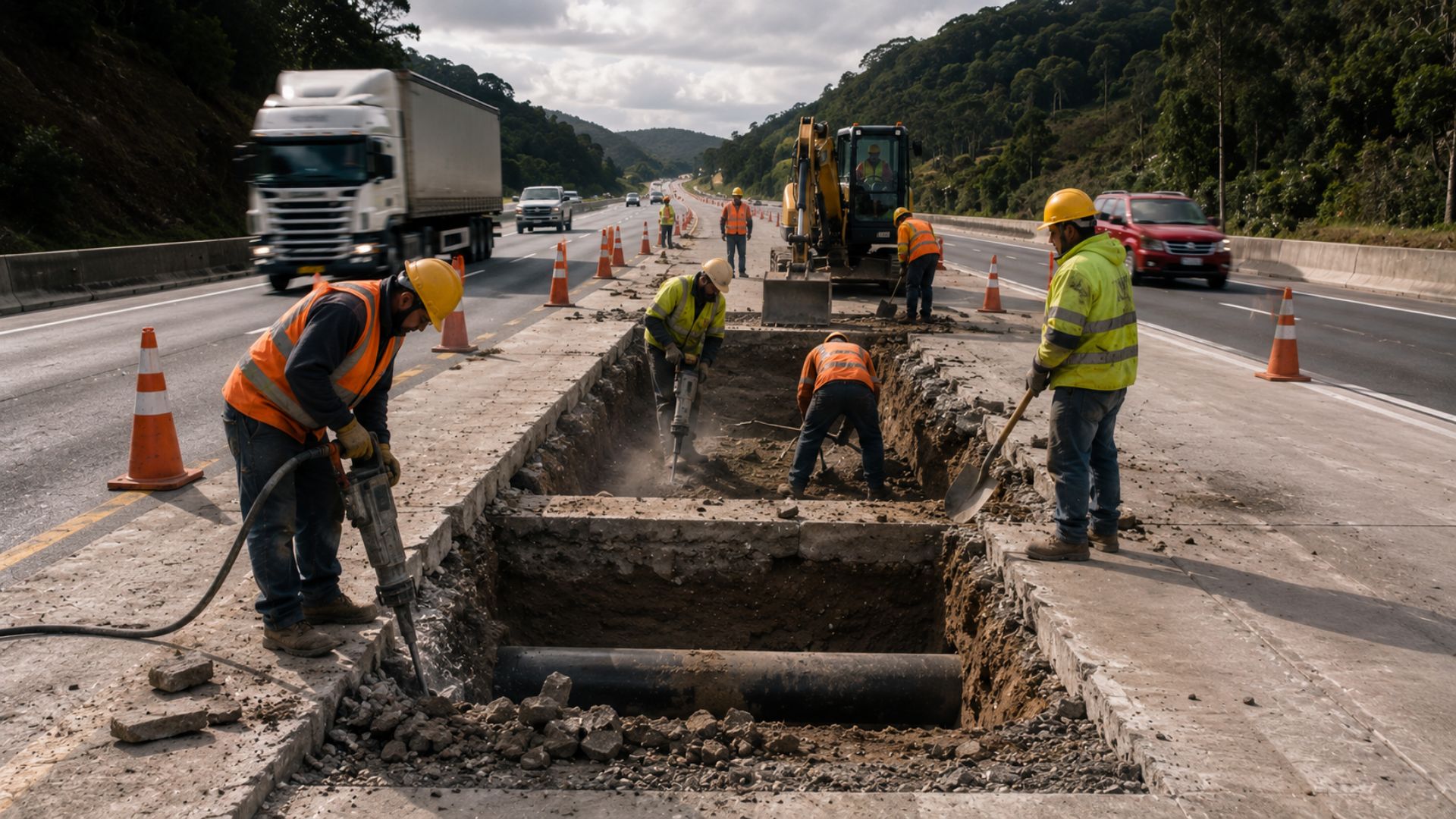

Santa Catarina has prohibited the opening of trenches on the state’s concrete highways for the passage of pipelines. Gas concessionaires, sanitation companies, and other services that cause damage to the highways will have to rebuild the road with the same original material and thickness, with no expiration date for accountability charges.
On May 20, 2026, Wednesday, the State Secretariat of Infrastructure and Mobility (SIE) of Santa Catarina published in the State Official Gazette a decision that prohibits the opening of trenches on the state’s concrete highways for the passage of pipelines. The measure directly affects gas concessionaires, sanitation companies, and other service providers who, until then, used to cut through the pavement to install ducts and pipes perpendicular to the roads, a practice that can compromise the structure of the roads.
The most stringent point of the regulation is the accountability with no expiration date. From now on, any company that causes damage to the highways during a crossing work will be required to rebuild the affected section with the same materials and thicknesses of the original project, even if the problem appears long after the completion of the service. The decision aims to protect public property and avoid patches that tend to deform and weaken the roads, causing potholes, sinkings, and bulges over the years.
What changes on the concrete highways of Santa Catarina


The new rule changes a model that was common in infrastructure works: the so-called transverse trench, where a perpendicular cut is made across the road to bury the pipeline. This method, although practical and cheap, weakens the concrete pavement, creating rupture points that tend to deteriorate with heavy traffic and temperature variations. Therefore, the SIE decided to prohibit invasive drilling on state and federal highways under its administration.
-
Brazil to Convert 80 Public Properties into 11,000 Affordable Homes Across 44 Cities to Address Housing Shortage

-
Brazilian Company Develops Wall Panels from Recycled Refrigerator Foam with Comparable Thermal and Acoustic Performance

-
Brazil’s São Paulo Region Unveils Latin America’s Largest Timber Shopping Mall, Built in 7 Months, Capturing Carbon and Preventing 900 Tons of Emissions
-
Danish Island Uses Seaweed for Durable, Centuries-Old Roofing Solution


In replacement of the transverse trench, the department recommends a non-destructive underground drilling method known as casing pipe. In this technique, a protective pipe is driven beneath the road without needing to open the concrete on the surface, and inside it pass the gas, water, or sewage pipes. The great advantage is that this system facilitates future repairs and maintenance without the need for new destructive interventions, preserving the integrity of concrete highways for much longer.
Liability Without Expiry for Companies
The most relevant part of the decision is about the responsibility of companies for damages. According to the regulation, the applicant of the work will be notified to correct any damage that manifests in the pavement due to the occupation, at any time after the completion of the service. In practice, this means there is no time limit after which the company is free from obligation: if the damage appears years later, it will still be called to bear the repair.
In cases of road alterations, such as swelling or sinking of sections, reconstruction with the same materials and thicknesses of the original project will be necessary. The company may also be called upon in situations like road expansion or improvements, when it is necessary to adapt or relocate the installed pipelines. This legal shield is what differentiates the measure in Santa Catarina and makes it more stringent in protecting the highways against poorly done patches.
How Future Crossing Works Will Proceed

The regulation also establishes clear rules for the execution of works that are still authorized. Under no circumstances can the highway traffic be completely blocked during the intervention, ensuring that the flow of vehicles continues even if partially. Furthermore, work signage must be installed beforehand and verified by inspection before the start of work, being removed immediately upon completion, to ensure driver safety.
If there is a need for the duct to be closer to the asphalt than recommended, the company will need to present a detailed technical justification. The rule also tightens requirements in risk areas, such as slopes, cuts, and embankments, demanding safety and drainage reinforcements. For sensitive sections, such as those with tolls, intersections, bridges, and viaducts, the regulation requires specific analyses before the release of any work on the highways.
Why Concrete Requires Extra Care
The concrete pavement, increasingly used on highways with heavy traffic, has different characteristics from traditional asphalt. It is more durable and resistant to the weight of heavy trucks, but it is also more sensitive to spot interventions. When a trench is opened in a concrete slab, the patch rarely recovers the original strength, creating a permanent weak point that tends to degrade and compromise the entire surrounding structure.
That is precisely why the pavement restoration, according to the standard, must maintain the same thicknesses and materials of the existing layers in the section. The necessary information can be obtained from the highway’s executive project or through inspection wells, with validation from regional coordinations. This technical care reflects the concern of the SIE in ensuring that concrete highways maintain the performance for which they were designed, without losing lifespan due to third-party works.
Santa Catarina follows the trend of other states
Santa Catarina is not alone in this strategy. States like São Paulo and Paraná already adopt similar rules to protect their pavements, and federal legislation also guides similar measures for road preservation. The very normative base of Santa Catarina had been under construction, with SIE instructions already establishing the non-destructive casing pipe method as the standard for crossings of energy and telecommunications networks on highways.
The measure is part of a larger context of managing the state road network, where the government seeks to balance the need for the expansion of essential services, such as gas, water, and sanitation, with the preservation of public assets. By transferring full responsibility for damages to the companies, the state intends to reduce public spending on repairs and extend the lifespan of the highways, which represent high-value investments for the coffers of Santa Catarina.
The decision of Santa Catarina represents an important tightening in the protection of concrete highways, transferring total and indefinite responsibility to concessionaires and service providers for the damages they cause. By replacing the transverse trench with the casing pipe and requiring identical reconstruction in case of damage, the state aims to end the era of patches that weaken the roads. It remains to be seen how the companies will adapt to these new technical and financial requirements in the coming months.
Do you agree with Santa Catarina’s decision to prohibit the opening of trenches on concrete highways and hold companies accountable indefinitely? Do you think other states should adopt similar rules to protect the roads? Leave your comment, tell us if you have ever faced problems on patched roads, and share the article with those interested in infrastructure, mobility, and public management.