Portuguese
  Spanish


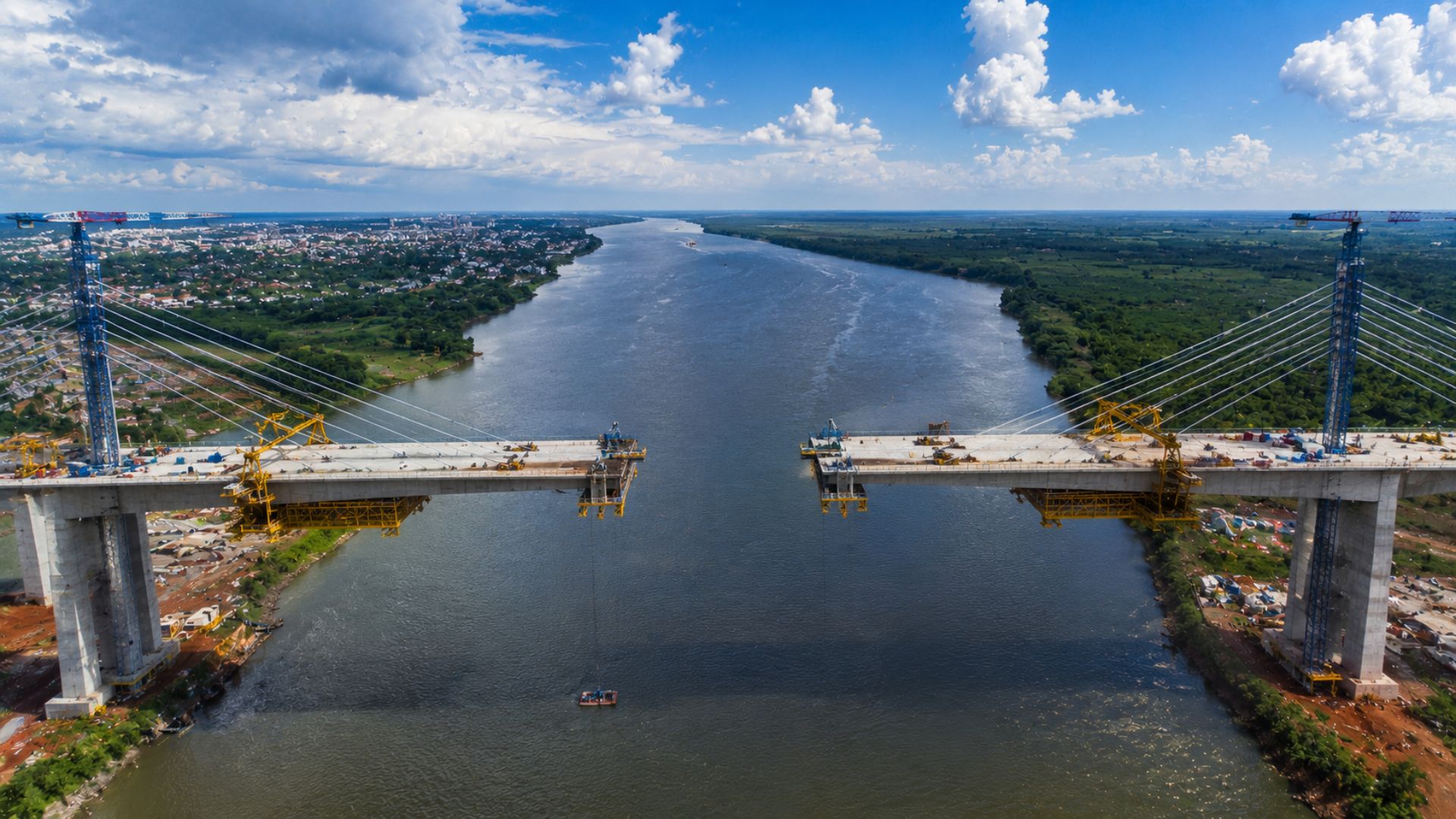


Just over 20 meters of concrete are needed to close the bridge that will unite Brazil and Paraguay over the Paraguay River for the first time. With almost 1.3 kilometers in length, the Bioceanic Route bridge connects Porto Murtinho to Carmelo Peralta and promises to open an unprecedented road shortcut between the Atlantic and the Pacific towards Asia.
On May 20, 2026, the Government of Mato Grosso do Sul confirmed that just over 20 meters of concrete, about 21 meters, are needed to physically unite Brazil and Paraguay for the first time over the Paraguay River, through the International Bridge of the Bioceanic Route. The construction, which connects the municipality of Porto Murtinho, in Mato Grosso do Sul, to the Paraguayan city of Carmelo Peralta, is in the final phase, and the meeting of the two ends, nicknamed by engineers as the kiss of the segments, was scheduled for May 31, 2026, according to those responsible for the construction.
The bridge, which cost about 500 million reais and is executed by the Binational Consortium PYBRA, is 1,294 meters long and 21 meters wide, with towers 125 meters high and a cable-stayed section supported by 168 steel cables, called stays. More than connecting two banks, the structure is the most emblematic piece of the Bioceanic Route, a logistical corridor that aims to create an unprecedented road shortcut connecting the Atlantic and Pacific oceans, shortening the path of Brazilian exports to Asian markets.
The kiss of the segments that will unite Brazil and Paraguay

The meeting of the two central parts of the bridge, over the bed of the Paraguay River, is technically called the closing segment, but has earned the affectionate nickname of the kiss of the segments. It is the moment when the two sides of the structure, one starting from Brazil and the other from Paraguay, finally touch, transforming what was construction into a crossing. This milestone was scheduled for the end of May 2026.
-
Netherlands Builds Road from 218,000 Recycled Plastic Cups and 500,000 Bottle Caps, Featuring Smart Sensors and Promising Triple the Lifespan of Traditional Asphalt

-
Brazil to Convert 80 Public Properties into 11,000 Affordable Homes Across 44 Cities to Address Housing Shortage

-
Brazilian Company Develops Wall Panels from Recycled Refrigerator Foam with Comparable Thermal and Acoustic Performance

-
Brazil’s São Paulo Region Unveils Latin America’s Largest Timber Shopping Mall, Built in 7 Months, Capturing Carbon and Preventing 900 Tons of Emissions


After this meeting, important steps still remain before opening to traffic. The teams need to install steel cables embedded in the reinforced concrete slab of the floor to permanently join the two sides, retension the 168 stays that support the central span, and place 168 dampers on these cables. The project, which involves about 280 workers between Brazilians and Paraguayans, is scheduled for complete delivery in August 2026, with the bridge also receiving paving, signage, lighting, and safety barriers.
The impressive dimensions of the Bioceanic Route bridge
The International Bridge of the Bioceanic Route is a large-scale engineering project. It is 1,294 meters long, almost 1.3 kilometers, and 21 meters wide, enough space for vehicle lanes, as well as a bike path and pedestrian walkway. The two main towers reach 125 meters in height and support the cable-stayed section, where the deck is suspended by dozens of steel cables attached to the top of the towers, giving the structure its striking silhouette.
In the central section, the free span was carefully designed to preserve navigation on the Paraguay River, allowing vessels to continue passing under the bridge. This technical detail helps explain why the project has become one of the most symbolic of recent regional integration in South America. Construction began in January 2022 and entered 2026 in the most visible and anticipated phase, with an investment equivalent to 684.6 billion guaranis, about 500 million reais, according to the Paraguayan government.
The Bioceanic Route and the shortcut between Atlantic and Pacific
The bridge is the central link of a much larger project, the Capricorn Highway Corridor, better known as the Bioceanic Route. It is a logistical corridor that will cross four countries, Brazil, Paraguay, Argentina, and Chile, connecting the Brazilian Midwest to the ports of northern Chile, such as Antofagasta and Iquique, on the Pacific Ocean. From these Chilean ports, cargo continues by sea towards Asia, the main destination for Brazilian commodities.
The logic is to create an alternative to the traditional route, where exports leave through Atlantic ports and round the entire South American continent. With the new shortcut, goods produced in the Midwest and Southeast of Brazil could cross the continent by land and embark directly on the Pacific. For Porto Murtinho, a municipality that for years was on the sidelines of major transport routes, the bridge represents the transformation into a new gateway for South American trade.
How much the new route can shorten the trip to Asia


The numbers of the logistical impact are significant. According to official estimates, the bioceanic corridor can reduce the maritime route of Brazilian exports by more than 9.7 thousand kilometers, especially those originating from the Southeast and Midwest, destined for Asia. On a trip to China, one of Brazil’s largest trading partners, the estimate is a reduction of about 23% in transport time, equivalent to something between 12 and 17 days less per trip.
This saving in time and distance can represent significant competitiveness gains for Brazilian agribusiness and industry by reducing freight costs and delivery times. The Bioceanic Route bridge would cease to be just a connection between two countries to become a strategic instrument of international trade, capable of repositioning the export logistics of an entire region on the global map of trade routes.
The access works needed for the bridge to function
The physical crossing of the bridge, however, does not solve everything on its own. For the corridor to function from end to end, complementary access works are needed on both sides of the border. On the Paraguayan side, works are advancing to connect the structure to Route PY15, the main axis of the Bioceanic Route in the country, in a stretch of about 3.8 kilometers of asphalt between the bridge and the highway, in addition to dredging, drainage, and fencing services in Carmelo Peralta.
On the Brazilian side, the National Department of Transport Infrastructure, DNIT, is carrying out access works via BR-267, with an investment of about 472 million reais. These work fronts are essential for the bridge to truly fulfill its role as an international shortcut, as it is useless to connect the banks of the Paraguay River if the roads leading to the structure are not ready and in good condition for heavy cargo traffic.
What the bridge represents for South American integration
The International Bridge of the Bioceanic Route will be the third road link between Brazil and Paraguay, adding to the historic Friendship Bridge in Foz do Iguaçu and the Integration Bridge, also in the border region. But its significance goes beyond the number: it symbolizes a new phase of physical and economic integration between the Mercosur countries, in a region, the Paraguayan Chaco, historically isolated and difficult to access.
For the Paraguayan government, the Bioceanic Route is expected to transform the Chaco region into a new logistical corridor in South America, attracting investments, generating jobs, and boosting local economies. The expectation is that the bridge will function as a catalyst for development, not only for Porto Murtinho and Carmelo Peralta but for the entire border strip, which is now seen as a strategic link in one of the most ambitious continental integration projects of recent decades.
There are just over 20 meters of concrete left to realize a dream of integration that has been envisioned for decades. When the kiss of the segments finally unites Brazil and Paraguay over the Paraguay River, the Bioceanic Route bridge will become much more than a structure of concrete and steel: it will be the symbol of a new path for South American trade towards the Pacific and Asia. It remains to be seen if the access works and complementary logistics will keep pace with this engineering achievement.
Do you believe that the Bioceanic Route bridge will truly transform the economy of the Midwest and reduce Brazilian export costs to Asia? Do you think Brazil is investing enough in integration projects with its neighbors? Leave your comment, share your thoughts on this new corridor between the Atlantic and the Pacific, and share the article with those who follow logistics, infrastructure, and international trade.