Portuguese
  Spanish


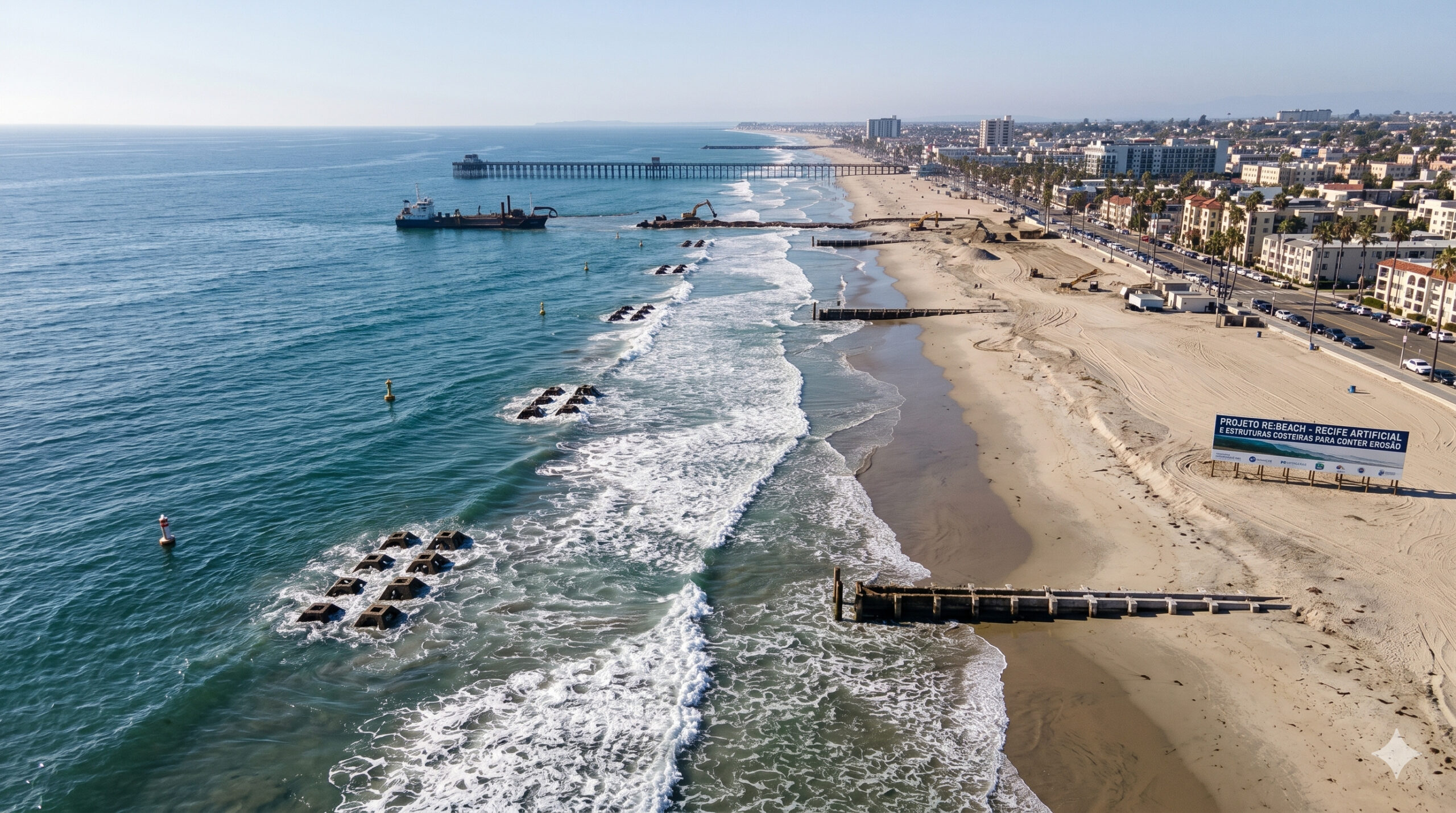


RE:BEACH Project tests artificial reef and coastal structures to contain erosion in Oceanside after decades of sand loss.
In 2025, the city of Oceanside, on the southern coast of the American state, entered a new phase in an attempt to contain a decades-long problem: the continuous loss of sand from its beaches. Data released by the city hall itself and the RE:BEACH program show that traditional interventions, such as artificial sand replenishment, have a temporary and insufficient effect given the intensity of coastal erosion.
The answer came from an international competition that brought together coastal engineers from different countries and selected an unusual solution: the “Living Speed Bumps” concept, developed by the Australian company International Coastal Management.
The project combines an artificial reef on the ocean floor with two coastal structures called artificial headlands, creating a system designed to reduce wave energy before it reaches the beach and increase the time sand remains on the coast.
-
A Brazilian city decided to purchase a piece of the Atlantic Forest with more than 153,000 square meters, and owners of preserved areas will be able to submit proposals to transform the forest into a conservation unit.

-
Brazilian siblings aged 11 and 7 read 240 books in just one year and caught attention on social media: while many children spend hours on screens, they turned their family’s routine into an example of reading, discipline, and curiosity.
-
The legendary oak that, according to the story, hid Robin Hood from the Sheriff of Nottingham, died at the impressive age of 1,200 years in England, and the first chilling sign of its end was that no leaves sprouted on the tree this spring.

-
While the world looks at forests, the UN warns that the Earth is also threatened by the silent degradation of natural grasslands and savannas, ecosystems that cover half of the planet, support billions of people, and can exacerbate water, food, and climate crises.


RE:BEACH Project born after decades of erosion that drastically reduced beach width
The RE:BEACH program was created in response to a structural problem that worsened throughout the 20th century. The construction of ports and changes in the natural flow of sediments interrupted the transport of sand along the coast, leaving entire stretches vulnerable to the continuous action of waves.
According to the project’s own data, millions of cubic meters of sand have already been artificially added to Oceanside’s coastline over the years, but much of this material was quickly carried back out to sea.
This cycle of replenishment and loss led the city to seek more lasting solutions, capable not only of replenishing sand but also of keeping it on the coast for longer.
“Living Speed Bumps” concept tries to slow down waves instead of blocking them
Unlike traditional solutions such as groynes and rigid barriers, the “Living Speed Bumps” concept does not try to completely interrupt the movement of waves or sand. The proposal is more subtle: to slow down natural processes.


The system combines three main elements. The first is an artificial reef installed hundreds of meters from the coast, designed to dissipate part of the wave energy still in the open sea. The second and third are two artificial headlands built on the beachfront, which help stabilize the sand and form accumulation areas.
The logic is simple, yet technically complex: reduce the speed at which sand is transported by the coastal system, increasing its retention on the beach without completely interrupting natural flows.
Artificial reef acts as the first barrier to wave impact
The artificial reef is one of the most important parts of the project. It is positioned offshore, about 900 feet from the coast, and designed to alter how waves break before reaching the beach.

Preliminary models indicate that such structures can reduce wave height and redistribute their energy, decreasing erosion on the sand strip. Furthermore, the reef can favor the deposition of sediments in specific areas, contributing to the gradual reconstruction of the beach.
This approach transforms the ocean into an active part of the solution, using the waves’ own dynamics to rebalance the coastal system.
Artificial headlands act as sand retention points on the beachfront
While the reef operates offshore, artificial headlands function at the interface between land and ocean. These compact structures are strategically positioned to create sediment retention zones.

By slightly modifying the geometry of the coast, headlands help form areas where sand tends to accumulate, reducing continuous loss along the coastline.
The goal is not to create visible and invasive barriers, but structures integrated into the coastal environment, maintaining the natural aesthetics of the beach and reducing negative impacts on neighboring regions.
Project undergoes laboratory tests with a realistic-scale physical model of the coast
Before any definitive construction, the project is undergoing an intensive testing phase. A 1:35 scale physical model of the Oceanside coast was built at Oregon State University’s wave laboratory.
In this controlled environment, engineers can simulate different oceanic conditions, including tidal variations, wave direction, and storm intensity.
More than 900 simulations have already been performed to test different configurations of the reef and headlands, adjusting parameters such as the height, positioning, and shape of the structures.

This level of modeling allows for more precise prediction of how the project should behave before actual construction, reducing risks and increasing the efficiency of the intervention.
US$1.8 million funding marks progress for implementation phase
In April 2025, the project received approximately US$1.8 million in funding approved by the California Coastal Commission, earmarked for expanding monitoring and advancing engineering stages.
This resource is used for environmental studies, additional modeling, and the development of the executive project, which still depends on regulatory approvals before construction.
Furthermore, the program was selected as a regional sand retention pilot project, expanding its relevance to other coastal cities facing similar problems.
Hybrid approach attempts to replace traditional solutions considered ineffective
Historically, many cities have resorted to rigid structures like groynes to contain erosion. However, this type of solution often generates side effects, such as transferring the problem to neighboring areas.
The Oceanside project represents a paradigm shift by adopting a hybrid approach that combines engineering with natural processes.
Instead of blocking sediment transport, the goal is to reorganize it, allowing sand to remain on the beach longer without compromising the balance of the coastal system. If tests confirm the system’s effectiveness, the model could be replicated in other coastal regions facing chronic erosion.
Cities in different parts of the world face similar challenges, exacerbated by factors such as sea-level rise, coastal urbanization, and climate change. The Oceanside project emerges as a potential real-world laboratory for solutions to a global problem, combining science, engineering, and environmental adaptation.
Ocean engineering now directly involved in urban beach reconstruction
The initiative reinforces the growing role of coastal engineering as a strategic tool for protecting coastal cities. Instead of merely reacting to erosion, projects like RE:BEACH seek to anticipate and control complex natural processes.
The use of artificial reefs, advanced modeling, and structures integrated into the environment indicates an evolution in how the relationship between city and ocean is being addressed.
The challenge now is to transform theory and simulation into concrete results on the sandy beach, something that will only be confirmed after the full implementation of the project.
Given this scenario, do you believe that solutions like artificial reefs and submerged structures can truly save entire beaches in the future, or does coastal erosion tend to overcome even the most advanced technologies?