





 Portuguese
  English
  Spanish
  6 min of reading
  0 comments


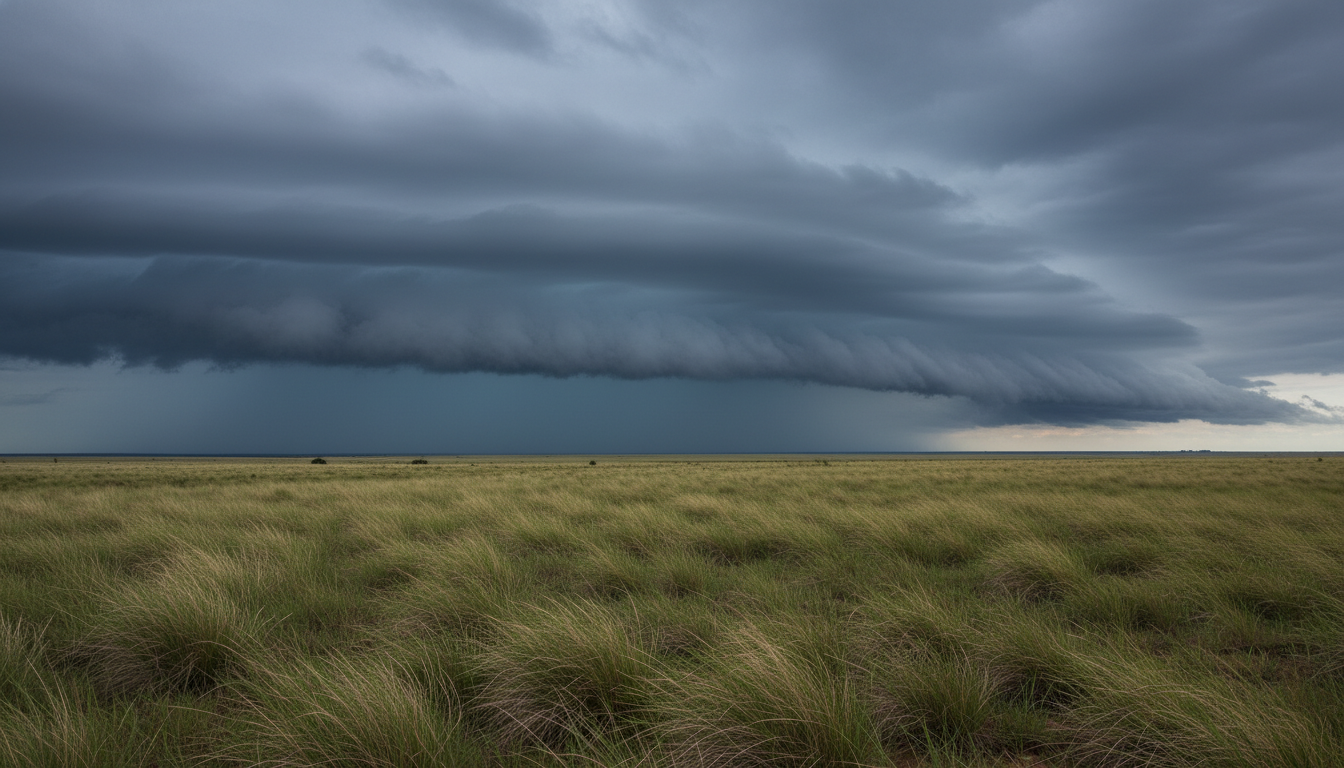
Sunday (17) brings heavy rain, strong winds, and the entry of dry and cold air through Northeast Argentina, with frost risk in Southern states and thermal loss announced by MetSul, INMET, and Climatempo
The cold front south of Brazil advances this Sunday, May 17, 2026.
According to meteorologist Estael Sias, from MetSul Meteorologia, critical areas of Paraná, southern Mato Grosso do Sul, and western São Paulo may record volumes of 100 to 150 millimeters by Monday.
In parallel, a new polar air mass enters through Northeast Argentina and Paraguay. Therefore, Rio Grande do Sul should feel dry and cold air by the end of Sunday.
-
Germany sees industrial production rise for the first time this year, but the result falls short and raises an alert in Europe’s largest economy.

-
Brazilian state receives a R$ 4.5 billion project, promises 9,000 jobs, unprecedented luxury hotels in Brazil, 392 luxury residences, and a new tourist complex.

-
São Paulo hides beneath the asphalt a project worth R$ 1.1 billion with 44.6 km of underground cables, energy from Itaipu, and a silent mission: to reinforce the ABC region of São Paulo.
-
Refrigeration technicians become a rare commodity in Brazil: the lack of qualified labor is already affecting air conditioning, supermarkets, hospitals, industries, and data centers, while salaries exceed R$ 4,400 in CLT positions, and the billion-dollar sector rushes to train new professionals.




According to Agência Brasil, in a bulletin from INMET, Rio Grande do Sul may accumulate about 50 millimeters.
In Santa Catarina, southern Paraná, and southern Mato Grosso do Sul, the institute mentions volumes close to 40 millimeters at the peaks of rain.
Cold front south of Brazil: volumes by region
The most voluminous band is concentrated between western São Paulo, southern Mato Grosso do Sul, Paraná, and northern Santa Catarina.
In most municipalities, the estimate is between 50 and 100 millimeters, with critical points reaching 150 millimeters in the next 48 hours, according to MetSul.
In practice, this means volumes equivalent to what is expected for the entire month in some locations, concentrated in less than three days.
To understand the scale: 150 millimeters equals 150 liters of water per square meter.
In urban areas with impermeable soil, this accumulation is enough to cause sewer overflow and street flooding.
Additionally, high gusts are expected. According to a bulletin from the Terra portal, areas of Rio Grande do Sul may experience winds close to 90 kilometers per hour in the metropolitan region of Porto Alegre.
On the coast of Rio Grande do Sul, the forecast is in the range of 70 kilometers per hour.
Cold front south of Brazil: temperature drop and frost
The entry of the new polar mass drops the thermometers by the end of Sunday. According to INMET, the maximums in the south and west of Rio Grande do Sul should be around 15 degrees.
In the Serra Catarinense, the predicted maximums are around 12 degrees, with minimums close to zero in high-altitude municipalities. Therefore, civil defenses have been monitoring since Friday.
According to INMET, the risk of frost spreads across several areas:
- Southwest of Paraná: high risk on Monday morning
- Central-west of Santa Catarina: high risk, especially in high altitudes
- All of Rio Grande do Sul: moderate to high risk in the southern half
- Southwest of Mato Grosso do Sul: low to moderate risk
For an idea, the previous system, at the beginning of May, dropped Curitiba to 2.5 degrees, the lowest temperature recorded in the capital of Paraná in 2026, according to Climatempo.
In that wave, 26 cities in the South had readings below zero. The minimums reached -3.3 degrees in São Joaquim and -3.1 degrees in Urupema, both in Santa Catarina.
According to CNN Brasil, with data from Climatempo and INMET, the Amazonian cold should manifest again this week. In Rio Branco, Acre, the forecast is for a minimum close to 18 degrees.

Cities on alert
The risk axis covers populated areas and strategic agricultural zones. In Paraná, Maringá, Londrina, Cascavel, Foz do Iguaçu, and the Metropolitan Region of Curitiba are on the radar.
In Santa Catarina, the focus is on the north of the state, with Joinville and Blumenau at the center of the rain band. In São Paulo, the instability affects western São Paulo.
On the other hand, central Mato Grosso and Goiás should stay out of the worst part. Only isolated showers are expected by the end of Sunday.
In Rio Grande do Sul, Porto Alegre, Caxias do Sul, Pelotas, and Santa Maria are on the radar for strong winds. According to AccuWeather’s forecast, the capital of Rio Grande do Sul will have maximums around 17 degrees.
Civil defense on alert
INMET has issued warnings for intense rains, thunderstorms, wind gusts, sharp temperature drops, and frost formation.
Compared to the wave at the beginning of the month, this passage brings less potential for temperature records but more rain volume in the west of the South and western São Paulo.
Therefore, the operational focus of the municipalities is on urban flooding, landslides on slopes, and tree falls. The most critical window is Sunday afternoon.
According to local civil defenses, it is recommended to avoid roads with a history of flooding, keep electronic devices unplugged in areas with lightning, and reinforce the fixing of light roofs.

Impacts on agriculture
The wheat crop in Paraná and Rio Grande do Sul is in the planting and initial development phase.
Therefore, the combination of heavy rain followed by frost may reduce the germination rate in more affected areas.
In fact, technicians from the southern agro network warn that the passage of intense fronts in May usually delays planting by two to three weeks.
Another sector on alert is dairy. In herds in western Santa Catarina, sudden drops reduce the productivity of the next day and increase energy consumption in milking machines.
On the other hand, the heavy rain recharges dry soils in western Paraná and southern Mato Grosso do Sul, areas with a water deficit in recent weeks.

Context: El Niño influences the winter
The year 2026 is under the influence of the El Niño phenomenon, with warming of the equatorial Pacific waters.
Compared to La Niña, El Niño usually makes the winter less harsh on average in Brazil.
According to meteorologist Alexandre Nascimento, interviewed by CNN Brasil, the beginning of winter should be “colder than the peak of winter.”
In July and August, according to the specialist, temperatures tend to rise above normal. On the other hand, the Southern region usually registers above-average rainfall in El Niño years.

Impact on the energy sector
Intense fronts in the South have a direct effect on the electrical system. The temperature drop increases the use of showers and heaters, especially in urban areas of the three Southern capitals.
In parallel, the heavy rain in the headwaters of the rivers in western Paraná recharges the reservoirs of the Paraná basin.
In practice, episodes like this reduce the pressure on the National Electric System Operator. The agency had been warning about the critical level of reservoirs in the South throughout early 2026.
According to analysts, demand peaks in cold waves are usually absorbed by natural gas thermals on the dispatch margin.
Even so, the effect of rain on the reservoirs compensates for the high consumption in the weekly balance.
Next window and what to expect
After the passage of this front, the weather stabilizes from Tuesday in the west of the South. Therefore, sun between clouds and gradually recovering temperatures are expected.
According to MetSul, a new polar air incursion is being monitored for the end of the week, with the potential to drop the minimums again.
The advance of cold waves in 2026 had already put 18 states on alert at the beginning of the month, with volumes close to 100 millimeters and winds of 90 kilometers per hour.
In another recent event, the rains of almost 200 millimeters in Pernambuco and Paraíba showed how sequences of instability can cause human tragedies.
Will the South of Brazil have to live with increasingly intense sequences of polar masses, even in an El Niño year? The next two months should provide the answer.
Still, it is worth remembering that all medium-term forecasts carry significant uncertainty. Models refine the estimate with each new round.
Municipalities usually monitor the evolution in 24 to 48-hour windows, an interval in which the forecast becomes more reliable.







Be the first to react!