






 Portuguese
  Spanish





Mix of Cement and Vedacit Becomes a Real Solution to Seal Baseboards, Protect Exterior Walls, and Reduce Infiltrations at Low Cost and High Resistance.
The combination of cement with liquid waterproofing type Vedacit — a traditional construction technique that went viral again in 2024 and 2025 in Brazil due to its proven ability to seal baseboards, protect exterior walls, reduce superficial infiltrations, and revitalize damp areas without major renovations. The method, widely documented in manuals from manufacturers such as Vedacit, Quartzolit, and Viapol, started to gain traction on social media because it brings together three essential factors for those who need to renovate on a budget: high efficiency, quick drying, and extremely low cost.
The result is a cementitious slurry of waterproofing character, used for decades in residential and commercial works to increase the surface resistance of concrete, protect masonry, and create a sealing layer against moisture. However, it was only recently that the technique became popular among ordinary residents, independent masons, and small contractors, precisely because it is a real, cheap, and safe solution when applied correctly.
How The Cement Slurry Works and Why It Is So Resistant
The mixture is simple, yet technically sophisticated: the liquid waterproofing agent acts as a water-repellent additive, reducing water absorption from the surface and increasing the durability of the applied layer.
-
With 26 Million Brazilian Families in Substandard Housing, Churches to Launch 2026 Challenge: Each Parish to Build or Renovate a Home for a Local Family

-
Wood-Look Aluminum Emerges as a High-Tech Alternative for Facades and Gates, Offering Sophisticated Aesthetics and Low Maintenance

-
Couple Transforms 1964 Concrete Water Tower into Four-Bedroom Home with Views of London Over Four Years
-
U.S. City Builds Tiny Home Village on Water Company Land to House 136 Homeless People: Inside the Social Housing Units




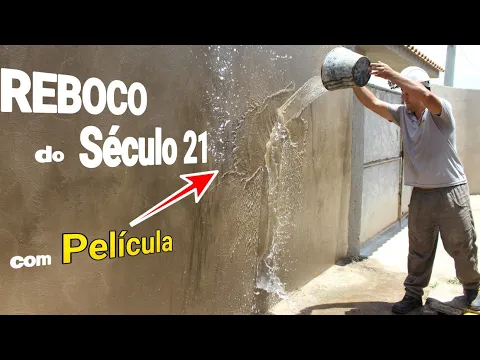

Meanwhile, the cement acts as a resistance matrix, creating a rigid film that strongly adheres to the substrate. When combined, the two materials produce a coating that:
- reduces water passage by capillarity;
- fills pores and microcracks;
- increases surface density;
- delays lateral moisture absorption;
- improves weather resistance and temperature variations.
It is the same principle used in water tanks, walls exposed to rain, wet areas, and baseboards that suffer from rising damp.
Why Did The Technique Become a Fad? The Economic Factor
In addition to efficiency, what made the mixture go viral was its extremely low cost. One liter of Vedacit waterproofing yields 15 to 18 m² when diluted and mixed with cement. The average application cost is much lower than that of commercial waterproof paint, and in some cases represents less than 20% of the price of ready-made solutions.
For families dealing with infiltration in baseboards, dark stains on exterior walls, recurring mold, and deterioration caused by rain, the cementitious slurry has become a realistic alternative — especially in regions with humid climates or in old homes with little protection against rising water.
Baseboards and Exterior Walls: Where the Technique Really Makes a Difference
Experienced professionals report that the slurry has worked particularly well in three concrete situations:
Baseboards With Rising Moisture
Rising damp occurs when water present in the soil rises through the pores of the masonry. This phenomenon is common in old houses, exposed walls, and homes with poorly waterproofed foundations.
The cementitious slurry applied in the first 30 to 50 cm of the wall:
- reduces absorption;
- creates a sealing layer;
- prevents whitish stains;
- reduces superficial mold.
It doesn’t resolve deep structural problems, but it mitigates the appearance and breaks the cycle of light moisture.
Exterior Walls Exposed To Rain
Walls that suffer wear from continuous rain tend to have high porosity and lateral infiltration. The slurry acts as a “mineral primer” that:
- closes microcracks;
- increases surface resistance;
- reduces the effect of splashes and driven rain;
- extends the lifespan of plaster.
After application, it is possible to paint over it with acrylic paint without losing performance.
Internal Damp Areas
Laundries, kitchens, bathrooms, and storage areas suffer from condensation and frequent contact with water. The slurry creates a hardened base for later painting, preventing the plaster from deteriorating over time.
Why Does The Mixture Work Better Than Common Paint?
Acrylic paint forms only a superficial film. On the other hand, the cementitious slurry:
- penetrates the pores;
- fills voids;
- creates internal crystallization;
- reduces permeability from the inside out.
It is a structural protection, not just aesthetic.
That’s why it is used in:
- reservoirs;
- water tanks;
- drainage ditches;
- foundation bases;
- buried walls;
- exposed pillars.
The technique is a derivative of traditional “polymeric mortars,” sold ready by large manufacturers, but in a more economical version adapted for home use.
The Technical Step That Determines The Success Of The Application
According to reference manuals, the slurry must contain:
- CPII or CPII-Z cement;
- Vedacit waterproofing (in the proportion indicated by the manufacturer);
- sufficient water to achieve a fluid consistency, without excess.
The surface must be:
- slightly damp;
- free of dust;
- without loose parts;
- free of peeling paint.
The application is done with a brush, allowing the mixture to penetrate deeply before hardening.
A Fundamental Detail: The Slurry Does Not Resolve Structural Problems
The cementitious slurry is excellent for superficial infiltrations and light moisture, but does not replace:
- proper drainage;
- asphalt membrane in slabs;
- deep waterproofing in foundations;
- repair of structural cracks.
Still, for walls, baseboards, and areas exposed to superficial water, it delivers a level of protection far superior to that of common paint.
An Affordable, Real, and Technically Proven Solution
The mixture of cement with Vedacit waterproofing has gone viral again because it delivers exactly what it promises: reduction of superficial infiltrations, increased resistance, protection against rain, and renewal of worn surfaces, all at an affordable cost and with methods widely documented in Brazilian construction.
For those facing light moisture issues and cannot invest in major renovations, the cementitious slurry has become one of the most effective, economical, and technically sound methods available.








Uso o mesmo impermeabilizante, só q com AC3. Muito melhor
Excelente informação…vou fazer, porque uma infiltração aparece na minha parede e na do vizinho… espero que esta novidade ajude a resolver esse problema horrível