Portuguese
  Spanish


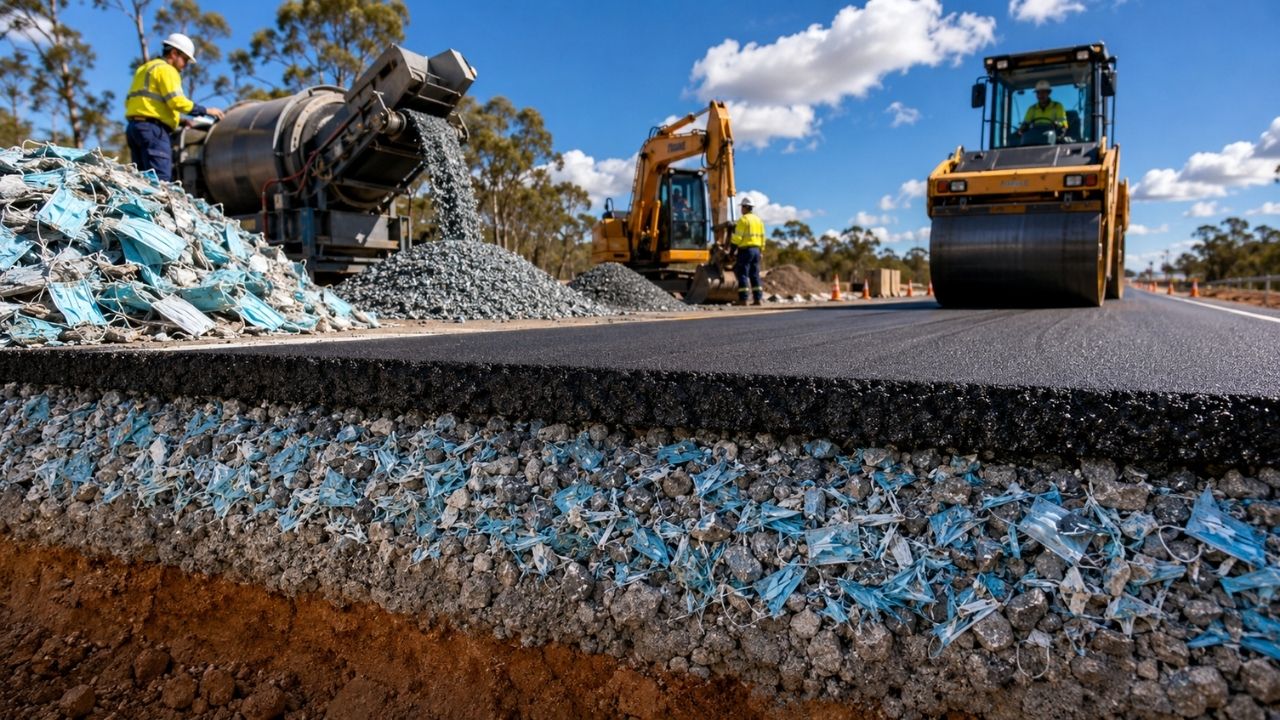

Researchers at RMIT, Australia, indicate that shredded disposable masks can be combined with recycled construction debris to create road base material. The ideal mixture uses 1% PPE and 99% recycled aggregate, utilizing 3 million masks per paved kilometer and preventing landfill waste.
The disposable masks used during the pandemic may find an unexpected destination in road construction, according to a study conducted by researchers at RMIT University, Australia. The proposal combines shredded PPE with processed construction debris to form a material aimed at the base and sub-base layers of pavements.
According to RMIT University, the study, published in the journal Science of the Total Environment, analyzed how disposable face masks could be repurposed in a circular economy solution. According to the research, just 1 km of two-lane road could consume about 3 million masks and prevent 93 tons of waste from ending up in landfills.
Pandemic waste enters the civil construction debate

The increase in the use of personal protective equipment during COVID-19 created a new environmental challenge. RMIT cites an estimate of 6.8 billion disposable masks used daily worldwide during the pandemic, a volume that pressured landfills, collection systems, and waste disposal policies.
-
After 79 Months and $145 Million Investment, Nepal Set to Open First 2.7 km Road Tunnel to Ease Traffic in Kathmandu Valley

-
In China, 23 Families Spent Over 4 Years Carving a 1.2 km Road Through a Cliff to Overcome Isolation and Transform a Remote Village

-
Giant 3,600-ton Crane Breaks Two World Records by Installing World’s Largest Single-Piece Forged and Welded Hydrogenation Reactor, Weighing 3,037 Tons, in Chinese Petrochemical Plant in Just Six Days

-
$80 Million Bridge in Brazil Cuts Travel Time from 30 Minutes to 1 Minute, but Audit Reveals Major Flaws



The research starts from a practical question: if this material already exists on a large scale, could it be transformed into input for infrastructure? The initial response from the tests was positive, but the researchers themselves treat the study as a feasibility stage, not as automatic authorization for uncontrolled use in real works.
Mixture uses 1% masks and 99% recycled concrete

The developed material combines shredded disposable masks with recycled concrete aggregate, known by the acronym RCA. This aggregate comes from processed construction debris and can already be used in lower layers of roads, such as base and sub-base.
The proportion considered ideal in the study was 1% shredded masks to 99% RCA. According to the researchers, this combination improves the material’s performance and maintains good cohesion between the components. The proposal addresses two problems at the same time: the disposal of PPE and the accumulation of construction waste.
Tests indicated resistance for pavement layers
Roads are formed by different layers, including sub-base, base, and asphalt on the surface. Each needs to withstand vehicle pressure, deformations, and the risk of cracking, especially on roads that receive heavy traffic.
In the tests described by RMIT, the mixture with disposable masks showed adequate performance in resistance to tension, water action, acids, deformation, mechanical resistance, and dynamic properties. According to the university, the material met the relevant civil engineering specifications for the studied application.
Study used unused masks and requires safety care
An important point is that the experiment was conducted with a small amount of unused surgical masks. This means that the research does not, by itself, eliminate the sanitary challenges involved in reusing disposable masks already used by the population.
The source mentions that other research analyzed methods of disinfection and sterilization of used masks. Even so, on a real scale, it would be necessary to ensure safe collection, sorting, decontamination, and processing. Without this control, the sanitary risk could compromise the environmental application of the idea.
Construction debris is also a central part of the solution


The proposal does not rely solely on masks. Recycled concrete aggregate plays an essential role because it forms the majority of the mixture and provides the structural base for the material. In Australia, according to RMIT, about 3.15 million tons of this type of aggregate end up added to stockpiles each year, instead of being reused.
By incorporating disposable masks into RCA, researchers are trying to create an alternative to reduce debris stockpiles and, at the same time, provide a destination for mass-generated plastic waste. The strength of the solution lies precisely in the combination of two waste streams that are usually treated separately.
RMIT also evaluates use in concrete
In addition to road applications, the RMIT team investigated the use of shredded disposable masks as aggregate material for concrete production. The results cited by the university are preliminary but indicate new possibilities for the reuse of PPE in construction materials.
Professor Jie Li, who leads the team at RMIT’s School of Engineering, stated that the idea arose from observing discarded masks on the streets. From this observation, the researchers began to study how circular economy thinking could transform an environmental problem into an input for infrastructure.
RMIT’s research shows that disposable masks can cease to be just a symbol of pandemic waste and enter a broader discussion about paving, recycling, and civil construction. The mixture with recycled construction debris presents technical potential for road base layers but still depends on studies, sanitary protocols, and scale validation.
The topic also raises an important question for governments and companies: should hard-to-dispose waste be treated only as a problem, or can it become raw material in public works? Do you believe disposable masks should be reused in roads, provided they undergo disinfection and technical control, or is the risk still too high? Leave your opinion in the comments.