Portuguese
  Spanish


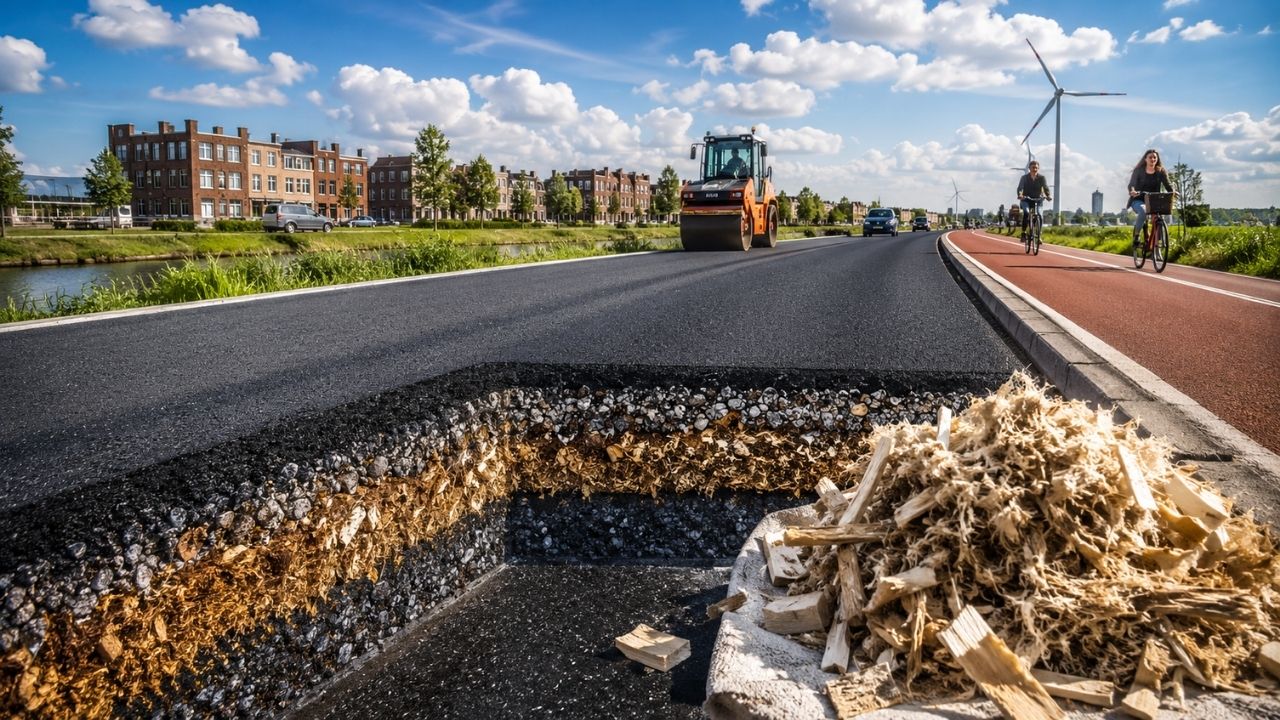


In the Netherlands, asphalt with lignin already appears on more than 25 test roads and replaces half of the fossil bitumen. According to WUR, the formula reduces CO₂ emissions by 30% and transforms paper industry waste into a plant-based binder for pavements, construction, and new sustainable materials.
Asphalt with lignin is being tested on dozens of road sections in the Netherlands as a partial alternative to fossil bitumen, the traditional binder produced from the petroleum industry. The research is conducted by Wageningen University & Research, WUR, which seeks to make roadworks more sustainable.
According to WUR, the solution already appears on more than 25 test roads in the country, including bike paths and provincial roads. According to the institution, replacing half of the bitumen with lignin can reduce CO₂ emissions associated with the material by 30%, while researchers evaluate performance, durability, and possible uses in other sectors.
Paper industry waste replaces bitumen

Lignin is a natural component of plants and helps give rigidity to plant cells. In the paper and pulp industry, it often appears as a process residue, often used in small quantities as fuel for energy generation.
-
72-Year-Old Man Spends Six Years Building a Rotating House for His Wife, Completing a Full Turn in 22 Seconds

-
Chinese Residential Building Surrounded by Circular Overpass After Residents Reject Compensation

-
After 79 Months and $145 Million Investment, Nepal Set to Open First 2.7 km Road Tunnel to Ease Traffic in Kathmandu Valley

-
In China, 23 Families Spent Over 4 Years Carving a 1.2 km Road Through a Cliff to Overcome Isolation and Transform a Remote Village



WUR began studying this material as a binder for asphalt because it can offer structure and adhesion similar to bitumen. The idea is to transform a plant by-product into a high-volume ingredient for roadworks, reducing dependence on fossil inputs.
Netherlands tests more than 25 roads with lignin

Before a widespread change in the industry, performance needs to be observed under real conditions. Therefore, more than 25 test roads in the Netherlands have already received lignin in the surface layer, in sections ranging from a bike path near the Wageningen campus to a provincial road in Groningen.
The roads are built with industry partners and are monitored with core samples, used to measure the durability and performance of the asphalt. According to WUR, the results observed so far are positive, with roads in good condition and within the required specifications.
Reduction of emissions depends on the level of substitution
The most striking data from the research is in the reduction of CO₂. According to calculations cited by WUR, the bio-based asphalt, when replacing half of the fossil bitumen with lignin, shows 30% lower emissions.
The project leader, Richard Gosselink, states that if the substitution reaches 100%, the expected reduction could double. Still, this stage depends on technical proof, industrial scale, and market acceptance, because pavements need to withstand traffic, weather, wear, and maintenance over time.
Annual asphalt production shows the size of the market
The Netherlands produces about 10 million tons of asphalt per year, mainly composed of gravel, sand, and bitumen. Since bitumen is derived from the petroleum chain, its partial replacement by plant-based binders can have a significant impact in a sector that uses large volumes of material.
Globally, WUR cites an annual consumption of about 90 million tons of bitumen. In this scenario, a bio-based alternative could avoid approximately 100 thousand tons of CO₂ per year. The potential lies precisely in the volume: even small changes in the binder can weigh heavily when applied to many roads.
Lignin can also advance to panels and civil construction


The research is not limited to pavement. WUR is also working with the Dutch company Trespa on the development of panels for internal use, in which half of the phenol, a toxic substance used in certain materials, is replaced by lignin.
According to the company’s calculations, this application could already generate a 30% to 50% reduction in CO₂ emissions. This indicates that lignin can move from asphalt to other construction materials, expanding the use of plant residues in more sustainable industrial chains.
Natural properties can help against weather and UV radiation
Another point studied involves the protective properties of lignin. The material has a natural role in stabilization against UV radiation, a characteristic that can be utilized in cosmetics, personal care products, and materials exposed to the weather.
WUR is also developing technology to produce light-colored lignin, expanding the possibilities of application. Additionally, researchers mention tests on window frames more resistant to weather conditions and initial studies for use as a component in aircraft fuel.
The asphalt with lignin shows how a residue from the paper industry can gain a new function in roads, panels, and bio-based materials. The proposal draws attention because it does not require immediately abandoning all known infrastructure but rather replacing part of a fossil input with a plant-based alternative.
The challenge will be to prove durability on a large scale, ensure a stable supply of lignin, and convince manufacturers to adopt the material without compromising safety and performance. Do you believe that roads with plant-based binders can become the standard in the future, or is it still necessary to prove that they withstand as much as traditional asphalt? Leave your opinion in the comments.