Portuguese
  Spanish


Common Trucks, Silent Drones, and Billion-Dollar Targets: One of the Most Ingenious Operations of Modern Warfare Occurred Under the Radar of the Russian Forces Without Anyone Noticing. Ukraine Used Creativity, Technology, and Strategy to Redefine the Limits of the Possible.
On June 1, 2025, five military airbases in Russia were hit by a coordinated and silent offensive.
Strategic bombers, such as the Tu-95 and Tu-22M3 models, were destroyed by kamikaze drones that took off not from enemy airspace, but directly from Russian soil.
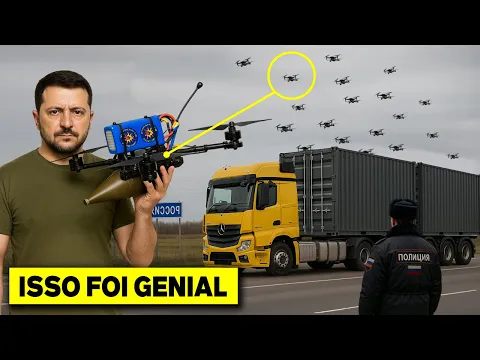
The operation, orchestrated by Ukraine, utilized modified civilian trucks to launch attacks from pre-infiltrated positions.
-
German Engineer Developed Diesel Engine Running on Vegetable Oil Decades Before Electric Cars Became Popular; Can This Forgotten Idea Work in 2026?

-
Creative Uses for Toilet Paper Rolls That Will Change Your Perspective
-
Crab Trapped in Plastic Bottle for 62 Days Near Okinawa Highlights Little-Known Impact of Marine Pollution on Small Animals
-
James Webb Telescope Uncovers Unexpected Clues on Mysterious Moon, Potentially Redefining Planetary Origins


The offensive, dubbed Operation Spiderweb, was developed in 2023 by the Security Service of Ukraine (SBU), with support from the Main Military Intelligence Directorate.
The plan aimed to bypass defensive systems such as the S-400, hiding suicide drones in vehicles parked near Russian military installations.
Civilian Trucks with Kamikaze Drones
The trucks, with legitimate Russian plates and a common appearance, were modified with secret compartments made of wood, equipped with automatic opening systems.
The structure included soundproofing, an internal battery recharging system, and a remotely operated liftable cover.
Externally, they were indistinguishable from common cargo vehicles.
Internally, they carried kamikaze drones of the FPV (“First Person View”) type, with embedded AI, navigating autonomously to their targets.
This drone technology used by Ukraine proved crucial for the success of the operation.
Entering Russian Territory via Alternative Routes
The infiltration began months in advance.
Some of the trucks were acquired within Russia itself, using front companies and local intermediaries.
Others crossed less monitored borders, such as those of Kazakhstan and Georgia, avoiding inspections by the Federal Security Service of Russia (FSB).
The suicide drones were sent in parts, later assembled in clandestine warehouses.
One of the logistics centers was identified in Chelyabinsk, where pro-Ukrainian Russian collaborators completed the final assembly of the equipment.
Kamikaze Drones Equipped with FPV Technology and Embedded AI
Each kamikaze drone, costing under US$ 30 each, was programmed with visual artificial intelligence capable of recognizing models of Russian aircraft.
The database was composed of images of real planes, harvested from museums and military records.
To ensure reliable navigation, even under electronic warfare, the drones combined mobile network remote control with dead reckoning and autonomous algorithms.
This tactical use of FPV drones with artificial intelligence shows how low-cost armaments can overcome advanced defenses.
Coordinated Attack with Suicide Drones
On the day of the attack, the trucks were positioned in industrial areas and warehouses near the airbases.
The compartments were opened remotely, and the suicide drones took off almost simultaneously, flying a few kilometers to their targets.
No Russian radar detected any movements, and there was no response from the S-400 system.
Shortly after the launches, the trucks themselves self-destructed: some were set on fire, while others exploded due to internal charges.
In certain cases, a final kamikaze drone was used to eliminate the vehicle.
The objective was to eliminate traces of the operation and avoid immediate retaliation.
Strategic Impact of Operation Spiderweb
With minimal investment, Ukraine inflicted estimated damages in the hundreds of millions of dollars, destroying aircraft valued at up to US$ 100 million each.
The attack exposed vulnerabilities in the Russian defensive apparatus and forced Moscow to reconsider its internal security protocols.
The operation symbolizes a new paradigm of modern warfare: affordable technology and effective camouflage overcoming high-cost conventional forces.
This Ukrainian tactic using embedded FPV drones represents a turning point in the conflict with Russia.
Is War Shifting Toward Engineering and Creativity?
The Operation Spiderweb showed that the war of the future will also be fought with tactical engineering, embedded software, and creative logistical solutions.
With drones of simple appearance and silent launches, Ukraine achieved one of the most sophisticated attacks of the conflict so far.
In light of this scenario, armed forces from various countries are beginning to reassess their land and air defense systems.
What was once considered impossible — launching drones from within enemy territory — is now a reality.
Will other nations follow this same logic of warfare with suicide drones hidden in civilian vehicles?