Portuguese
  Spanish


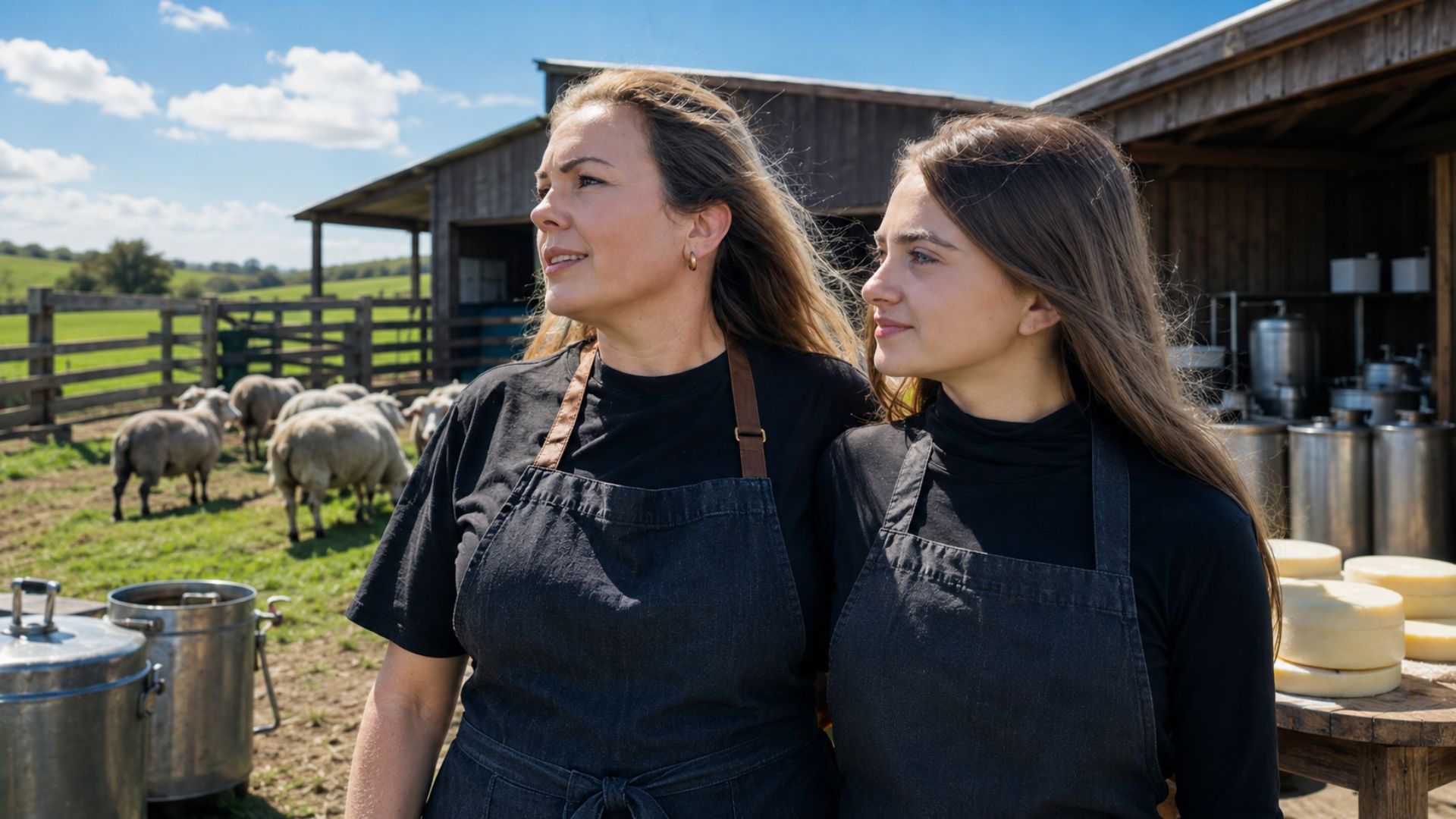


TV Cachoeira Novo Tempo report shows Denise Nidermeer, a nutritionist who left the city in 2020, created Cabanha La Serrana, became a cheesemaker and today balances being a mother and daughter, agroindustry, a flock of 260 sheep, award-winning derivatives and fights to value sheep’s milk in Brazil in a specialized niche market.
The story of mother and daughter is at the center of the life change of Denise Nidermeer, a nutritionist who left the city during the pandemic, in 2020, to transform the countryside into a business in the interior of RS. The report by TV Cachoeira Novo Tempo, published on May 7, 2026, shows Denise as a rural producer, cheesemaker, owner of the ranch, mother of two daughters, and responsible for sheep’s milk derivatives at Cabanha La Serrana.
The turnaround happened because Denise wanted to combine her nutrition background with food production and add value to sheep farming. The initial project was to work with sheep for meat, but the family migrated to sheep’s milk, a market still little known in Brazil. The routine that seemed like a rural dream turned into a heavy operation, with animals, climate, motherhood, production, sales, and consumer education all at once.
From city to countryside, the project changed along with the sheep

Denise Nidermeer told TV Cachoeira Novo Tempo that the enchantment began when visiting a tourist property with dairy sheep. The direct contact with the animals, especially when feeding a lamb, reinforced the decision to proceed with the project in the countryside.
-
Brazilian Farmers with Basic Education Create Backyard Machines That Win National Invention Contest, Beating 242 Projects

-
Brazilian Farm Innovates with Cage-Free Chickens, Producing 3,300 Odorless Eggs Daily

-
From Selling Unsold Saplings to Creating Brazil’s Most Awarded Olive Oil Brand with 330 Accolades and a $12 Million Goal by 2026
-
China Builds 400-Hectare Irrigation System in Tanzania to Aid 1,000 Families Dependent on Rainfall


The shift to sheep’s milk production came as a way to generate more value for the property. Instead of selling only animals or meat, Denise began transforming the milk into derivatives. It was a business decision, but also a life choice: leaving the city and embracing a routine without a clear separation between home, work, and upbringing.
Mother and daughter enter the routine that mixes care, production, and sales

The axis of mother and daughter appears in the difficulty of balancing motherhood with agroindustry, farm, and rural production. Denise is the mother of two daughters and reported that she needs to divide her time between family, animals, product manufacturing, and property management.
This point prevents a romanticized view of the countryside. The producer describes the work as difficult, affected by climate, access to the property, sheep management, and administrative responsibilities. The countryside does not appear as a simple escape from the city, but as a business that requires presence every day.
Sheep milk still needs to be explained to the consumer


One of the biggest challenges pointed out by Denise is making people understand that sheep also produce milk. In Brazil, consumption is much more associated with cow’s milk and, to a lesser extent, goat’s milk.
Therefore, part of the work of Cabanha La Serrana is educational. Denise needs to present the product, explain the taste, show the derivatives, and overcome the initial strangeness. Before selling cheese or sweets, she needs to sell an idea: that sheep milk can have a place on the Brazilian table.
Sweeter taste helps open niche market
According to Denise Nidermeer, sheep milk has more total solids than cow’s milk, with a richer composition in fat and protein. She describes the taste as mild and sweet, even lighter compared to goat’s milk.
This characteristic favors the production of higher value-added derivatives, such as cheeses, yogurts, and dulce de leche. The niche exists precisely because the product does not compete only by volume; it tries to compete by creaminess, taste, and differentiation.
Own agroindustry allowed transforming milk into final product
The journey of Cabanha La Serrana began in 2020 with 25 sheep and one ram. In 2021, Denise sought Emater to develop the agroindustry plant. The structure was inaugurated in 2024 and formalized the following year.
The existence of the agro-industry changed the level of the business. With it, Denise began to process the milk and produce derivatives within the structure itself. Without this step, the value would remain trapped in the raw material; with it, sheep milk turns into cheese, sweets, and its own brand.
Award-winning sweet brought visibility to the interior of RS
The award-winning sweet became one of the main calling cards of the production. Denise told TV Cachoeira Novo Tempo that the dulce de leche made with sheep milk was recognized in 2025 as the best artisanal dulce de leche in Rio Grande do Sul.
The product also received a silver medal at the Prêmio Queijo Brasil and came in second place in a contest at Expointer, according to the report. For a little-known market, an award is not a detail: it is public proof of quality and a way to break consumer resistance.
Herd grew to 260 sheep
The property now has 260 sheep, according to the report by TV Cachoeira Novo Tempo. The lactating animals are kept in a barn and provide the milk used in the products of Cabanha La Serrana.
Each sheep spends about 200 days in lactation and yields an average of 1 liter per day. The processing structure has the capacity to handle up to 500 liters daily. These numbers show that the business is still niche, but already operates with enough scale to sustain its own agro-industry.
Producing own corn became part of the equation
To make the property more viable, Denise also started producing the corn used in the animals’ feed. Emater contributed to the development of a drying silo, a model mentioned in the report as a lower-cost alternative adaptable to the farmer’s needs.
This detail shows that the business does not rely solely on the cheese room. The operation involves feed management, storage, physical structure, animal health, and production control. In the field, the profit from the derivative begins before milking, in the cost of maintaining the herd.
Special cheeses increase the value of milk
In addition to the award-winning sweet, Cabanha La Serrana produces special cheeses. Denise presented to the report a cold maturation chamber, with cheeses inspired by styles such as Italian pecorino and parmesan.
The strategy makes sense because sheep milk has a high solids content and favors creamier products. In a niche market, the derivatives help differentiate the production. The pure milk may be little known, but the cheese opens a more familiar door for the consumer.
Lack of specific regulation limits the sale of pure milk
Denise explained that the sale of pure sheep milk still lacks specific regulation in Brazil. Therefore, the production at Cabanha La Serrana focuses on derivatives that follow rules for similar products made with cow or goat milk.
This point is crucial to understanding the business model. The choice of cheese, dulce de leche, and other derivatives is not just commercial; it also responds to the regulatory environment. When legislation does not keep up with the product, the agribusiness needs to find safe ways to exist.
Mother, cheesemaker, seller, and rural producer on the same day
Denise’s routine combines roles that, in an urban company, could be divided among several people. She is a mother, wife, manager of the farm, cheesemaker, seller, and rural producer.
This overlap helps explain why the story of mother and daughter has social appeal. It is not just about rural entrepreneurship, but an attempt to balance motherhood, economic autonomy, and specialized production. The success of the sweet appears in the showcase, but the hard work comes before, during, and after the sale.
Specialized market grows, but still requires patience
The production of sheep milk in Brazil remains a specialized market, aimed at fine cheeses and derivatives with higher added value. The advantage lies in the product’s differential; the difficulty is in forming a consumer audience.
Denise states that she wants to see her products reaching new markets, with growing recognition of quality. However, this progress depends on tasting, information, regulation, and distribution. A niche product does not grow just because it is good; it grows when the consumer understands why it costs, is worth it, and stands out.
The story of mother and daughter, in the case of Denise Nidermeer, shows a life change that left the city in 2020 and became a rural business in RS. Cabanha La Serrana started small, structured an agribusiness, reached 260 sheep, created derivatives of sheep milk, and gained visibility with an award-winning sweet.
The case also reveals the limits of romanticism in the countryside: there is climate, difficult access, incomplete legislation, feeding costs, animal management, direct sales, and motherhood all in the same package. Do you think niche products like sheep milk have room to grow in Brazil, or do they still rely too much on awards and consumer curiosity? Share your opinion.