






 Portuguese
  Spanish





From Reading Stones in the Middle Ages to Modern Designs, Discover the Evolutionary Journey of Eyeglasses and How They Transformed Society, Science, and Culture.
The question “who invented eyeglasses?” does not have a simple answer. Unlike modern inventions, eyeglasses cannot be credited to a single person. Their history is an evolution that stretched over centuries, involving observations and refinements from various cultures and individuals.
We will explore from the earliest concepts of visual aid to the establishment of eyeglasses as we know them, highlighting the milestones that made vision correction possible.
Before Eyeglasses: The First Attempts to Enhance Vision
The journey toward clearer vision began long before the formal invention of eyeglasses. In Ancient Rome, around AD 60, the philosopher Seneca used a glass globe filled with water to enlarge texts. Emperor Nero was also said to use an emerald, supposedly to enhance his vision.
-
Bruno Guimarães, 28, Misses Crucial Penalty Against Norway in World Cup After Replacing Vinicius Jr.

-
Inspired by a school lesson on Africa’s water crisis, a young boy raised money through chores to fund a well that transformed a Ugandan community.

-
Brazilian Construction Worker Moves to France, Earns Up to €2,500 Monthly with Home Renovations, Gains Social Media Attention

-
US Navy Sinks USS Oriskany with 230 kg of C-4, Creating World’s Largest Artificial Reef in 37 Minutes





A significant advancement came with the “reading stones.” Between the 10th and 13th centuries, monks in Europe, primarily in Italy, manufactured semi-spherical lenses made of quartz or beryl. When placed over a text, they magnified the letters, assisting scholars with presbyopia (difficulty seeing up close).
The scientific basis for this was solidified by the Arab scholar Ibn al-Haytham (Alhazen), who in the 11th century suggested that polished lenses could help people with visual impairments.
The Birth of Eyeglasses in Medieval Italy
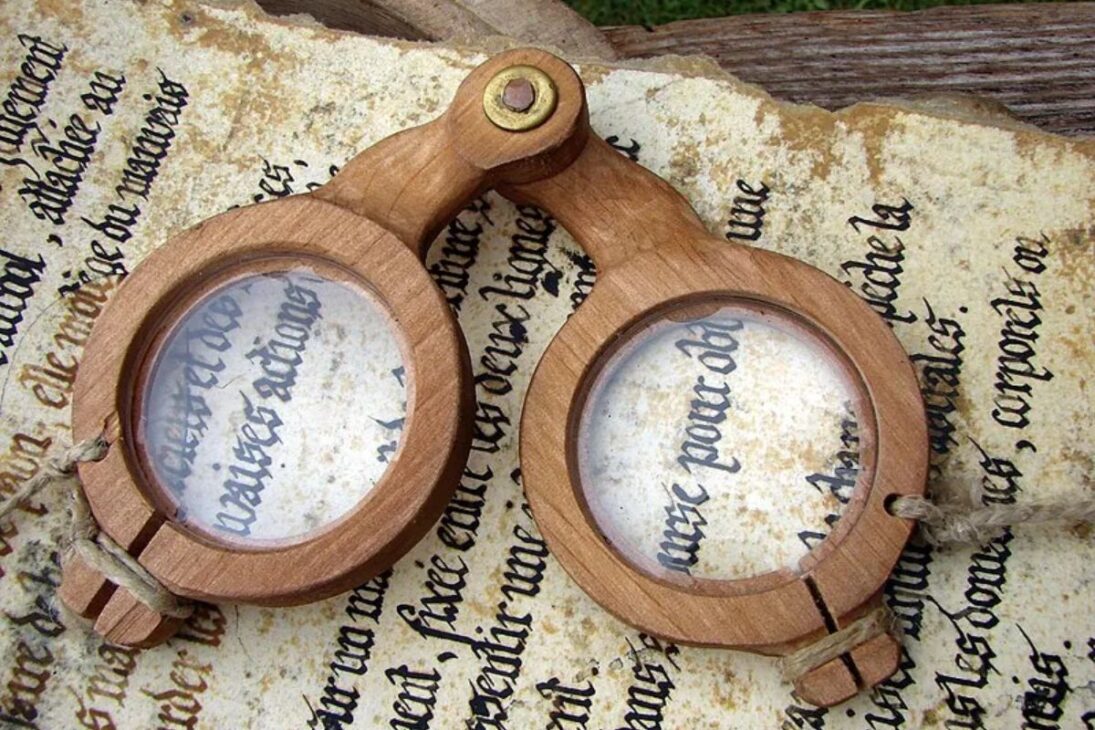
The transition from reading stones to a wearable device occurred in Italy in the late 13th century. Pisa and Venice are noted as the most likely epicenters of this innovation. Although the Florentine Salvino D’Armate is often cited, his existence is considered doubtful by modern historians.
The strongest evidence comes from a 1306 sermon by the Dominican friar Giordano da Pisa. He claimed that the art of making glasses that allow good vision had been found less than twenty years prior and that he had known and spoken with the inventor, whose name, unfortunately, he did not record. The earliest models, known as “rivet glasses,” consisted of two convex lenses joined by a rivet, which balanced on the nose.
The Technology Behind the Invention: The Crucial Role of Venetian Glass
The development of eyeglasses is directly linked to advancements in glass manufacturing in Venice and on the island of Murano. From the 13th century, Murano became the center of high-quality glass production in Europe.
The Republic of Venice strictly protected its secrets, ensuring a monopoly on the production of “white glass,” clear and colorless, essential for lenses. A milestone was the development of cristallo around 1450 by Angelo Barovier. This exceptionally clear and bright glass elevated the quality of lenses. The invention of eyeglasses was, therefore, an achievement of both optics and materials science.
The Evolution of Design: From Practicality to Comfort
The first “rivet glasses” were uncomfortable and needed to be held by hand. The evolution of design sought to address these usability issues. Shapes such as the Pince-nez emerged, which clamped to the nose by pressure.
The major innovation was the invention of side arms. The English optician Edward Scarlett is credited with popularizing, around 1727, the modern design with arms that rest on the ears. Later, in 1784, Benjamin Franklin invented bifocal lenses, combining lenses for near and far vision in a single frame. These evolutions transformed eyeglasses into a practical and essential accessory for daily use.
How Much Does a Pair of Eyeglasses Cost Today?
Today, the price of a pair of eyeglasses in Brazil is the sum of the frame and lens costs, and it can vary drastically.
Frames: prices can start around R$ 130 for simpler models and exceed R$ 2,000 for designer brands like Prada or Oakley. Factors such as material, design, and brand directly influence the cost.
Lenses: the cost of lenses depends on the material (plastic, polycarbonate, resin), the refractive index (for higher prescriptions, making them thinner), and the treatments applied (anti-reflective, scratch-resistant, UV protection, blue light filter). Simple lenses can cost from R$ 120. However, high-index resin lenses with multiple treatments, from manufacturers like Zeiss or Essilor, can exceed R$ 3,000 or R$ 4,000, and complex multifocal lenses can reach over R$ 8,000.
To find a wide variety of options that fit your budget and needs, it is always recommended to visit a trusted optical store, such as Otica Isabela, where professionals can guide you on the best combination of frames and lenses for each case.





