Portuguese
  Spanish


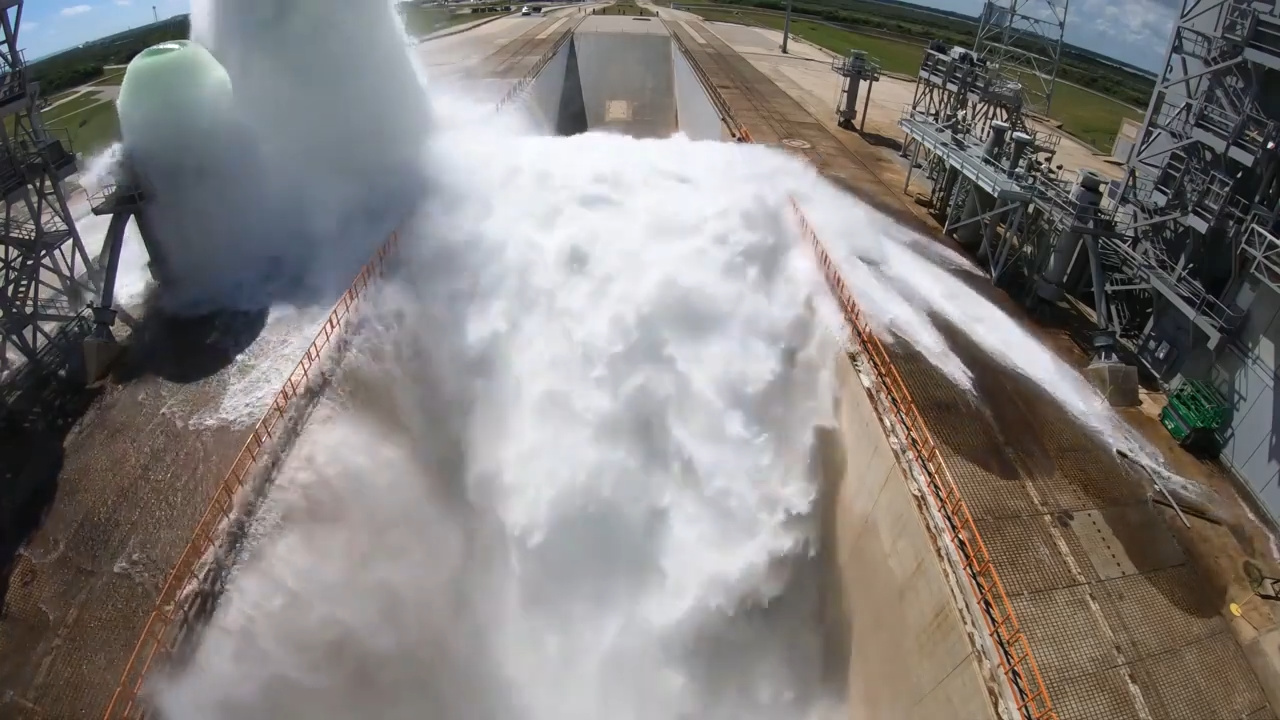

NASA’s Ramp 39B dumps 1.7 million liters in less than 30 seconds to protect the SLS rocket from an invisible threat more destructive than fire
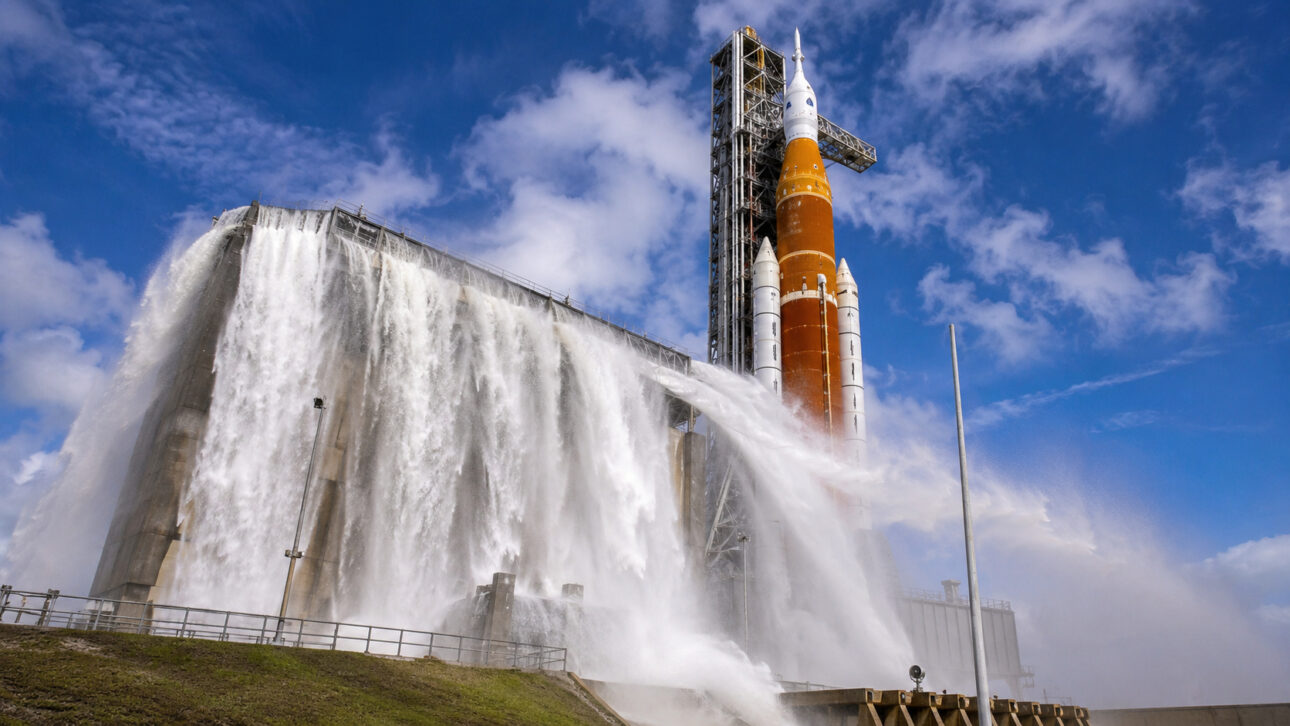
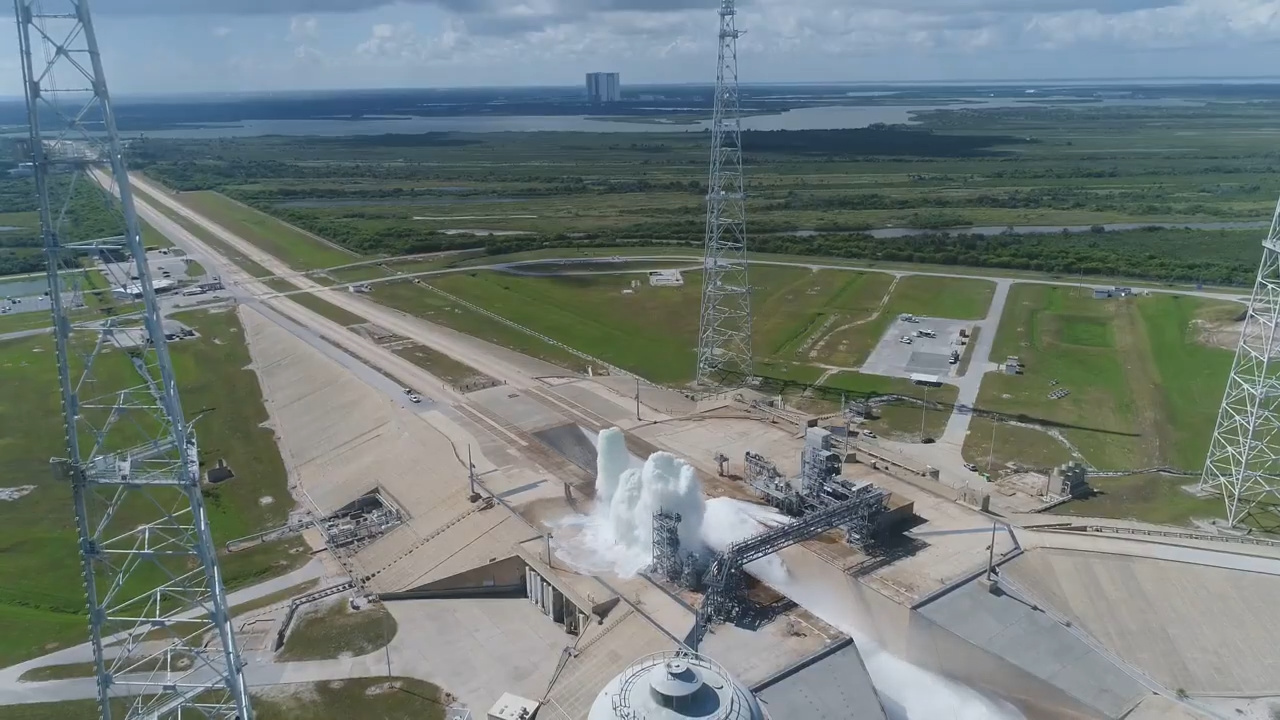
According to NASA, the Sound Suppression and Ignition Overpressure Protection System, known as IOP/SS, at Launch Pad 39B at the Kennedy Space Center in Florida, dumps about 1.7 million liters of water in less than 30 seconds onto the Mobile Launcher and the flame trench during rocket ignition and liftoff. At its peak, the flow reaches 1.1 million gallons per minute, enough volume to empty two Olympic-sized swimming pools in one minute.
All this water is not there to extinguish fire. According to NASA, its main function is to absorb acoustic energy and reduce the overpressure created by the engines of the Space Launch System, the SLS. The four RS-25 engines and the two solid boosters together generate 3.8 million kilograms of thrust, and the sound wave produced by this force is powerful enough to damage the rocket itself before it even leaves the ground.
NASA’s sound suppression system uses water to protect the SLS rocket from overpressure
According to NASA, the great risk at the moment of ignition is not just the flame, but the extreme acoustic pressure that spreads from the base of the rocket. Part of this energy rises directly towards the vehicle structure and can excite resonant vibrations, reach electronic components, tear insulation, and deform structural elements.
-
China to Drill 15 Kilometers into the Earth, Set to Break Russia’s Record for Deepest Man-Made Hole

-
Researchers Use Algae to Enhance 3D-Printed Walls, Boosting Strength by 25% and Speeding Construction by 33%

-
Drill Uncovers Freshwater Rivers Hidden Beneath the Ocean Floor
-
3,000-Ton, 81-Meter Attack Submarine Begins Sea Trials, Equipped with Heavy Torpedoes and Anti-Ship Missiles


Water enters this equation because it is an extraordinarily efficient absorber of acoustic energy. When it comes into contact with extreme heat and pressure, a portion quickly evaporates, and this process converts part of the pressure wave energy into heat, reducing the intensity of the impact that reaches the rocket.


This logic is not theoretical. NASA itself learned this the hard way on the first space shuttle flight, when the sound energy damaged the vehicle and forced the agency to improve its acoustic suppression systems in the following decades.
Flame trench of Ramp 39B has 93 thousand bricks and a deflector that diverts the heat from the SLS
According to NASA, even before the water comes into action, the engineering of Ramp 39B is already working to control the heat and violence of the ignition. The flame trench is the first line of defense and was completely renovated for the Artemis program.
The structure is 137 meters long and received more than 93 thousand heat-resistant bricks, in three different sizes, installed with special mortar and adhesive anchors.
These bricks were designed to withstand temperatures that can reach 1,200 degrees Celsius, a level compatible with the environment generated by the base of the SLS in the first seconds of burning.
At the base of the trench, a flame deflector redirects the exhaust energy to the north side, moving the flame away from the rocket’s structure and the ramp itself. Part of the system’s water is released directly onto this deflector to prevent the accumulated heat from damaging the equipment during ignition.
How NASA releases 1.7 million liters in less than 30 seconds without using pumps
According to NASA, the tank that feeds the IOP/SS system of Ramp 39B is located in a tower next to the platform and stores about 1.5 million liters. The most impressive point is that the system does not rely on pumps for the main discharge.
All the water is released by gravitational pressure. The tank is elevated enough so that the force of gravity alone moves up to 1.1 million gallons per minute through the pipes, valves, and nozzles that feed the flame trench, the deflector, and the interface points of the Mobile Launcher.
During the renovations for Artemis, NASA also replaced the entire control system. More than 1.3 million feet of copper cables were removed and replaced with 300,000 feet of fiber optics, a 77% reduction in cable volume, with increased reliability and less electromagnetic interference.
The new controls operate with triple redundancy, requiring agreement between three independent systems before opening or closing valves.

30-meter Geyser Revealed the True Strength of Pad 39B System
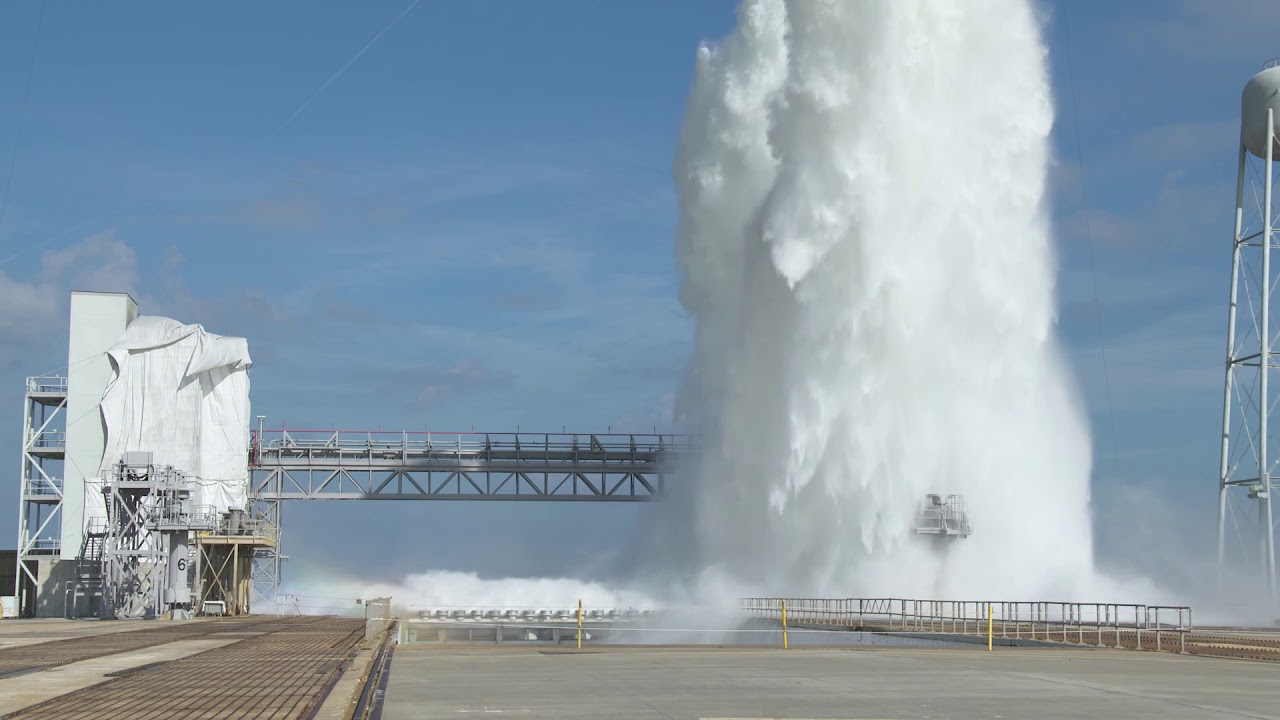
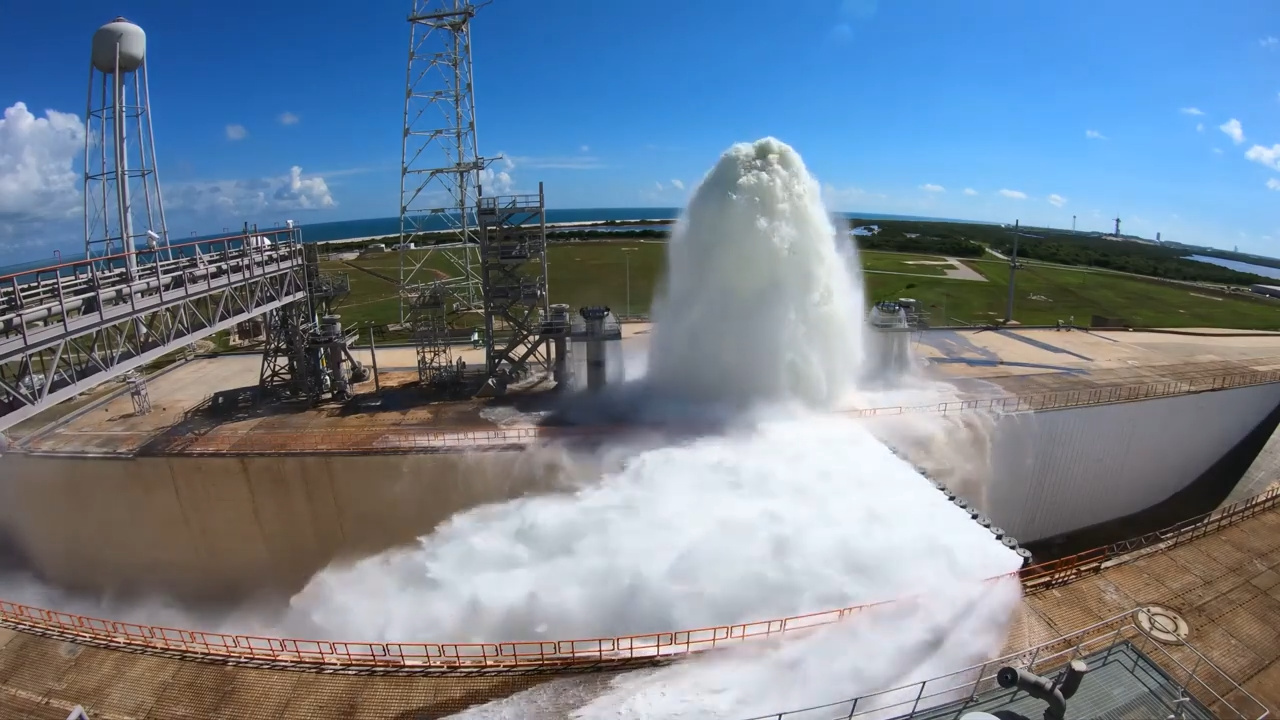
According to NASA, the flow tests conducted before the Artemis missions produced an unexpected visual effect that went viral. When the Mobile Launcher is not present on the pad, part of the water that would normally flow to the mobile tower finds no connection and ends up gushing upwards through the open outlets.
The result was a water column that reached 30 meters high in tests conducted in 2018. According to Nick Moss, deputy project manager of the pad, the phenomenon occurred precisely because the mobile launcher was not connected to receive the system’s flow.
This geyser does not represent a defect. On the contrary, it brutally shows the amount of hydraulic energy the system can generate.
With the rocket present and all connections in place, this same force is redirected to absorb sound, cool surfaces, and protect one of the most expensive vehicles ever built by humanity.
NASA’s Pad 39B Carries Almost 60 Years of History from Apollo 10 to Artemis
According to NASA, Pad 39B was not created for the Artemis program. Its history began in the Apollo era, and the first launch from it was Apollo 10 on May 18, 1969, a mission that served as a dress rehearsal for the Apollo 11 lunar landing.
Since then, the ramp has launched missions from Skylab, the joint Apollo-Soyuz mission, 53 space shuttle flights, and now the SLS. In almost six decades, the structure has gone through three major phases of American space exploration, always undergoing renovations to accommodate vehicles with completely different requirements.
For Artemis, the changes were profound. In addition to the refurbished flame trench and updated water system, NASA installed three 180-meter lightning protection towers, taller than the Vehicle Assembly Building itself, reinforcing the platform’s adaptation to the new lunar rocket.
Damage on the first space shuttle flight explains why NASA invests so much in acoustic suppression
According to NASA, the current sound suppression system of Pad 39B exists because the risk has already materialized in the past. On the first space shuttle flight, in April 1981, the STS-1 mission suffered structural damage caused by acoustic pressure waves generated during ignition and the first seconds of flight.
More than 16 tiles of the vehicle’s thermal protection system were damaged or lost. The investigation concluded that the acoustic energy reflected by the ramp structure and the ground had exceeded the designers’ predictions. It was this episode that accelerated the evolution of the agency’s IOP/SS systems.
The current system of Pad 39B is, therefore, the result of four decades of accumulated engineering. The water that disappears into vapor during ignition is not a scenic detail of the launch.
It is the barrier that prevents the very sonic violence of the launch from destroying, in seconds, what NASA took years and billions of dollars to build.