






 Portuguese
  Spanish


China Builds Giant Fish Farming Ships with Smart Sensors, Electric Propulsion, and Capacity to Supply Its Domestic Market
The demand for fish in China seems limitless. And instead of relying on imports, the Asian country is betting on increasingly innovative solutions to ensure the supply of its domestic market. The latest move: to build enormous offshore fish farming ships, so impressive that they are already being called true floating “aircraft carriers” for fish.
The world has been watching China’s fishing appetite for some time. According to data from the FAO, nearly one-third of the global fishing volume is related to the country. There are plenty of reports of Chinese fleets sweeping the waters of distant places like Peru. Now, in addition to traditional fishing, China is heavily investing in large-scale marine aquaculture.
Wan Qu Ling Ding: A Floating Aircraft Carrier for Fish
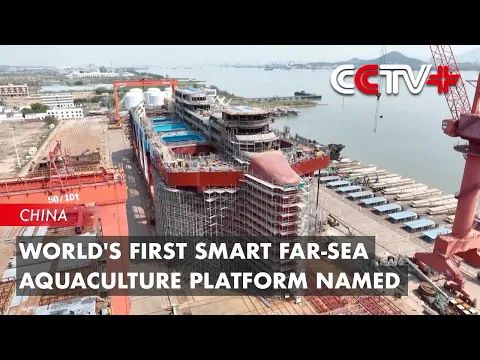
One of the main players in this strategy is the imposing Wan Qu Ling Ding, a ship that looks like it came out of a futuristic movie. According to information from CCTV, it was successfully launched on May 27.
-
Controversial 262-Meter Skyscraper in New York Blocks Empire State Building View, Offers 26 Luxury Apartments Priced Up to $18 Million

-
12-Year-Old Turns Childhood Drawings into a Sticker Brand, Earning $5,000 and Donating Part to Charity

-
Before “Ouviram do Ipiranga,” Brazil’s National Anthem Had a Sung Introduction Few Brazilians Know Today
-
Lufthansa CEO Jens Ritter Takes on Flight Attendant Role, Uncovers Overlooked Issue in Economy Class


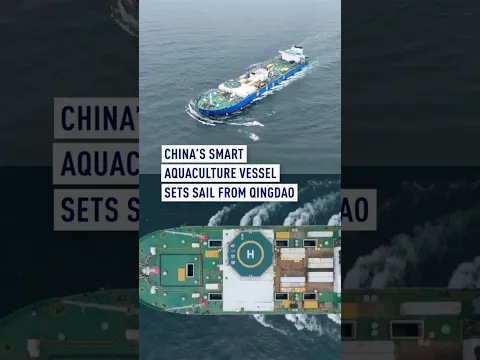
Built by Jiangmen Hangtong Shipbuilding Co., the ship will be delivered in August to Zhuhai Ocean Development Group Co. and will begin operating as a giant floating farm, with truly impressive dimensions: 155.8 meters long and 44 meters wide.
In addition to its size, what stands out are its 12 farming compartments, capable of holding up to 80,000 m³ of water. In other words: equivalent to about 32 Olympic swimming pools. The estimated production capacity ranges between 3,000 and 5,000 tons of fish per year — equivalent to what a land-based farm of approximately 3.33 million square meters would produce.

Smart Aquaculture
The Wan Qu Ling Ding has been designed to farm high-value species in the Chinese market, such as golden pomfret, yellowtail, and grouper. In addition to meeting domestic consumption, it is also expected to supply the tourism sector.
One of the technological differentials of the ship is its water exchange system with the marine environment, which improves water quality and, consequently, the quality of the fish farmed. Each compartment features state-of-the-art sensors and automatic feeding systems.
But it doesn’t stop there: if the sensors detect abrupt changes in water quality or signs of pollution, the semi-submerged compartments can be raised quickly. This reduces water resistance and allows the ship to move rapidly to safer areas.

Autonomy and Intelligent Navigation
Another highlight of the Wan Qu Ling Ding is its autonomy. The electric propulsion system offers what its creators call “autonomous maritime nomadism”. The ship has a range of up to 2,000 nautical miles and can navigate autonomously to avoid natural phenomena such as typhoons.
Moreover, it is equipped with a wind power generation system of 20 kW, capable of supplying all the electricity consumption of the aquaculture systems on board. A good example of how technology can be integrated into the fishing industry.
On the website of Salmar Ocean, it is possible to see a water filtration system similar to that used on the Wan Qu Ling Ding, present on the ship Guoxin-1.
Hai No. 1: The First Ship Dedicated to Salmon
While the Wan Qu Ling Ding prepares to begin operations, another impressive ship is already ready: the Hai No. 1, built by Huangpu Wenchong Shipyard in Guangzhou.
This is the world’s first ship dedicated exclusively to salmon farming. With a length of 250 meters, this giant of the seas can also move agilely to avoid contaminated areas.
After the initial tests conducted in April, the Hai No. 1 is expected to begin production in June. Its capacity is impressive: up to 8,000 tons of salmon per year. And thanks to the processing plant installed on board, it can deliver fresh salmon to some domestic markets in just 24 hours.
National Strategy for Food Independence
Why are these ships so strategic for China? The answer is simple: food self-sufficiency. According to the SCMP, in 2024 China imported around 100,000 tons of salmon. The expectation is that demand will exceed 200,000 tons by 2030.
Today, over 80% of the salmon consumed in the country relies on imports. Therefore, ships like the Wan Qu Ling Ding and the Hai No. 1 play an essential role in China’s strategy to reduce this dependency and stabilize the fish supply chain.
Not by coincidence, the Ministry of Agriculture and Rural Affairs of China published guidelines in 2023 to promote the development of marine aquaculture.
A Model That Can Transform the Global Fishing Industry
With these gigantic “aircraft carriers of fish,” China is not only seeking to feed its own market. It also aims to strengthen its food security in an increasingly unstable global scenario marked by tariffs and trade tensions.
As it has demonstrated in other sectors, the country is betting heavily on technology to reinforce its food sovereignty. And offshore aquaculture, with ships like the Wan Qu Ling Ding and the Hai No. 1, promises to be a key piece of this strategy.


Existe estudo de impacto ambiental desse empreendimento?
Isso só prova, que se o homem usar sua inteligência e a tecnologia para o bem, o mundo só tem a ganhar.
História da carochinha, a função desses navios é outra. No mínimo vão fazer pesca predatória e depois dizer que produziram no navio.