






 Portuguese
  Spanish
  4 min of reading
  1 comment


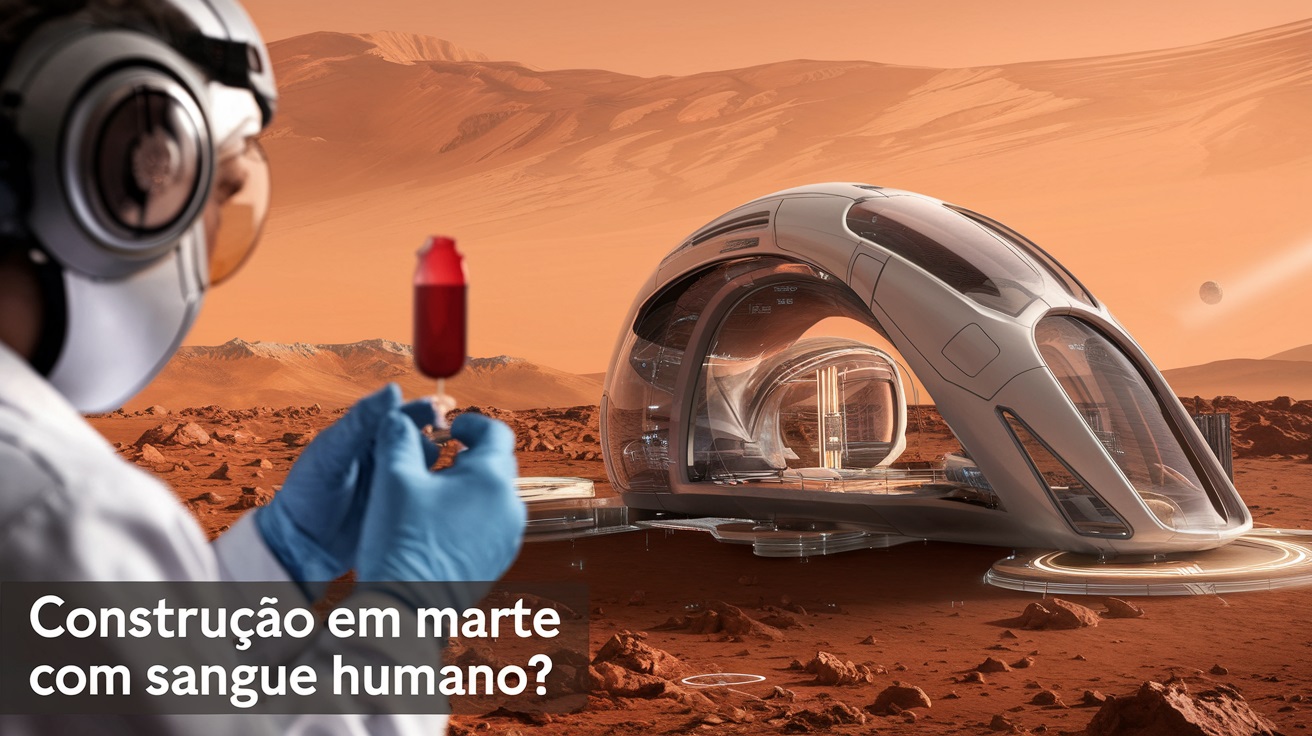


With Exorbitant Costs to Transport Materials from Earth, Researchers Explore Innovative and Sustainable Alternatives for Construction on Mars, Utilizing Local Resources and Surprisingly… the Human Body Itself!
Construction on Mars with human blood? The red planet has become more than just a theme for science fiction movies; it poses one of the greatest challenges in modern engineering and architecture. Researchers are exploring innovative ways to enable human colonization in such a hostile environment. What if the solution for construction on Mars lies within the human body itself?
Transporting materials from Earth to Mars comes with an astronomical cost—it’s estimated that sending a single brick could cost up to two million dollars. This challenging reality has led scientists to seek more accessible and sustainable alternatives, utilizing local resources and, surprisingly, human bodily fluids.
The Hidden Treasure of the Red Planet
The soil of Mars, known as regolith, is a fine mineral dust abundant on the planet. This material is considered promising for construction on Mars, but its natural structure is too brittle to be used alone.
-
Helicopter Drops 180 Tons of Sand and Gravel on Swedish River to Revive Ecosystem Damaged by Decades of Exploitation

-
Brazilian Company Launches Retro Smartphone with 48 MP Camera, T9 Keyboard, and Privacy Features for Social Media-Free Use

-
Self-Taught Chinese Farmer Builds 5-Ton Submarine from Scrap, Launches It in Anhui River
-
Invisible Induction Technology Enables Wireless Power for Blenders, Coffee Makers, and Air Fryers, Reducing Countertop Cables





This is where a creative solution proposed by researchers from Kharazmi University in Iran comes in: mixing regolith with a protein found in human blood, serum albumin. This combination results in a material called AstroCrete, whose strength is comparable to traditional concrete.
The idea is inspired by ancient Roman techniques, where masons would add animal blood to mortar to increase its durability. On Mars, modern technology would allow for the replication of this approach, utilizing albumin to create strong and durable structures.
Blood, Sweat, and Urine: The Ingredients of AstroCrete
The human body’s contribution doesn’t stop at blood. Studies indicate that adding urea—present in urine and sweat—to AstroCrete can increase its strength by up to 300%. These advancements make the material a viable option for construction on Mars, especially considering the difficulties of transporting resources.
However, not everything is that simple. The production of AstroCrete depends directly on the availability of bodily fluids. Each astronaut could donate enough plasma to produce only a small amount of concrete every 72 weeks. This means that building a single dwelling would require the combined effort of several Martian colonists.
3D Printing and Other Alternatives
To make the process more efficient, technologies like 3D printing could be used in the manufacturing of structures with AstroCrete. Additionally, the presence of calcium carbonate on Mars could serve as a supplement to create an even stronger mortar.
Other solutions are also being studied, such as the use of polymer- or sulfur-based concrete. Despite this, AstroCrete stands out for its direct reproduction from local and renewable resources, eliminating the need for massive transportation of materials from Earth.
The Challenges of Colonization and the Sacrifices of Pioneers
The use of bodily fluids for construction on Mars may seem like something out of a science fiction script, but it reflects the real challenges of colonizing another planet. The first Martian colonists will have to be incredibly self-sufficient, using all resources—including their own bodies—to ensure the survival and progress of the mission.
Although this approach requires sacrifices, it also symbolizes human adaptation to the extreme conditions of the red planet. Additionally, solutions like AstroCrete highlight the creativity and innovation necessary to tackle the challenges of building an extraterrestrial future.
Construction on Mars with Human Blood
As research advances, the idea of construction on Mars with human blood is more than just a scientific curiosity. It represents the pursuit of self-sufficiency in an environment where every resource counts. While the prospect of using the human body as part of the construction process is challenging, it also symbolizes humanity’s resilience in the face of space’s adversities.
The colonization of the red planet is still a distant dream, but innovative solutions like AstroCrete are bringing that dream closer to reality. As scientists continue to explore new possibilities, the idea of building a home on Mars becomes increasingly plausible. And who knows? One day, human blood may become the foundation of a new world.





Só podia ser idéia Árabe…