






 Portuguese
  Spanish
  5 min of reading
  0 comments


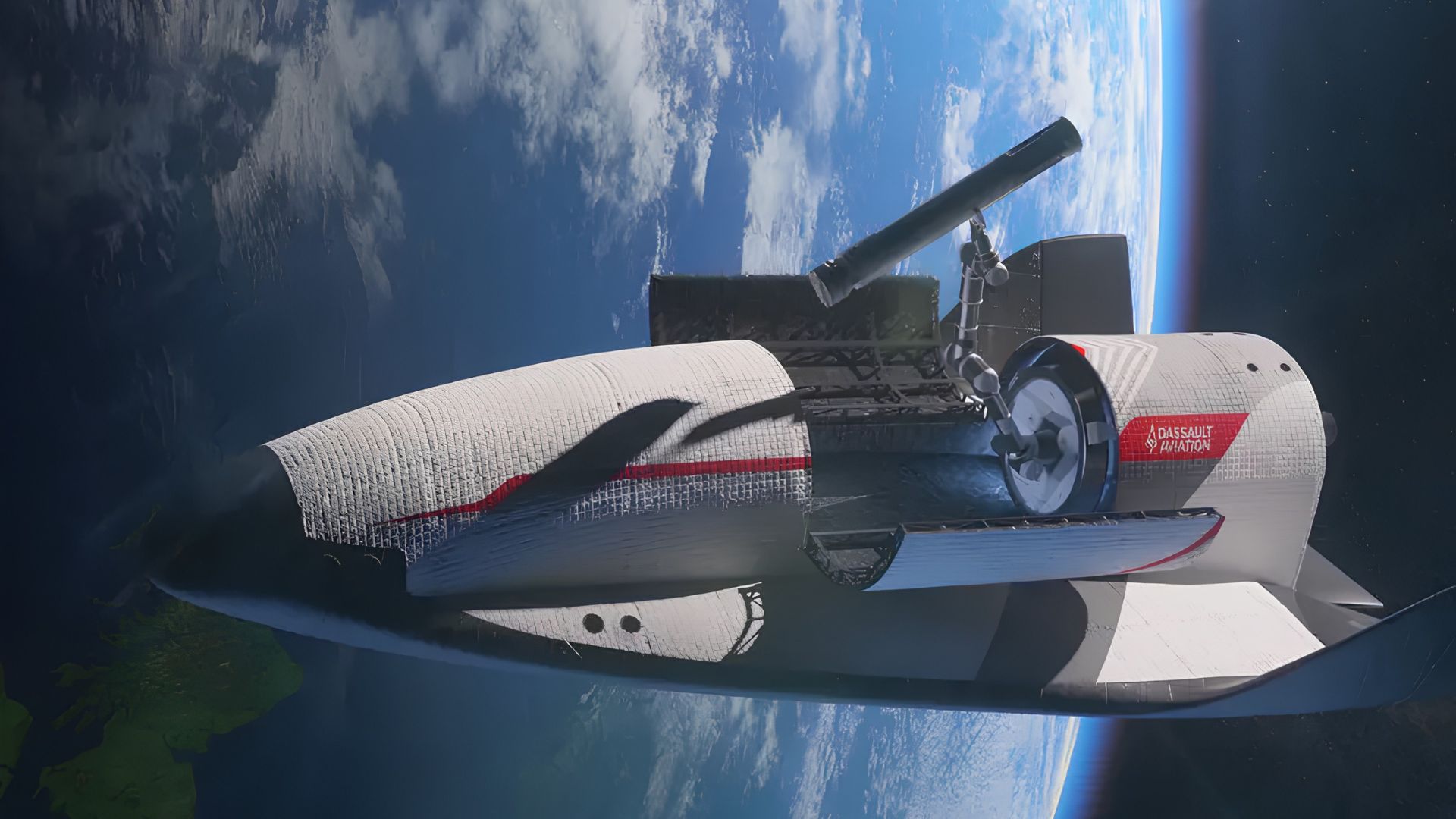
Dassault and OHB presented the VORTEX-S to ESA, a reusable spaceplane for orbital transport and autonomous missions in low orbit.
A partnership between France and Germany aims to change the orbital transport landscape using a machine that seems to be a cross between a military jet, an orbital spacecraft, and an experimental plane. The French Dassault Aviation, manufacturer of the Rafale fighter and Falcon jets, joined forces with the German OHB, one of Europe’s largest space companies, to propose to the European Space Agency (ESA) the development of the VORTEX-S, a reusable spaceplane capable of transporting cargo to space stations, performing autonomous orbital missions, and returning to Earth as a reusable aircraft.
The project was born to create a European alternative to reusable space systems dominated by the USA and China
The VORTEX-S is part of a larger initiative called VORTEX, an acronym for Véhicule Orbital Réutilisable de Transport et d’Exploration, or Reusable Orbital Vehicle for Transport and Exploration. The concept was initially presented by Dassault Aviation during the Paris Air Show of 2025.
According to the companies, the goal is to create their own reusable space mobility capability for Europe, reducing dependence on foreign solutions in future orbital operations.
-
German Collector Discovers New Mineral in Ancient Mine, Named After Him

-
Elon Musk Plans $25 Billion Chip Factory with SpaceX and xAI at Tesla’s Massive Texas Site, Visible from Space

-
Brazilian Innovator Marcelo Loureiro Sets Guinness World Record with 12,000 km Robotic Surgery from Brazil to Kuwait
-
Workers Discover 19th-Century Iron Ship and Indigenous Artifacts During COP30 Construction in the Brazilian Amazon


The project arises at a time when the United States, China, and even private companies are increasing investments in reusable vehicles for orbital missions, cargo transport, and long-duration operations in space.
The same company that produces the Rafale will be responsible for designing the spaceplane
Dassault Aviation will take on the role of principal architect and global integrator of the VORTEX-S. The company has over a century of experience in complex aircraft and is globally recognized for the development of the Rafale fighter, considered one of Europe’s most advanced military platforms, as well as the Falcon executive jet family.


According to Dassault itself, the company has also accumulated experience in space studies related to historical European programs, including participation in the Hermes project, an old European spaceplane concept, as well as the ESA’s atmospheric reentry demonstrator IXV.
The German OHB will be responsible for the service module that keeps the spacecraft alive in orbit
While Dassault develops the spaceplane, OHB will be responsible for the system’s service module.
This module functions as a kind of orbital section responsible for energy, propulsion, operational support, and various systems necessary for orbital missions.
Marco Fuchs, CEO of OHB, stated that the initiative was born from the need to create autonomous European space transport capabilities and highlighted that the combination of an aircraft manufacturer and a company specialized in orbital systems creates a complementary architecture for the project.
The VORTEX-S was conceived to transport cargo to space stations and operate alone around the Earth
According to the proposal presented to ESA, the VORTEX-S will not just be a transport vehicle. The spaceplane was designed to perform round-trip missions to space stations, as well as act as an autonomous orbital platform in missions known as free flyer, when the vehicle operates independently without remaining docked to a station.
This type of operation can allow for the transport of equipment, conducting scientific experiments, technological tests, and future applications related to observation, orbital logistics, and space research.
The VORTEX family foresees increasingly larger versions until reaching an operational cargo vehicle
The VORTEX-S represents just one stage within a broader program. According to information published by Aviation Week, Dassault is already working on a sequence of vehicles starting with the VORTEX-D demonstrator, expected to fly around 2028.

Dassault Reusable Orbital Transport – Reproduction
After it would come the VORTEX-S itself, described as an intelligent platform for autonomous orbital flight.
The next evolution would be the VORTEX-C, an operational cargo version with a total estimated mass between 8 and 9 tons and the capacity to carry approximately 2 tons of payload. The company is also studying a future manned version called VORTEX-H.
The project attempts to resurrect a European dream that spans generations of space engineering
The idea of a reusable spaceplane has accompanied the European aerospace industry for decades. Projects like Hermes, Space Rider, and various studies conducted by the ESA have sought ways to create vehicles capable of operating beyond the atmosphere and returning to Earth without relying exclusively on disposable capsules.

The VORTEX emerges within this tradition, but with an important difference: the attempt to create a reusable platform aimed not only at technological experimentation but for regular orbital transport operations.
The proposal appears at a time when space autonomy has returned to being treated as a strategic issue.
With the growth of the Chinese presence in space, the expansion of American reusable systems, and the advancement of new private projects, several European countries have begun to advocate for investments in vehicles capable of ensuring independent access to orbit.
The companies involved themselves state that the VORTEX-S was conceived precisely to strengthen Europe’s capacity for reusable space mobility and to enhance the continent’s technological independence.
The continent that built the Rafale now attempts to build a craft capable of crossing the space frontier and returning
For now, the VORTEX-S remains a proposal presented to the ESA and still depends on future approvals, investments, and development stages.
Even so, the project is already attracting attention because it brings together two of Europe’s largest aerospace companies around an ambition that spans generations: to create a machine capable of uniting the characteristics of an airplane, orbital craft, and reusable vehicle in a single system.
If it advances beyond the conceptual phases, the VORTEX could represent a European attempt to enter an extremely exclusive group in space engineering: those vehicles that not only reach space but return from it ready to fly again.


-

-

-

8 people reacted to this.