






 Portuguese
  Spanish


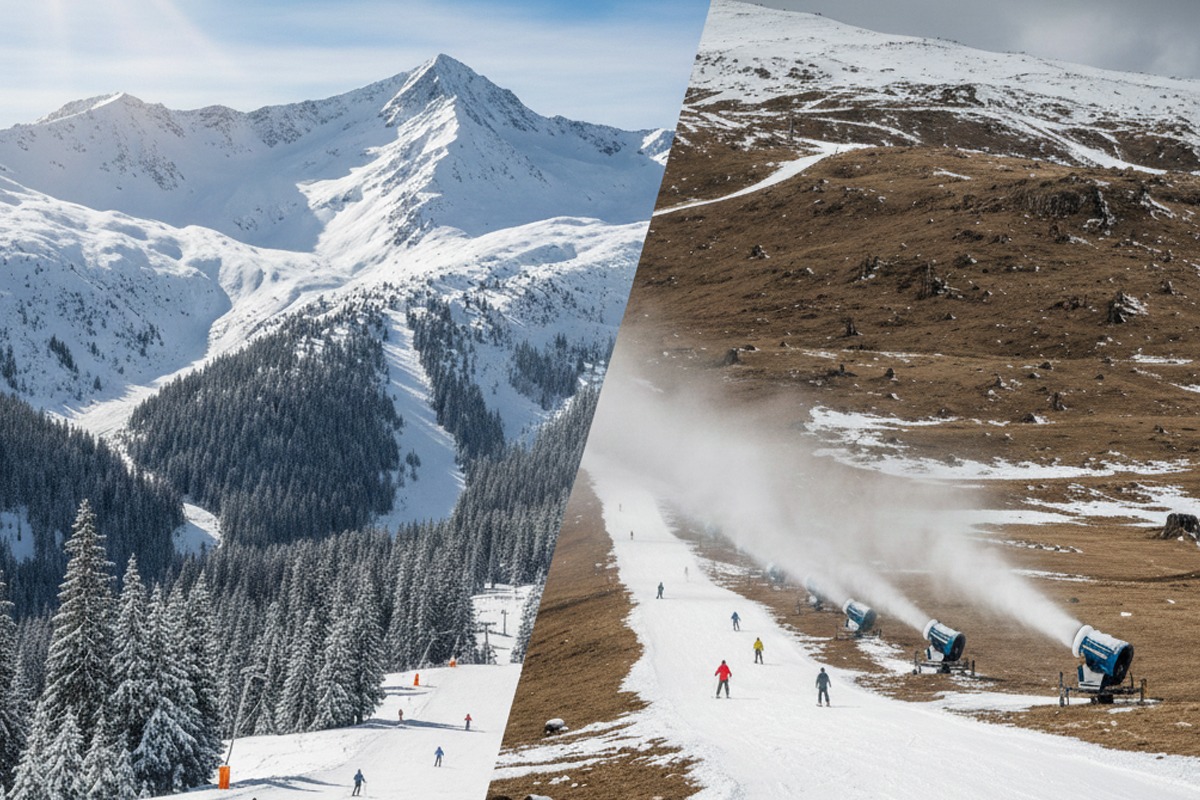

Brazil Has No Tradition Due to Lack of Snow, But What If It Disappears from Europe and the US? Understand How Climate Change Is Transforming Winter Sports in 2026.
In Brazil, the absence of snow has always been the natural barrier to the development of winter athletes. However, in 2026, the scenario has dramatically reversed: the problem is no longer the lack of tradition in tropical countries, but the real possibility that snow will disappear from its historical strongholds. With rising global temperatures, iconic winter sports venues in Europe and North America are facing an uncertain future where the “white” of the mountains is giving way to the brown of the earth.
What Happens When Snow Countries Go Without Winter?
Recent studies indicate that if carbon emissions are not drastically reduced, only one of the 21 cities that have hosted the Winter Olympic Games would have climatic conditions to repeat the event by the end of this century. Countries like Switzerland, Austria, and France, where skiing is part of national identity, are already seeing the accelerated retreat of glaciers and a shortening of winter seasons.
In 2026, the question “what if it stops snowing?” has ceased to be hypothetical. Low-altitude ski resorts around the world are already closing their doors or operating at a loss, turning the sport into a luxury dependent on expensive technology.
-
Workers renovating a playground in northern England uncover 176 World War II bombs buried underground; training artifacts still contained explosives.

-
Brazilian Architect Transforms Waste into Sustainable Homes with Solar Power and Rainwater Systems for 40 Years

-
Security Guard Becomes Doctor at Louisiana Hospital Where He Once Worked, Studied Chemistry Between Shifts

-
Woman Rescued from Luxury Complex in Brazil Worked Without Pay for 55 Years, May Be Entitled to Over $300,000




The Era of Artificial Snow and Plastic Slopes
To save the spectacle, the solution has been artificial snow. Currently, major competitions rely almost 100% on snow cannons. However, this “laboratory snow” brings two significant dilemmas:
- Resource Consumption: Production requires millions of liters of water and a massive amount of electricity, which ironically accelerates the carbon footprint.
- Athlete Safety: Artificial snow is denser and hardens faster than natural snow, making the slopes faster and more dangerous, increasing the risk of serious injuries.
Moreover, countries without natural snow are already investing in indoor training centers (with controlled temperature) and synthetic polymer slopes that mimic the glide of skiing, allowing athletes to train year-round, regardless of external weather conditions.
A Future of “Winter Games” Without Winter?
The climate crisis is forcing the International Olympic Committee (IOC) to rethink the model of rotating venues. There is the possibility of creating a system of “Fixed Venues” that still have natural cold or even including sports that do not strictly depend on natural ice, such as rollerskiing.
While Brazilian athletes like Lucas Pinheiro struggle to carve out space on the ice, the world watches a race against time so that this same ice does not become just a memory in archival videos. The winter sport of the future may be defined not by who skis better on snow, but by who can manufacture the best conditions for it to still exist.
This article was based on reports and analyses from Bloomberg on the impacts of climate change on winter sports and the Winter Olympics.


