






 Portuguese
  Spanish


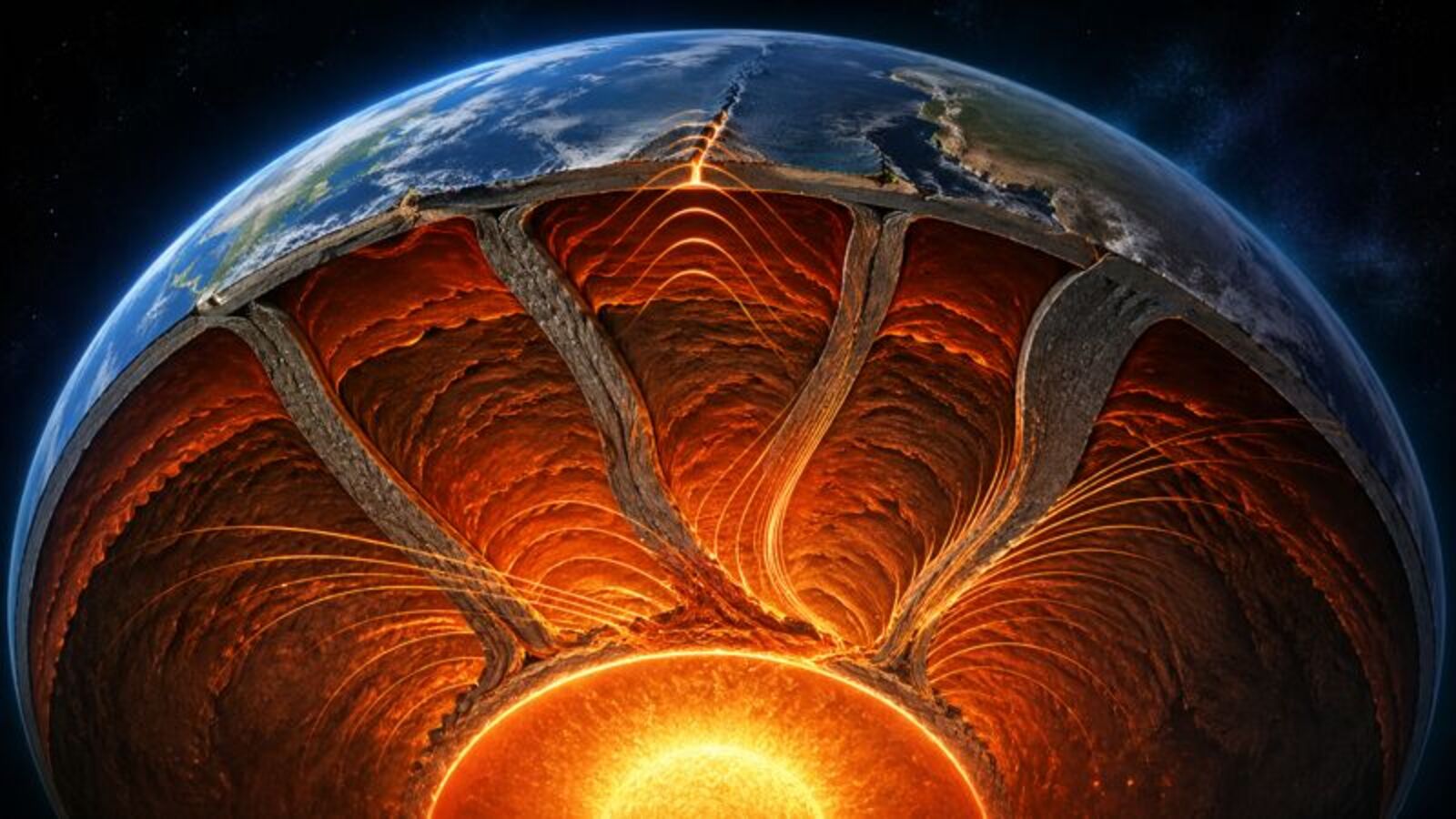


Unprecedented research analyzed over 16 million seismograms and showed how ancient buried tectonic plates deform Earth’s lower mantle at a depth of 2,900 kilometers, impacting the understanding of Earth’s internal dynamics
A global study has identified for the first time how Earth’s lower mantle is deformed by ancient buried tectonic plates, about 2,900 kilometers from the surface, revealing deep traces of the planet’s internal dynamics.
Lower mantle gets unprecedented map
The research was led by Jonathan Wolf, from the University of California, Berkeley, with collaborators.
The team gathered over 16 million seismograms obtained from 24 data centers worldwide.
-
China Unveils Most Human-Like Humanoid Robot for Public Sale, Featuring Silicone Skin and 88 Joints, Priced from $17,600

-
Brazil Deploys Water-Landing Ambulance Planes in the Amazon, Cutting Travel Time from 3 Hours to 12 Minutes to Reach Isolated Communities

-
LG Unveils 635-Liter InstaView Fridge with Touch-Activated Door, Craft Ice, UVnano Purification, and Smart Features
-
Astronauts Returning from Space Show Reduced Immune Cells and Thymus Suppression, Highlighting Potential Risks for Long Mars Missions


This dataset is the largest ever assembled for this type of investigation. With it, researchers were able to map about 75% of the lower mantle, a layer located just above the boundary between the Earth’s mantle and core.
The scale of the analysis allowed for the observation of a broad, unprecedented global reach of this layer, bringing together seismic signals from different regions of the planet in a single global mapping effort.
The work identified, for the first time on a global scale, how this deep region is being altered.
The deformation appears linked to pieces of ancient tectonic plates, buried millions of years ago in the Earth’s depths.
Seismic waves show deformation
Earthquakes were key to revealing this process. When they occur, they generate seismic waves that travel through the planet’s interior and change behavior according to the direction of travel and the material traversed.
When the speed of these waves varies according to direction, scientists identify seismic anisotropy.
This signal indicates that the material has been deformed and acquired an oriented structure, similar to fibers aligned in a certain direction.
Seismic anisotropy allows us to infer how the mantle flows and transforms over millions of years.
Even without direct access to this depth, earthquake records help reconstruct Earth’s internal movement.
The results showed seismic anisotropy in approximately two-thirds of the analyzed regions. Most of these deformations appear precisely where geophysical simulations had already indicated the presence of ancient subducted tectonic plates.
Ancient plates continue to influence the planet
Subduction occurs when one tectonic plate dives beneath another and is pushed into the planet’s interior.
Over tens of millions of years, these structures can reach the boundary between the mantle and the core.
The study indicates that these plates, even at extreme depths, continue to interfere with Earth’s internal dynamics.
They have disappeared from the surface, but still leave detectable marks in the lower mantle through seismic waves.
“It’s not exactly a surprise, because this is predicted by geodynamic simulations,” Wolf said. “But, at the scale we are working, it had never been demonstrated with the methods we are using.”
Scientists are still investigating why these plates exhibit seismic anisotropy. One possibility is that they retain a kind of structural memory from the period when they were closer to the Earth’s surface.
Another explanation, considered more likely by the team, involves intense deformation at the moment the plates sink and interact with the core-mantle boundary. Extreme heat and pressure can alter minerals and reorganize their internal structure.
Difference between mantle layers
The upper mantle, closer to the surface, is already relatively well understood. Its deformation is dominated by the drag of moving tectonic plates, a dynamic confirmed with good precision by seismic data.
This understanding, however, does not apply to the lower mantle. In this region, processes are more complex, occur at extreme depths, and remain difficult to observe on a broad scale.
“We don’t have any large-scale understanding of flow in the lower mantle. And that’s exactly what we want to find out,” Wolf stated.
Database could open new fronts
The database gathered in the study was described by Wolf as a “treasure.” It will continue to be explored in new research, with the potential to broaden the understanding of the planet’s internal reorganization.
The absence of an anisotropic signal in some areas does not necessarily mean a lack of deformation. It may only indicate that the signal is too weak to be detected by current methods.
The long-term perspective is to gather enough information to map the global flow directions in the lower mantle.
This advance would help detail how Earth reorganizes internally over geological time.
With information from Época Negócios.


