






 Portuguese
  Spanish
  7 min of reading
  0 comments


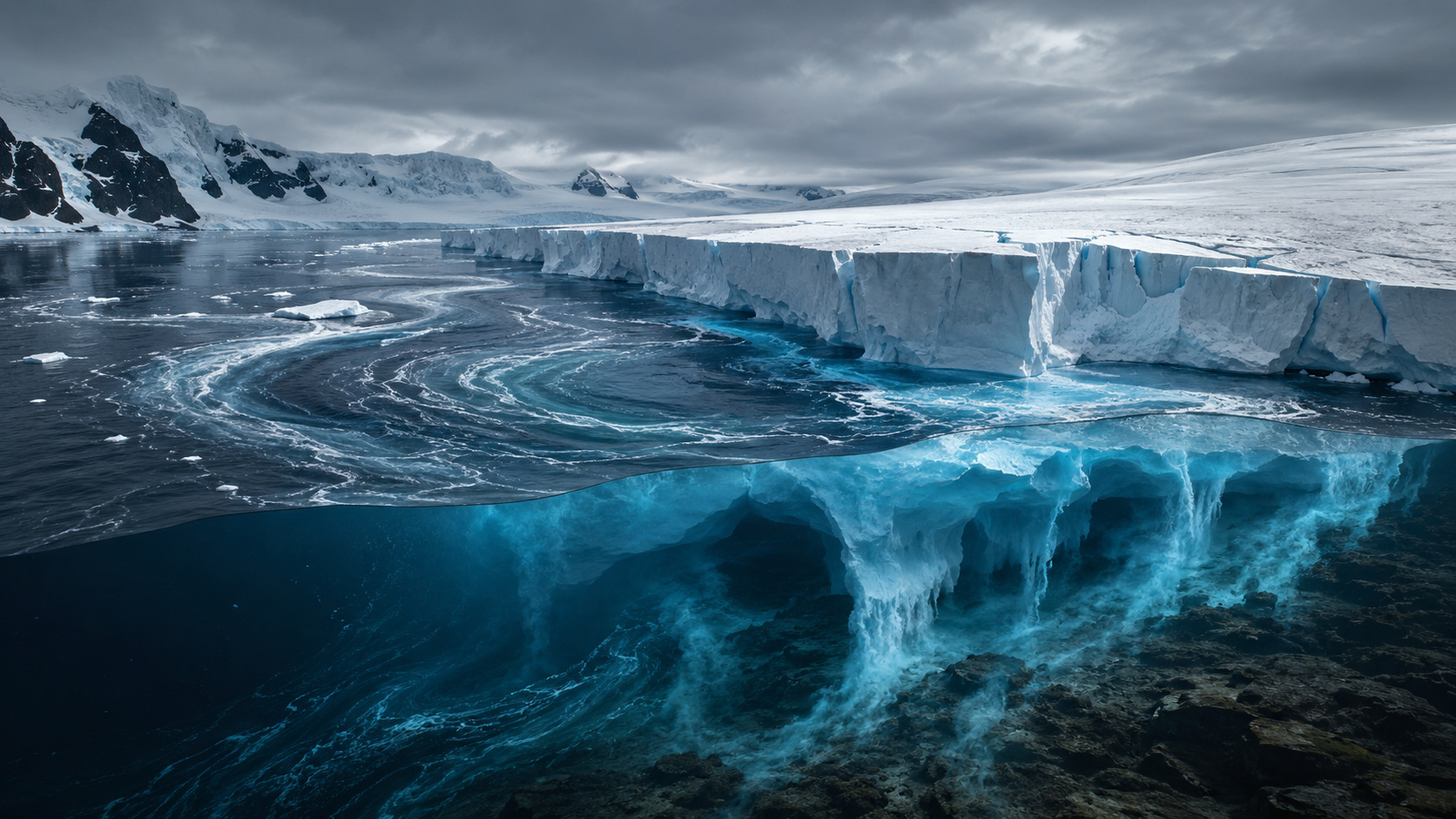
Study shows that meltwater can alter ocean circulation and accelerate basal melting in Antarctica.
A study published on May 15, 2026, in Nature Geoscience revealed a mechanism that could make projections about Antarctica more concerning: the water released by the melting of ice shelves not only raises sea levels but also alters ocean circulation around the continent. According to the research led by Madeleine K. Youngs, this positive feedback could account for two-thirds of the increase in basal melt rate in all simulated ice shelves. The discovery changes the weight of the problem because it shows that melting should not be treated as a fixed variable in climate models. The more ice melts, the more the ocean can reorganize its temperature and salinity layers, allowing warmer waters to reach the base of the shelves and cause even more melting.
Basal melting of Antarctica could be accelerated by a chain reaction hidden beneath the ice shelves
The study analyzed the interaction between ice shelves and ocean circulation using a circumpolar model of the Antarctic ocean with interactive ice shelves. This approach allowed observing not only the direct effect of climate warming but also how the meltwater itself changes the circulation that controls the heat beneath the ice.
The central conclusion is that the ocean does not react passively to melting. When freshwater from ice enters the system, it changes the density of water masses, interferes with the formation of cold layers, and alters the ability of warmer deep waters to enter the cavities beneath the shelves.
-
While scientists test giant balls on the seabed, a startup wants to sink concrete and steel tanks held by cages filled with stones up to 700 meters deep to transform compressed air into an invisible underwater battery.

-
Former NASA engineer transforms drones into “seed helicopters” capable of firing 300 balls per minute, targeting degraded areas with half-meter precision, and planting up to 40 million trees per year in a new race for aerial reforestation.

-
Brazil deploys drones to scatter seeds on nearly inaccessible slopes and attempts to transform degraded hills into forests with aerial planting up to 100 times faster, in a green offensive launched in Rio de Janeiro.
-
Second half of June brings more intense cold, polar air mass, and above-average rainfall in Brazil



Freshwater from ice weakens cold barriers and opens the way for warm water to reach the base of the shelves
The physics of the process depends on temperature, salinity, and density. In some regions of Antarctica, cold and dense waters form a barrier near the bottom, hindering the entry of warmer deep waters into the cavities beneath the ice shelves.


When more ice melts, the fresh water released can dilute this cold and salty layer. With the barrier weakened, relatively warmer ocean waters can advance underneath the platforms, intensifying basal melting.
The study describes this cycle as a positive feedback. More melting produces more fresh water, the fresh water weakens the ocean’s density structure, and this weakening facilitates the entry of heat under the ice.
Two-thirds of the simulated increase in melting came from the ice-ocean feedback itself
The strongest number from the research is in the technical summary of Nature Geoscience. The authors state that the positive feedback from melting accounts for two-thirds of the increase in the melting rate over all ice platforms in the analyzed simulations.
This data is important because it shows that a significant part of the risk does not come only from the external warming imposed on the climate system. It also comes from the ocean’s internal response to the increasing volume of meltwater entering around Antarctica.
In practical terms, this means that models treating platform melting as a fixed input may fail to capture a relevant portion of future acceleration. The real system may behave like a dynamic machine, where ice and ocean continuously influence each other.
Ice platforms function as natural brakes holding back continental glaciers
Ice platforms are floating extensions of glaciers that advance from the continent over the ocean. They do not directly raise sea levels when they melt because they are already floating, but they play a decisive role in holding back the continental ice behind them.

This effect is known as buttressing. When a platform thins, fractures, or loses mass, it reduces its ability to brake the flow of grounded glaciers, allowing more continental ice to advance into the ocean.
This is why basal melting is so concerning. Loss from below can weaken structures that visually still appear intact in satellite images but are already losing thickness and mechanical strength.
Melting from below was already recognized as a central force in Antarctica’s mass loss
The new study does not come out of nowhere. NASA had already highlighted, based on research published in the journal Science, that basal melting accounted for 55% of all mass loss of Antarctic ice shelves between 2003 and 2008.
This previous data consolidated the idea that the ocean is one of the major drivers of Antarctic instability. The difference now is that the 2026 research focuses on the feedback effect, showing how meltwater can reorganize circulation and alter future melting.
Instead of just asking “how much does the warm ocean melt the ice,” the researchers asked something more complex: how does the melted ice change the ocean that will melt the next ice. This change in question is the scientific core of the agenda.
The effect is not the same across Antarctica and may even protect some regions in the short term
One of the most important points of the study is that the feedback does not have the same signal in all sectors of the continent. In regions with dense shelf waters, the effect can amplify melting, but in other areas, the transported freshwater can form cold layers that temporarily hinder heat entry.

The University of Maryland highlighted that regions like the Weddell Sea may experience dangerous amplification of the positive cycle. Meanwhile, areas like the Western Antarctic Peninsula and the Amundsen Sea may receive, in the short term, some protective effect from cold freshwater barriers transported from upstream sectors.
This protection, however, is not simply good news. According to Youngs, it depends on intense melting in other regions first, which means that the local “shield” may be linked to severe ice losses in neighboring sectors.
The study shows that melting can act as a regional force opposing or comparable to external warming
Nature Geoscience states that the feedback from melting has comparable importance, and in some regions an opposite signal, to the response directly forced by the climate. This means that the ocean around Antarctica can respond in very different regional ways to the same global warming.
This complexity helps explain why projections about Antarctica have such large uncertainties. It is not enough to know the average global temperature, because the fate of the platforms also depends on salinity, coastal currents, freshwater transport, and the entry of deep waters into specific cavities.
For climate models, this is a huge challenge. Representing Antarctica requires simulating fine interactions between ice, ocean, and atmosphere, in remote regions where direct observations are still difficult.
Climate models may be leaving out an important part of the risk
According to Madeleine Youngs, many climate models used in international projections do not include this feedback cycle interactively. The researcher stated that the IPCC treats melting as a fixed input, rather than a process that responds and reshapes the ocean over time.
This point is crucial for the common reader. If the model places an amount of melting as input data but does not allow this melting to alter ocean circulation and generate new melting, part of the real dynamics may be underestimated.
The concern is not that the models are “wrong” in a simple way, but that they may be incomplete precisely in a mechanism capable of accelerating ice loss in key regions.
The climate tipping point may arrive sooner if feedback is underestimated
Youngs stated that if humanity continues on an emissions trajectory without significant changes, there is a possibility of reaching a climate tipping point sooner, especially when this positive feedback is considered. The statement appears in the University of Maryland’s release about the study.
This type of warning needs to be understood precisely. The study does not claim that all of Antarctica will collapse immediately, nor does it set an exact date for ice shelf rupture. What it shows is that the interaction between melting and circulation can reduce the safety margin used in current projections.

In other words, the risk lies in the silent acceleration. The system can change pace before the effects are fully visible on the surface, because a decisive part of the process occurs hidden beneath kilometers of floating ice.
The global impact appears in sea level and the vulnerability of coastal cities
The connection between ice shelves and sea level is indirect but powerful. When shelves weaken, grounded glaciers can accelerate their flow to the ocean, and this continental ice contributes to the global rise in sea level.
The University of Maryland notes that more than 680 million people live in low-lying coastal zones vulnerable to sea level rise. The institution also cites IPCC estimates that Antarctica could contribute an additional 28 to 34 centimeters of sea level rise by 2100 in high emission scenarios.
Global projections from IPCC AR6 indicate that the average sea level could rise between 0.63 meter and 1.01 meter by 2100 in the very high emissions scenario, compared to 1995-2014. This range includes various contributions, such as ocean thermal expansion, glaciers, Greenland, Antarctica, and land water storage.
The discovery shows that the danger may lie in the invisible mechanism between ice, salt, and heat
The new study places Antarctica in a more complex and urgent perspective. The problem is not just ice melting due to a warmer ocean, but ice melting and simultaneously modifying the ocean that controls the next melting.
This invisible mechanism between freshwater, salinity, density, and heat could be decisive for the future of Antarctic shelves. If underestimated, part of the global coastal risk may also be underestimated in the scenarios used by governments and cities.
The question remains whether climate models will be able to keep up with the speed of this chain reaction before the Antarctic Ocean itself begins to push the system to a point difficult to reverse.







-

1 person reacted to this.