






 Portuguese
  Spanish


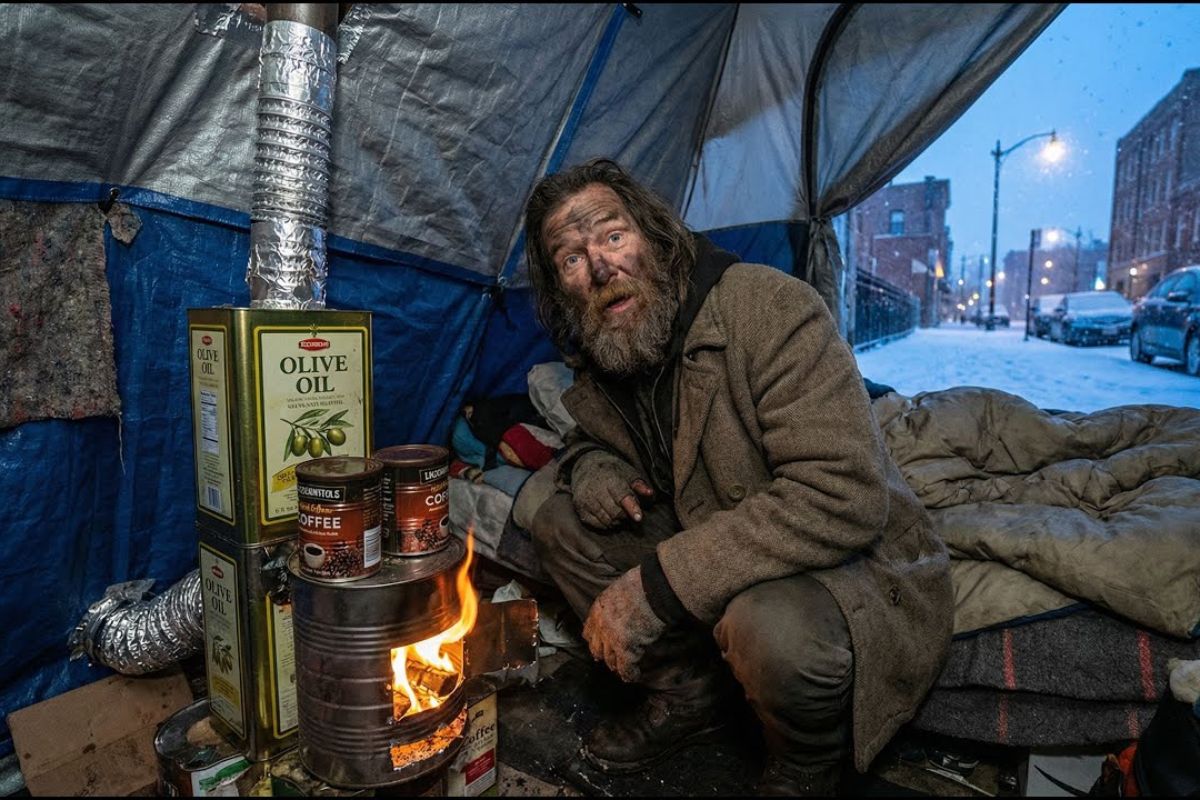


On Sidewalks, Overpasses and Improvised Camps, Homeless People Face Severe Wind Chill Without Electricity or Gas. Heating Comes from Controlling Heat Loss: Cardboard as Thermal Insulation, Mylar Reflecting Radiation and Barriers Against Moisture and Wind. It Works, But Imposes Dangers and Limits on Nights Below Zero Today
What stands out on freezing nights is not just the cold, but the improvised engineering. Homeless people learn that the body produces heat all the time, but loses that heat even faster when wind, moisture and contact with the ground come into play. The difference between sleeping and shivering until dawn is, almost always, in managing heat loss.
In many cases, energy-free shelter is born from discarded materials, knowledge accumulated by necessity, and tough decisions about safety. Homeless people combine thermal insulation, radiation reflection, and condensation control to get through nights below zero, knowing that some solutions increase comfort, but also increase risk.
The Physics of Cold in Urban Survival

Common intuition says that “heat comes from fire,” but urban practice shows another hierarchy: conduction to the ground, convection by the wind, and evaporation associated with moisture drain energy faster than most people imagine.
-
Bruno Guimarães, 28, Misses Crucial Penalty Against Norway in World Cup After Replacing Vinicius Jr.

-
Inspired by a school lesson on Africa’s water crisis, a young boy raised money through chores to fund a well that transformed a Ugandan community.

-
Brazilian Construction Worker Moves to France, Earns Up to €2,500 Monthly with Home Renovations, Gains Social Media Attention

-
US Navy Sinks USS Oriskany with 230 kg of C-4, Creating World’s Largest Artificial Reef in 37 Minutes




Homeless people prioritize blocking the ground and the wind because the wind chill can drop when air moves, even if the thermometer seems less hostile.
The most underestimated factor is moisture.
When bedding, cardboard or shoes get wet, thermal insulation collapses and the body starts to expend energy to heat water, not air.
On nights below zero, this detail alters choices such as seeking a drier place, elevating the improvised bed off the ground, and maintaining minimal ventilation to reduce condensation without exposing the shelter to the wind.
Cardboard as Thermal Insulation and the War Against Moisture

Among common materials, cardboard stands out as an efficient resource because corrugated cardboard traps air.
Trapped air acts as a thermal barrier, similar to the principle of a down jacket, but with zero cost and wide availability in urban centers.
In recurring descriptions, three layers of cardboard under a sleeping bag can raise the perceived temperature by 10 to 15°, a significant difference for homeless people on nights below zero.
The performance depends on the type and condition of the material. Thick cardboard, like appliance boxes, tends to retain more air and last longer, while thin cardboard gives way easily.
The enemy is moisture: wet cardboard loses thermal insulation capacity almost immediately and can promote mold in a few days.
That’s why homeless people report using simple layers that separate cardboard from the damp ground, trying to delay moisture and preserve thermal insulation for more nights.
Mylar, Radiation and the Problem of Condensation

If cardboard retains, mylar reflects. Mylar blankets, lightweight silver emergency blankets, are said to reflect up to 90% of body heat back to the user.
When homeless people use mylar as internal lining, the shelter functions as a radiation chamber, where the body heats the air and the material returns part of the heat by reflection.
The problem is that mylar also blocks the exit of vapor. Within a few hours, moisture released by breathing and skin can condense on the cold surface and wet clothes and blankets.
Being wet in the cold is worse than dry cold, because it destroys thermal insulation and accelerates heat loss.
That’s why descriptions insist on a delicate balance between heat retention and minimal air exchange, as ventilating too much drops the temperature and too little raises condensation.
Active Heat: When Efficiency Increases, Danger Does Too
When heat retention isn’t enough, active heat sources come into play, and the boundary between efficiency and danger becomes narrow. Hand warmers, based on iron oxidation, are described as capable of reaching around 158°F and maintaining heat for 8 to 10 hours.
The logic is one of optimization: instead of “quantity”, homeless people prioritize positioning in areas of high blood flow, because warming the blood heats the body faster than just warming the extremities.
Other approaches mention small flames and radiant heating in confined spaces, with estimates of a temperature increase of 10 to 20° in small shelters.
Here, the central point is risk: cardboard, plastic, and insufficient ventilation create a sensitive combination, and any mistake turns a shelter into a fire hazard or exposure to smoke in a closed space.
Describing these methods does not mean recommending replication, because on nights below zero the cost of an accident tends to be disproportionate.
Heated Stones and Organic Decomposition as Thermal Mass
There are strategies without continuous flame that rely on thermal storage. Dense heated stones are described as capable of retaining heat for 6 to 8 hours, functioning as passive thermal mass.
The technical point is the choice of material: stones with internal moisture can fracture when heated, raising physical risks in already tight environments.
For this reason, descriptions emphasize caution and avoid turning this resource into a “standard solution,” as the thermal benefit comes with risk.
The most extreme alternative mentioned is organic decomposition as a thermal source. Active compost piles can reach 120 to 160°F at the core and sustain heat for weeks when there is fresh material and constant microbial activity.
Technically, it is applied biology, but with hidden costs: smell, insects, high moisture, and health risks.
On nights below zero, homeless people who approach this type of heat seek the thermal side of a natural process, but have to deal with exposure to vectors and worsened thermal insulation when moisture dominates the environment.
Subsoil and Human Heat: Stability, Community and Risks
Another urban response is to move underground. Below the frost line, the ground tends to stay around 55°F year-round, reducing thermal extremes and, in theory, decreasing the body’s energy expenditure.
There are descriptions of communities in tunnels and drains, with examples cited in Las Vegas, New York, and Moscow.
For homeless people, the physical benefit is immediate: less wind, less variation, and less loss by convection, especially when cardboard and mylar shelters cannot withstand open weather.
However, the subsoil trades cold for another set of risks. Drainage tunnels can flood on short notice, and there are mentions of documented deaths by drowning in places that were dry shortly before.
Ventilation also becomes a technical issue: without circulation, humidity rises and condensation attacks thermal insulation again.
Still, the logic remains: when the surface is hostile, homeless people look for stability where it exists, even if the price is water unpredictability and insecurity.
In parallel, there is a more constant method: human heat.
The body emits about 100 watts continuously, and when three or four people share a small space, the combined thermal load can raise internal temperature by 15 to 25°C, without fuel and without flame.
In descriptions associated with disaster survival and expeditions in Antarctica, sleeping in groups is linked to a reduction in hypothermia deaths by about 40% compared to sleeping alone.
For homeless people, this also becomes a social strategy: sharing heat means simultaneously sharing vigilance, reducing isolation, and increasing the chance of getting through the night.
On nights below zero, homeless people do not “create heat” from nothing: they control losses, combine cardboard, mylar, moisture, and thermal insulation, and calculate risks in real-time.
The result is a silent engineering that mixes physics, biology, and improvisation, making it clear that the axis of survival is not the heater, it’s heat loss and the safety of the shelter.
In your city, what should come first when the cold tightens: expansion of heated shelters, 24-hour outreach teams, or temporary structures to cut wind and moisture? And, looking at homeless people, which factor do you believe most decides the night: thermal insulation on the ground, moisture control, or the chance to sleep in a group with protection?





Vergonha dos *humanos*. Egoísmo, disputa, preferem investir nas guerras, armas, posses doque acolher os necessitados que vivem no relento. Lamentável
Moisés;homem de Deus Jeová,disse certa feita uma grande verdade, que a pobreza ou seja os pobres,sempre existirão para que os nossos corações em Jesus Cristo,façamos a caridade e misericórdia a eles no seu sofrimento!Imaginemos que todos nós no mundo, fossemos ricos!como haveriamos de ter a solidariedade humana, ensinada e pregado por Jesus Cristo!?A piedade e a compaixão são dois principios fundamentais do bom cristão para ganharmos a salvação eterna!
Só li besteiras! Que Moisés tu tá falando? Opinião de cristão **** mesmo…
E a tua opinião é o quê?
A soberania da verdade?
Tu opiniãozinha e mais m**** do quê a dele! Kkk
Acorda sabichão.