Portuguese
  Spanish


The Chinese company XCMG confirmed that it will start local assembly of electric trucks between the end of 2026 and the beginning of 2027, at the Pouso Alegre factory in Minas Gerais. According to information from the portal Transporte Mundial, the operation begins with light models and is part of an investment of R$ 270 million that includes a research center and gradual nationalization of components, at a time when the rise in diesel has accelerated the search for electric vehicles in the country.
XCMG confirmed that it will start assembling electric trucks in Brazil between the end of 2026 and the beginning of 2027. The information was given by Rodrigo Setrak, commercial manager of electrified products of the Brazilian operation, in an interview with the site Transporte Mundial. The production will be done in CKD/SKD format, using the structure of the factory that the company has maintained since 2014 in Pouso Alegre, in the south of Minas Gerais, an industrial park of 1 million square meters where yellow line equipment such as excavators, cranes and motor graders are already produced.
The decision to locally assemble electric trucks marks a new chapter for a company that entered the Brazilian truck market in 2021 and already has about 350 electric vehicles in circulation in the country. The total investment in the factory expansion is R$ 270 million, an amount that includes the construction of a new warehouse, the installation of an electric station, the expansion of offices, and the creation of a research and development center. The goal is to start with light models and gradually advance to heavier categories as demand grows — a movement accelerated by the rise in diesel, which has triggered the search for electric alternatives in freight transport.
Assembly starts with light trucks

XCMG’s strategy for electric trucks in Brazil follows the same logic that the company applied to the yellow line: start with assembly using imported components and gradually nationalize parts as the local supplier chain develops. The first models to come off the Pouso Alegre line will be VUCs and 3/4 electric trucks, segments where demand is stronger and financial return is faster.
-
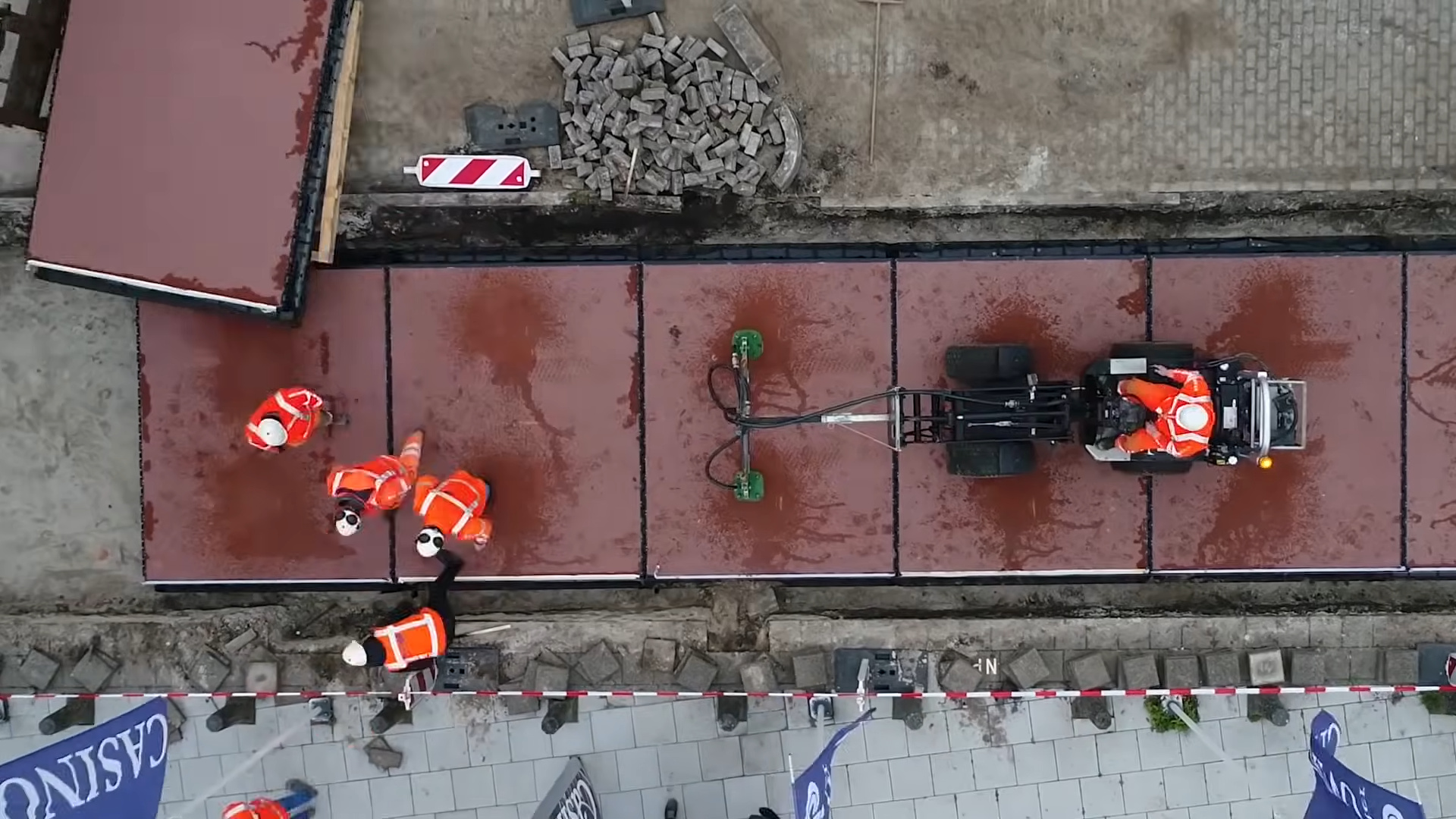
Netherlands Builds Road from 218,000 Recycled Plastic Cups and 500,000 Bottle Caps, Featuring Smart Sensors and Promising Triple the Lifespan of Traditional Asphalt

-
Brazil to Convert 80 Public Properties into 11,000 Affordable Homes Across 44 Cities to Address Housing Shortage

-
Brazilian Company Develops Wall Panels from Recycled Refrigerator Foam with Comparable Thermal and Acoustic Performance

-
Brazil’s São Paulo Region Unveils Latin America’s Largest Timber Shopping Mall, Built in 7 Months, Capturing Carbon and Preventing 900 Tons of Emissions


Setrak explained that Brazil has a metal-mechanical industry robust enough to nationalize chassis, axles, and brake systems, but acknowledged that batteries, electronic components, and high-voltage systems still pose challenges for local production. The idea is to import these items in the first stage and advance in nationalization as the supplier network matures. The Pouso Alegre factory already has the infrastructure for this: 150,000 square meters of warehouses, an annual capacity of 7,000 units, and about a thousand employees, of whom 96% are Brazilian.
The portfolio of electric trucks that XCMG already offers
While local assembly has not yet started, XCMG already markets one of the largest portfolios of electric trucks in the market in Brazil. The line ranges from light commercial vehicles to tractor units approved to operate with compositions of up to 74 tons. The most powerful model, the E7-80T, features a 747 horsepower engine, 400 kWh battery capacity, and a range between 150 and 250 kilometers depending on the load.
On the opposite end, the E7-49T delivers 482 horsepower and a 282 kWh battery, aimed at heavy road operations. The manufacturer also develops specific solutions for forestry and sugarcane operations, expanding the reach of electric trucks to sectors that traditionally rely exclusively on diesel. Charging can be done by direct current chargers, completing the cycle in just over an hour under ideal conditions.
Diesel price increase boosts demand for electric trucks
What changed the pace of the conversation was the price of diesel. According to Setrak, customer requests for electric trucks have grown by more than 30% in recent months, driven by the fuel’s escalation and the impact of international geopolitical tensions on transportation costs. The executive acknowledged that the demand profile has changed: previously, the interest came from companies focused on ESG goals and decarbonization; now, the main motivation is operational cost reduction.
The movement has also ceased to be exclusive to large fleets. Small carriers, urban distributors, merchants, and even bakeries have started to seek electric vehicles. The drop in the cost of fast and ultra-fast chargers since 2022 has helped unlock projects that previously stalled at the feasibility analysis stage. The scenario created a window of opportunity for manufacturers like XCMG, who already had a ready product and now find real demand.
The price difference that is shrinking
One of the biggest obstacles to the adoption of electric trucks has always been the higher price compared to diesel. This gap is shrinking. According to Setrak, in the light and medium segments, the difference has already decreased to something between 10% and 15%, making the investment return time plummet. The executive stated that, depending on the application, the electric truck pays the difference between 60,000 and 80,000 kilometers driven — a huge leap compared to the 400,000 kilometers that were necessary a few years ago.
In the heavy and extra-heavy segments, the difference still ranges between 30% and 35%. But XCMG’s expectation is to reduce this gap by the end of the decade through scale gains, technological evolution, and component nationalization. Local assembly in Pouso Alegre is a central part of this cost reduction strategy, as production in Brazil eliminates part of the import taxes and logistical costs of bringing ready-made vehicles from China.
Urban operations at the forefront of electrification
Urban operations continue to be the most fertile ground for electric trucks. The usage model is favorable: the vehicles run during the day making distributions, transfers between distribution centers, or short-distance deliveries, and return to the base for overnight recharging. Companies operating in this format are already able to achieve significant financial gains by switching from diesel to electricity.
Setrak states that the market’s major turning point will come when electric trucks reach ranges between 400 and 500 kilometers. From this point, medium-distance operations also become viable, and the trend is that many companies will reorganize logistics to take advantage of lower operational costs. Until then, local assembly of electric trucks in Pouso Alegre could be the factor that accelerates the transition in Brazil — with a product manufactured here, more competitive pricing, and a support chain that is beginning to form.
Do you think electric trucks assembled in Brazil will really compete with diesel, or will battery prices still hinder this transition for years? Share in the comments what you think about the future of freight transport in the country.