






 Portuguese
  Spanish


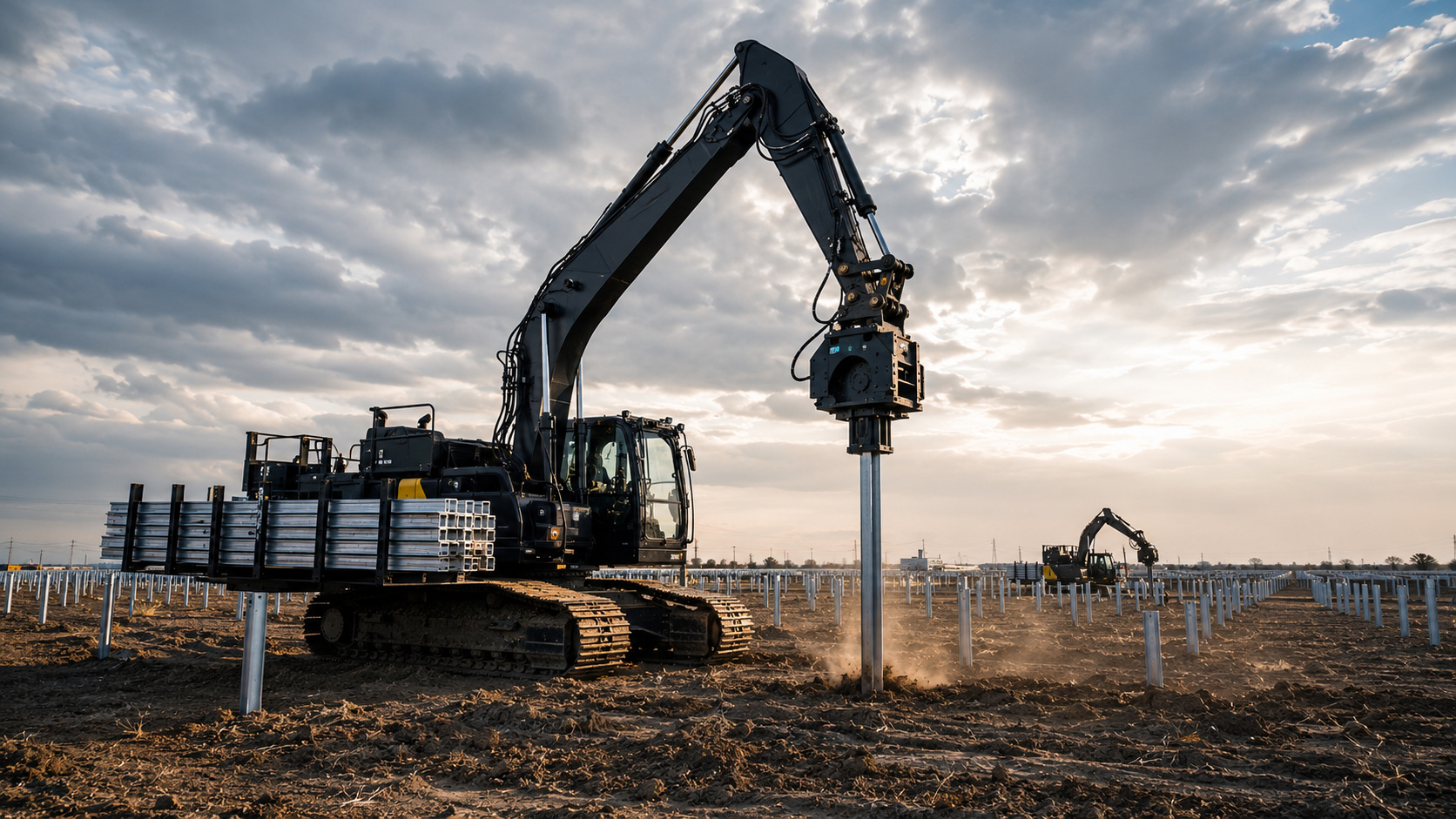

Robot RPD 35 shows how solar pile driving can change in solar plants by combining strength, logistics, land surveying, and data collection in a single autonomous machine created for large-scale solar energy projects
The end of solar piles installed by hand is beginning to take shape with an autonomous machine designed to work in the construction of solar plants. The RPD 35, from Built Robotics, was created to drive piles into the ground before the arrival of the panels.
The information was released by Built Robotics, a construction robotics company. The robot combines surveying, stake distribution, driving, and data collection in a single operation, with 40,000 pounds of impact and a maximum capacity for 224 stakes.
In practice, the machine targets a heavy phase of solar energy. Before a plant starts generating electricity, the land needs to receive thousands of support points. It is at this stage that the RPD 35 aims to reduce manual effort, repetition, and time loss.
-
Billionaire says the most valuable skill will help overcome job elimination caused by AI, following Bill Gates’ fears

-
A Dutchman created a ‘box’ that makes trees grow in the desert almost without water and without irrigation: the invention has already brought seedlings to dozens of countries and achieves up to 90% survival where common planting did not exceed 10%.

-
Abandoned warehouse hid a giant collection of rare computers, with over 2,000 artifacts from the 1930s to the 1980s.
-
Scientists warn that melting ice is triggering an alarming chemical transformation in preserved areas, and the first signs are already concerning researchers worldwide.




Why the construction of solar plants begins long before the panels appear
A completed solar plant usually attracts attention due to the panels aligned on the ground. However, the decisive part begins before that. The structure needs well-positioned solar piles to support the equipment that holds the modules.


These piles function as the physical base of the plant. They enter the ground in sequence and need to follow the project plan. If a piece is out of place, the subsequent assembly can be compromised.
Therefore, the construction of solar plants requires strength, repetition, and control. It’s not just about placing pieces on the ground. It’s necessary to know where each pile goes, bring the material to the correct point, and record the work done.
This work explains why automation draws so much attention in the sector. When a machine performs several steps at once, the project can gain more pace and organization.
The RPD 35 combines four stages that usually slow down the construction
The RPD 35 was developed to combine four stages into a single operation. The machine surveys the land, distributes the stakes, drives the pieces, and collects execution data.
The survey helps indicate where the stake should be installed. The distribution deals with moving the pieces within the construction site. The driving places the stake into the ground with force. The data collection records what has been done.
This set is important because large solar plants depend on repetition. The same task needs to be performed many times at various points on the land. Any stoppage between one phase and another can hinder progress.
With an autonomous machine, the process becomes more integrated. The proposal is to reduce the separation between measuring, transporting, driving, and checking.
Autonomous machine with 40,000 pounds of impact shows the heavy side of clean energy
Solar energy has a clean, modern, and silent image. But the foundation of a plant requires heavy construction. Before the panels can function, the ground needs to receive structures capable of supporting the entire system.

The number of 40,000 pounds of impact shows the size of the RPD 35. This force indicates that the machine was designed for industrial work, not for a simple or small installation.
Built Robotics, a construction robotics company, described the RPD 35 as a fully autonomous robot for solar stake driving. The official specs also indicate a maximum capacity for 224 stakes.
This type of equipment shows that the energy transition also depends on robust machines. Clean generation begins after an intense physical stage, with prepared ground, aligned pieces, and repeated execution on a large scale.
Capacity for 224 stakes changes the routine within the solar site
The maximum capacity for 224 stakes is one of the most striking points. In a solar construction, transporting the pieces also consumes time and effort.
When a machine carries many stakes at once, the operation can become more continuous. Instead of stopping multiple times to fetch material, the equipment works with greater autonomy within the work front.
To understand it simply, imagine a large empty field that needs to receive rows and rows of supports. Each stake needs to reach the right place and enter the ground in the correct position.
By combining load, positioning, and driving, the RPD 35 changes the logic of the construction. The machine not only drives the stake into the ground. It participates in a complete installation sequence.
Data collection in driving helps transform heavy construction into a controlled process
Data collection is an important part of the RPD 35. In a large construction, recording what has been done helps to monitor progress and check execution.
This means that the machine does not work only with force. It also stores information from the operation, which makes the driving of solar stakes more organized.
This point brings the solar construction closer to a more controlled process. The machine performs the heavy task and, at the same time, helps document the service.
In large plants, this control matters because there are many stakes and many installation points. The greater the repetition, the greater the need to carefully monitor each step.
Automation in solar energy does not eliminate construction, but changes who does the most repetitive part
The RPD 35 does not show a solar plant without construction. It shows a change in the way heavy, repetitive, and precision-dependent tasks are executed.
Automation comes in precisely where there is great physical effort and repetition. Driving solar stakes on a large scale requires constant force, rhythm, and checking. This is the type of activity where robots can gain ground.
The main change is in the integration of the steps. Instead of dividing the operation between lifting, transport, driving, and recording, the machine tries to bring everything together in one front.
This helps explain the appeal of the theme. The technology does not appear only in the solar panel or the electrical system. It also reaches the ground, in the roughest part of the construction.
Why this machine draws attention even outside the energy sector
The RPD 35 draws attention because it transforms a little-known stage into a strong image. An autonomous machine driving solar stakes with 40,000 pounds of impact shows that clean energy also requires heavy engineering.
The subject also surprises because many people imagine solar energy only as panels installed in the field. The foundation that supports everything usually stays out of the conversation.
By carrying up to 224 stakes, distributing pieces, driving into the ground, and recording data, the robot shows how the construction of solar plants can become more industrialized.
This is the point that makes the topic so strong. Automation has left the factories and warehouses and arrived at the solar site, where thousands of pieces need to be installed with repetition and precision.
Built Robotics’ autonomous machine shows that the expansion of solar energy does not depend solely on more efficient panels. It also depends on new ways of building the physical foundation of the plants.
With 40,000 pounds of impact, capacity for 224 stakes, and four-stage integration, the RPD 35 places automation at the center of a heavy, repetitive, and essential phase of solar construction.
If a machine can already lift, distribute, drive, and record stakes on its own, to what extent will the construction of future solar plants still depend on manual labor as we know it today? Share your opinion.





