






 Portuguese
  Spanish


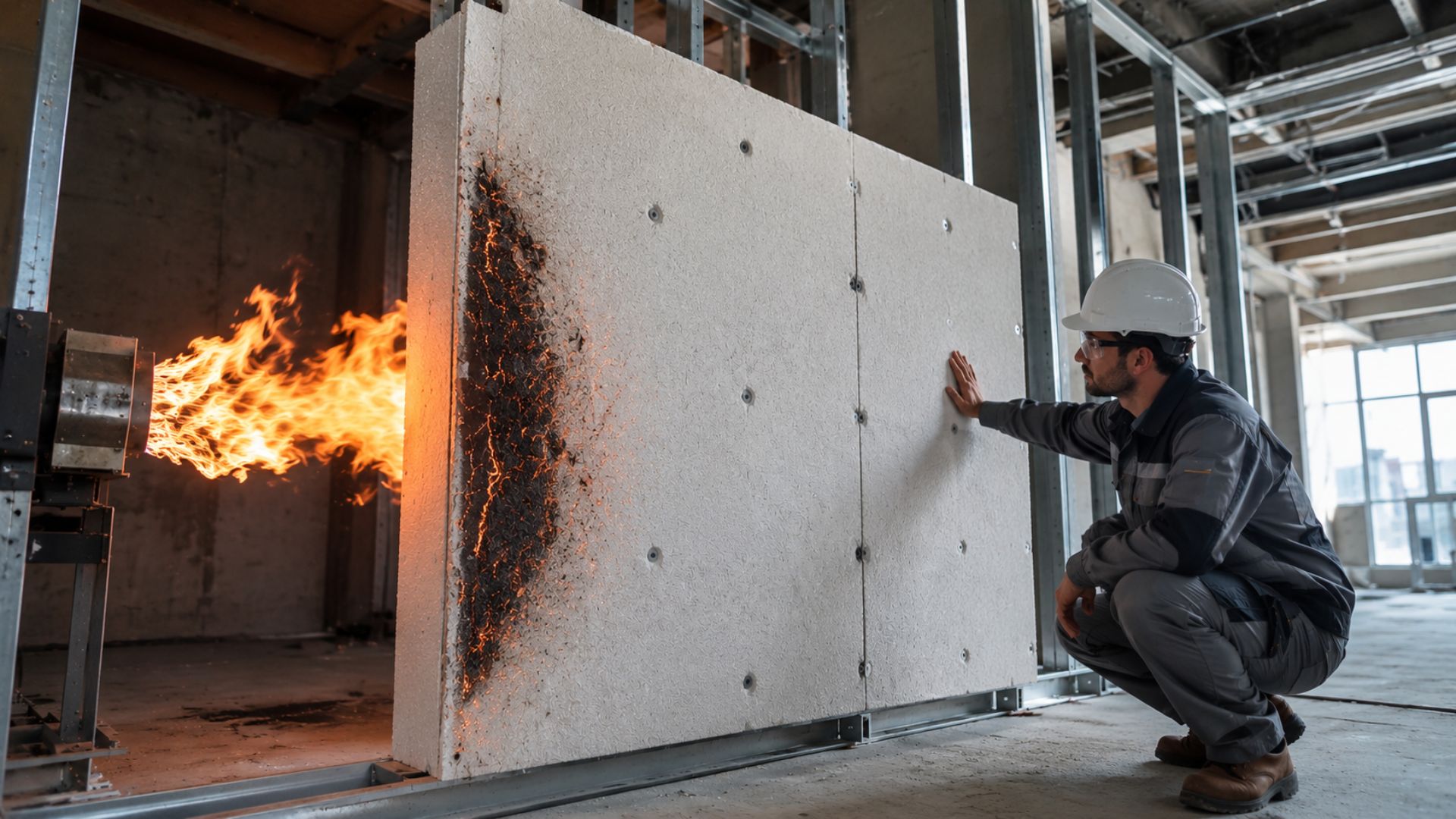

Technical material still little known outside construction sites advances in projects that require more safety, durability, and stability in internal areas, especially when walls, ceilings, and partitions need to deal with fire, humidity, and more controlled maintenance.
The calcium silicate board is gaining ground in construction projects that require superior performance in fire resistance, dimensional stability, and use in indoor environments subject to humidity.
Although it does not automatically replace common gypsum, the material is established as a technical alternative for walls, ceilings, partitions, ducts, and areas where safety and durability weigh more in the specification.
Formed by mineral compounds based on calcium silicate, the board is applied in passive fire protection systems and in closures with higher technical requirements.
-
Billionaire says the most valuable skill will help overcome job elimination caused by AI, following Bill Gates’ fears

-
A Dutchman created a ‘box’ that makes trees grow in the desert almost without water and without irrigation: the invention has already brought seedlings to dozens of countries and achieves up to 90% survival where common planting did not exceed 10%.

-
Abandoned warehouse hid a giant collection of rare computers, with over 2,000 artifacts from the 1930s to the 1980s.
-
Scientists warn that melting ice is triggering an alarming chemical transformation in preserved areas, and the first signs are already concerning researchers worldwide.




According to Promat, a manufacturer specialized in this segment, these materials are used in fire doors, partition walls, floors, ceilings, and other components that depend on thermal stability and mechanical integrity.
Calcium silicate board gains ground in technical areas
In more demanding constructions, the choice of closure stops considering only appearance or initial cost and starts to involve criteria such as performance, safety, and maintenance over time.
Technical areas, shafts, corridors, industrial kitchens, commercial buildings, hospitals, schools, hotels, and industrial environments usually require solutions capable of dealing with heat, humidity, impact, and more controlled maintenance.
According to Promat, their fire protection boards can protect steel, concrete, wood structures, and composite systems, as well as create fire compartmentalization and ducts aimed at heat and smoke control.
The manufacturer also states that their products are tested by accredited independent institutes and classified as non-combustible, a relevant feature for projects that depend on proven performance.
For this reason, calcium silicate should not be treated merely as a “different board” for finishing, as its function is linked to the behavior of the construction system.
The final result depends on the complete set, formed by structure, fasteners, joints, surface treatment, finishing, and, when the application requires, fire resistance tests of the specified system.
Fire resistance changes the comparison with plaster
In comparison with common plaster, the most relevant difference appears in projects that need to meet passive fire protection requirements.
In these situations, the calcium silicate board is specified to help delay the effects of fire on construction elements and maintain internal barriers functioning for a certain period, according to the adopted system.
Described by Promat as a high-density cementitious calcium silicate board, the PROMATECT-H line is used both for high-temperature insulation and passive fire protection.
According to the manufacturer, the product withstands peaks of 400 °C and offers suitable mechanical properties for self-supporting constructions, provided it is applied within the specified conditions.
Another example comes from Kemwell Fire, which describes the MultiKem MP-1000 board as non-combustible, aimed at internal and semi-exposed applications, combining fire resistance, moisture, impact, and thermal insulation.
According to the company, the product can offer up to 120 minutes of fire resistance, depending on the system configuration adopted in each project.
Moisture and stability weigh in the specification
Besides fire protection, moisture resistance is one of the factors that put calcium silicate on the radar of engineers and architects.
Promat states that PROMATECT-H is hygroscopic, vapor permeable, and capable of maintaining shape stability and load capacity in humid conditions, always within the specified conditions for the product.
Also in this regard, Kemwell Fire claims that its boards present dimensional stability under heat and in severe humidity environments, with indication for wet and damp areas.
This characteristic gains relevance in projects where deformations, water absorption, or frequent replacements can increase costs, interrupt activities, and compromise the environment’s lifespan.
Even so, performance does not depend solely on the isolated board, as manufacturers usually condition the result to correct installation and compatibility between components.
This evaluation includes the environment’s ventilation, the specified finish, joint treatment, and compliance with the technical guidelines of each construction system.
Dry construction favors technical solutions
The advancement of boards in lightweight systems accompanies the expansion of dry construction in projects seeking more controlled assembly, less mess, and a reduction of wet stages.
According to Kemwell Fire, lightweight structures are gaining recognition compared to traditional masonry, especially in solutions for walls and ceilings with specific project criteria.
In this scenario, calcium silicate can be installed in structures compatible with modular systems, as long as the solution is sized for the intended purpose.
The advantage is not only in the speed of assembly but in the ability to combine fire resistance, rigidity, stability, and finish in a single specification.
From an architectural point of view, the final appearance also contributes to its use in visible areas, as the panels can be painted, coated, or surface-treated.
Thus, the material can be applied in technical spaces and architectural areas without imposing a temporary or industrial look, as long as the finish follows the purpose of the environment.
Common plaster remains competitive in simple areas
Despite the advancement of technical panels, common plaster, drywall, cement boards, and other light closures remain relevant in many constructions.
In dry environments, without special fire resistance requirements and with less exposure to moisture, traditional solutions remain competitive due to cost, availability, and familiarity of labor.
The scenario changes when the construction requires a greater set of properties in the same system, especially in places where safety and future maintenance are decisive factors.
In buildings for collective use, industrial areas, and environments with stricter standards, an inadequate specification can lead to premature maintenance, additional reinforcements, or replacement of components earlier than expected.
Therefore, the calcium silicate board fits better in projects where safety, durability, and stability need to be evaluated along with the price per square meter.
The choice should consider reports, technical data sheets, applicable standards, manufacturer guidance, and the designer’s responsibility for the complete system.
Common plaster, therefore, does not come to an end.
However, a more careful selection of materials is gaining strength in places where visual finish is no longer sufficient to meet the requirements of use, safety, and maintenance of walls, ceilings, and internal partitions.





