






 Portuguese
  Spanish


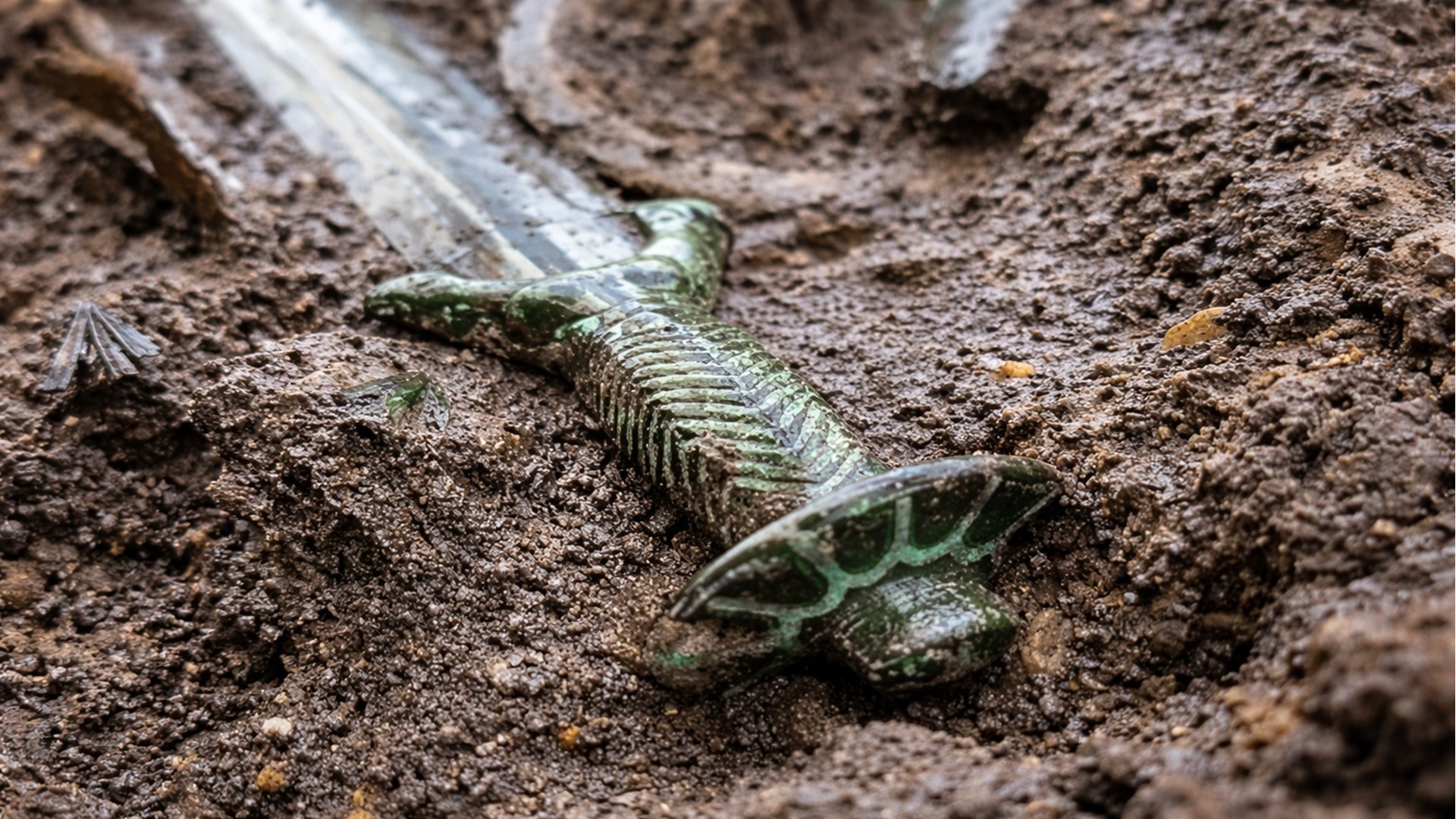


Discovery In 2023 In Southern Germany, The Legendary Octagonal Sword Of 3,400 Years Was Analyzed With Computed Tomography And Synchrotron Radiation BESSY II In Berlin, Revealing Internal Tang, Rivets, And Embedded Copper, Tin, And Lead In The Original Structure
Archaeologists unearthed a legendary octagonal sword from the Bronze Age, dating back 3,400 years, in southern Germany, analyzed in 2023 with computed tomography and synchrotron radiation in Berlin, revealing how the grip, blade, and metal inlays were joined.
The discovery occurred in 2023, when archaeologists found an Achtkantschwert, an eight-edged sword originating from southern Germany. Upon being removed from the grave, the object exhibited preserved metallic reflections. The piece was described as rare and associated with legendary narratives.
According to LBV, the sword was transported from Bavaria to Berlin in a padded box. The goal was to determine how the grip and blade were joined and to identify the composition of the materials embedded in the grooves of the pommel and pommel plate.
-
Brazilian Government Challenges Drug Trafficking Claims Linked to Social Program with Study by Fiocruz and Harvard

-
Resident left tap running to prevent freezing, but woke up to ice in the sink after -1.8°C cold snap in Brazil’s Serra Gaúcha region.
-
Man Inherits Old House in France and Discovers 100 kg of Hidden Gold Throughout the Property
-
Pyramid-Shaped Apartment Building in China Stands Out with 18 Floors, 45-Degree Inclined Facade, and Terraced Design Inspired by Traditional Rice Paddies



Legendary Sword And The Challenges Of Non-Destructive Analysis
The researchers faced the challenge of uncovering the secrets of the legendary sword without damaging it. Due to its exceptional state of preservation, the blade remained sharp, which required adaptation of the study methods applied to the Achtkantschwert.
To conduct the investigation, BLfD turned to the Helmholtz-Zentrum Berlin and the Bundesanstalt für Materialforschung und -prüfung. The synchrotron radiation source BESSY II was utilized, allowing for detailed examinations without compromising the integrity of the artifact.
Using computed tomography, the researchers created a three-dimensional model with X-rays. The images showed that the blade extends into the tang, forming a tang that was held and secured with rivets by the blacksmith.
Technology Reveals Internal Structure And Fastening Techniques
The analysis confirmed that the blacksmith attached the tang to the grip and secured it with rivets. The three-dimensional model allowed visualization of the structural union between blade and grip, providing objective data on the manufacturing process.
The study also examined the grooves on the grip. Initially, researchers assumed that the embedded material was tin, due to its malleability. However, X-ray examinations indicated a different composition.
It was identified that the manufacturer embedded copper wires in the grooves. The presence of copper demonstrated a craftsmanship that aimed for visual contrast between the reddish copper and the golden bronze of the main alloy.
Copper Inlays, Traces Of Tin, And Possible Chemical Patina
In addition to copper, traces of tin and lead were detected, presumably from the bronze alloy. The identification of these elements broadened the understanding of the materials used in the production of the legendary sword.
According to researcher Dr. Johann-Friedrich Tolksdorf, there are already records of inlay work with copper wire in bronze from other discoveries. To highlight the contrast, copper may have been patinated, meaning chemically darkened.
The proposed hypothesis suggests that the patina could have been applied with substances like urine to intensify the visual contrast between the metals. This technique emphasizes the level of craftsmanship development in the Bronze Age.
Investigations Continue Into Workshops And Techniques Of The Bronze Age
The investigation is not yet concluded. Archaeologists are seeking to obtain more information about the workshops responsible for producing the weapon and the techniques employed nearly three thousand five hundred years ago in southern Germany.
Principal researcher Beate Herbold stated that producing these swords was a complex process. She emphasized the interest in understanding how the grip was attached to the blade and how the characteristic patterns were incorporated.
Prof. Mathias Pfeil, Chief Conservator of BLfD, declared that modern measurement methods allow an understanding of how the metal was worked nearly 3,500 years ago, with surprising precision and highly developed skills.
The legendary sword remains under analysis, with expectations of new data regarding its manufacturing, materials, and historical context. The study combines physical preservation and advanced technology to reveal technical details without compromising the artifact.


Deve ser uma espada para cortar leGUMES? 🤣🤣🤣 oito lados e nenhuma foto
Pelo menos uma imagem para servir de referência, pode até ser um desenho, espada de oito gumes? Como seria?
N sei se vc sabe, mas o “gume” da espada é a parte do fio, quando vc fala uma espada de 8 gumes e n mostra nem faz referência a isso sua matéria por mais interessante que seja, perde credibilidade…