Portuguese
  Spanish


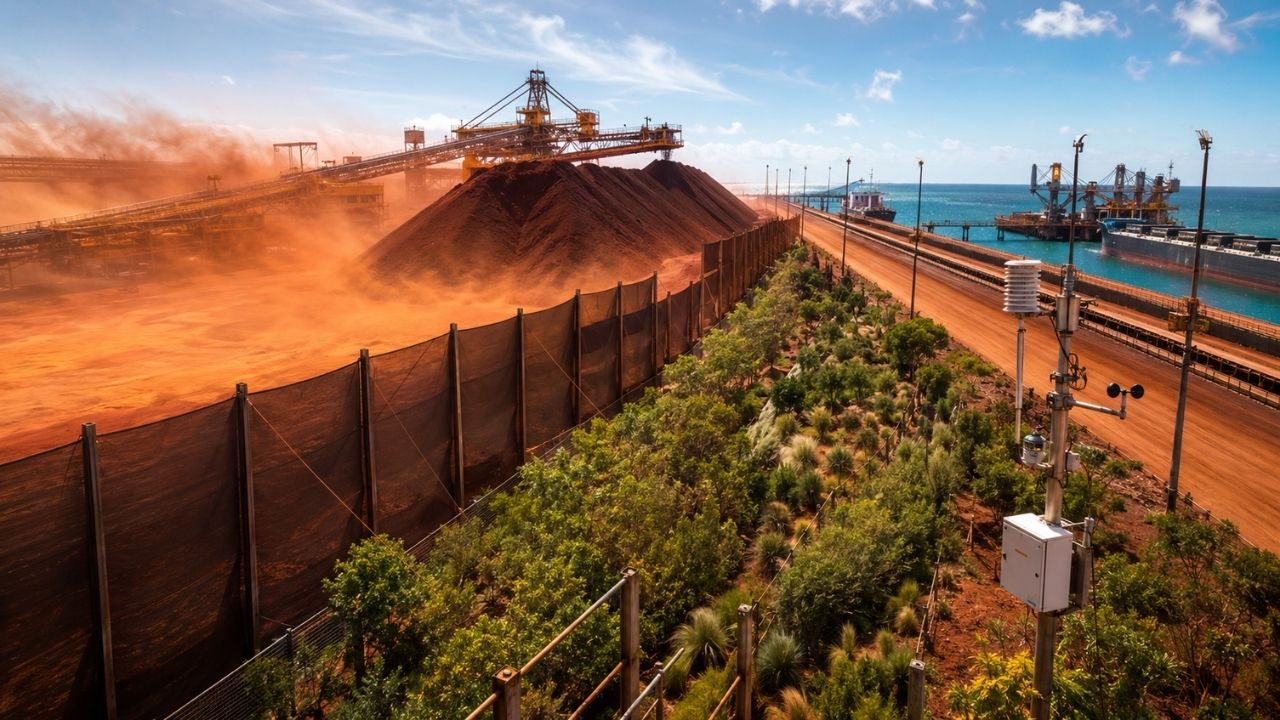


With iron ore mining in Port Hedland, BHP combines 150,000 native plants, windbreak curtains, and real-time monitoring software to control dust. AUD 300 million program included barriers completed in 2024, system prepared for cyclones, and data-based actions in the Australian Pilbara.
BHP’s iron ore mining in Port Hedland, Western Australia, now includes a set of measures to reduce dust impacts on Pilbara operations. The company states that it works with the government, industry, and local community to improve air quality control.
According to BHP, the program was announced in April 2020, with an investment of AUD 300 million over five years, and results were detailed by BHP on August 19, 2025. Actions include planting 150,000 native species, windbreak curtains, real-time monitoring, and systems prepared for severe weather conditions.
Native plants become a barrier against dust in Port Hedland

One of the most visual points of the program is the LEAF Project, an acronym for Leaf Enhanced Air Filtration. The initiative uses 150,000 local native plants to create a green barrier in the West End district of Port Hedland, an area linked to iron ore mining operations.
-
Nigeria Dumps 120 Million Tons of Sand into Atlantic to Build Massive City with 8.4 km Sea Wall for Protection Against Ocean Waves and Erosion

-
German Engineer Developed Diesel Engine Running on Vegetable Oil Decades Before Electric Cars Became Popular; Can This Forgotten Idea Work in 2026?

-
James Webb Telescope Uncovers Unexpected Clues on Mysterious Moon, Potentially Redefining Planetary Origins

-
$1.5 Billion Sleipnir Vessel Transforms Ocean into Floating Construction Site with 12 Hybrid Engines and Capacity to Lift 20,000 Tons


The species were selected to maximize the capture of suspended dust and also improve the visual aspect of the region. The barrier covers 7 hectares and is about 2.3 kilometers long, forming a living structure between the operations and the urban surroundings.
Project involved university, community, and indigenous groups

BHP reports that the LEAF Project was carried out in collaboration with the Town of Port Hedland, Curtin University, Greening Australia, Kariyarra Aboriginal Corporation, IBN Group, Yurra, local community groups, and other stakeholders. The proposal was to combine environmental control with landscape outcomes for residents.
In November 2024, the Town of Port Hedland took over the maintenance and management of the area. According to the company, the vegetative barrier continued to develop despite minor damage caused by Tropical Cyclone Zelia. The detail shows that in Pilbara, any environmental solution needs to consider strong winds and extreme events.
Windbreak curtains protect ore stocks

In addition to the plants, BHP installed three windbreak curtains in its Port Hedland operations. The structures were completed in the fiscal year 2024 and are designed to reduce wind speed over ore stocks, decreasing the potential for dust lift-off.
These curtains were designed for the specific conditions of the Pilbara region and rated to withstand cyclones. In port mining operations, controlling the wind is a direct part of particle control, especially when large volumes of ore are stored before shipment.
System was tested by tropical cyclone
In the fiscal year 2025, Tropical Cyclone Zelia tested the mesh rupture system in the windbreak curtains at Nelson Point and Finucane Island. According to BHP, the mechanism behaved as expected during the weather event.
The design anticipates that the panels will be secured by cables and clips that break under a certain load. When this happens, the panel becomes marked or loose, but remains attached to the structure. After the passage of extreme weather, the damaged panels can be replaced and the loose ones reinstalled.
Real-time monitoring guides operational decisions
BHP also uses an Air Quality Management System, called AQMS, to monitor real-time data, predict future conditions, and guide decisions on dust. The software runs on a configurable application, P2, used at WAIO facilities in Port Hedland and Newman.
The system alerts teams when an event occurs that requires dust management or formal recording. It also requires checklists, observations, and actions taken during these events, according to licensing requirements. In this case, mining depends not only on physical barriers but on data-driven operational response.
Data helps predict and respond to dust events


P2 complements a visualization system that receives near real-time data streams from monitors installed on-site. These panels help teams respond more accurately and quickly when there is a risk of impact on air quality.
In practice, monitoring allows decisions to be made before the problem worsens. The combination of windbreak curtains, vegetative barriers, and software aims to reduce operational dust emissions and improve air quality outcomes in areas near operations.
Program is part of BHP’s larger commitment in Pilbara
The Pilbara Air Quality Program was presented by BHP as part of its commitment to the continuous improvement of environmental performance in iron ore operations. The company states that it seeks to balance air quality controls, local services, jobs, and economic opportunities in the region.
This balance is especially sensitive in Port Hedland, where mining coexists with urban areas, port operations, and regulatory pressures. Dust is not just an operational detail: it influences public health, community perception, licensing, and the reputation of the mining activity.
The BHP strategy in Port Hedland shows that modern mining needs to deal with challenges that go beyond ore extraction and transportation. Native plants, windbreaks, and real-time monitoring are part of an attempt to reduce particles in a region marked by strong winds, ore stocks, and cyclone risk.
At the same time, the case raises an important question for other mining regions: can such measures compensate for the impacts of the activity or do they only reduce part of the problem? Do you believe that green barriers, windbreaks, and real-time monitoring should become standard in large mining operations? Leave your opinion in the comments.