






 Portuguese
  Spanish
  4 min of reading
  0 comments


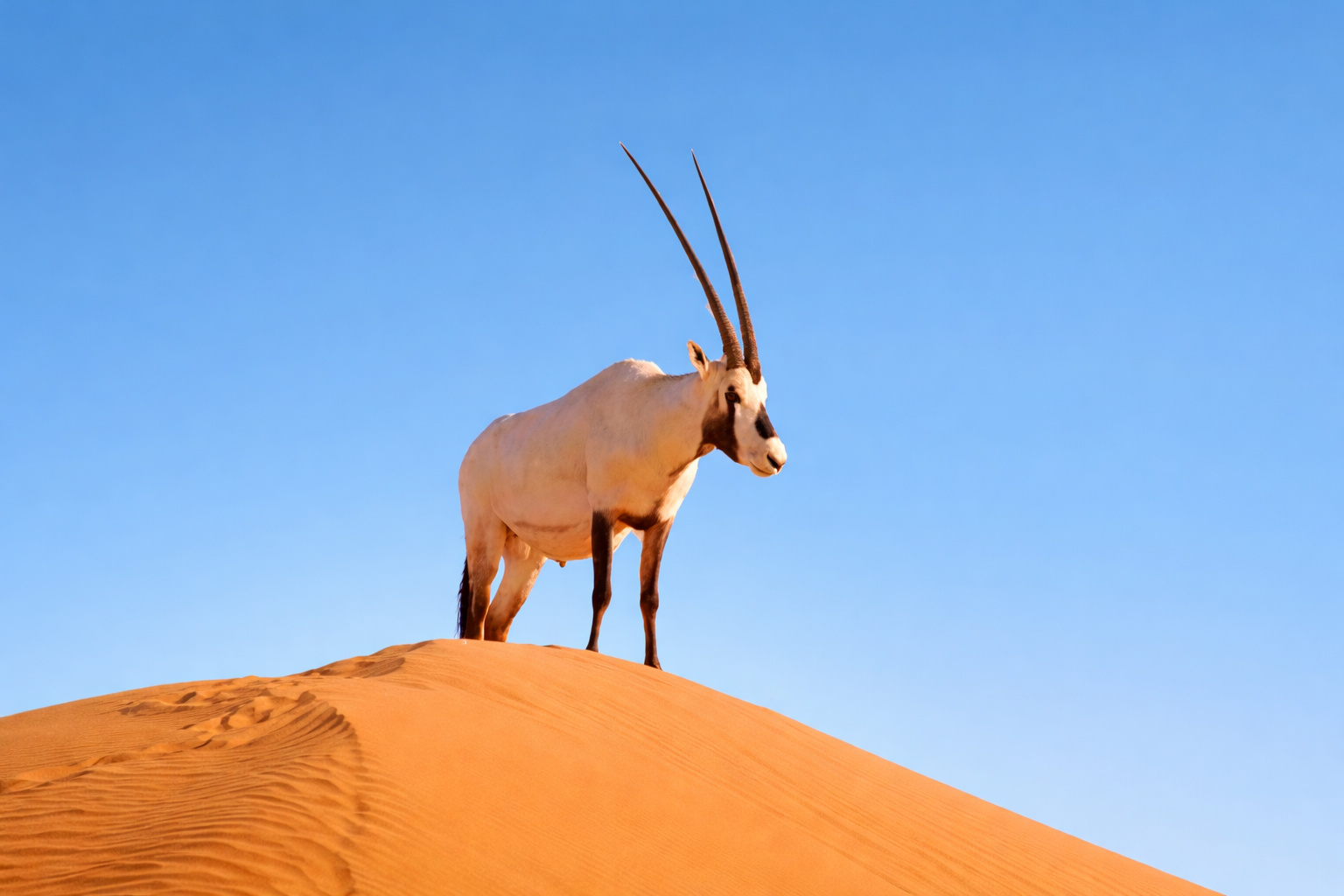
Species Once Considered Condemned Survives in a Single Stronghold, Challenges Extinction Models, and Becomes a Top Priority for Global Conservation After Intensive Efforts.
For decades, science treated its disappearance as inevitable. Intensive hunting, habitat loss, and human pressure in arid regions had reduced the population to such low numbers that many experts began to talk about functional extinction. Still, a small core survived. The animal is the Arabian Oryx, a desert antelope whose survival in a single isolated stronghold began to challenge classical extinction models and rewrite global conservation strategies.
What seemed like a countdown slowly transformed into a race against time — and then into a rare case of reversal. Today, the Arabian oryx is not just an unlikely survivor: it has become a top priority for international programs seeking to prove that conservation can work even when everything suggests otherwise.
Arabian Oryx: From Desert Symbol to Near Total Collapse
Historically, the Arabian oryx was an icon of the desert landscapes of the Arabian Peninsula. Adapted to extreme environments, capable of covering long distances in search of scarce water and food, it coexisted for centuries with nomadic human communities.
-
Survivor of 1966 SS Daniel J. Morrell Shipwreck in Lake Huron Recounts 38-Hour Ordeal in Extreme Cold

-
The Greatest Hoax in World Cup History? The Film That Denied Brazil’s 1958 Victory and Exposed How Fake Evidence Can Seem Convincing on TV
-
Fake South Korean Online Stores Offer Shopping Thrill Without Spending Money or Receiving Products
-
The War of Jenkins’ Ear: How a Severed Ear Sparked One of the 18th Century’s Most Unusual Conflicts



This balance collapsed in the 20th century. The combination of modern weapons, roads, vehicles, and recreational hunting accelerated a brutal decline. In just a few decades, entire populations disappeared. The animal was eliminated from virtually all of its historical range, leaving only one single stronghold under intensive surveillance.
For conservation biology, the scenario was alarming: very low numbers, fragmented territory, and extreme risk of inbreeding.
The Last Stronghold and the Thin Line Between Existing and Disappearing
The survival of the Arabian oryx became concentrated in extremely restricted protected areas, where human pressure was reduced to a minimum. These places functioned as artificial refuges, sustained by constant monitoring, armed protection against poachers, and the strict management of habitat.
Ecologically, the situation was fragile. Any disease, extreme weather event, or failure of protection could mean definite extinction. Nevertheless, the remaining core stayed alive — defying pessimistic predictions.
This period marked the transition of the Arabian oryx from a wild species to a totally protected species, with each individual counted, tracked, and safeguarded.
When Extinction Models Fail
Classic extinction models indicate that very small, isolated, and genetically impoverished populations tend to collapse. In the case of the Arabian oryx, this seemed like a definitive sentence. What happened was different.
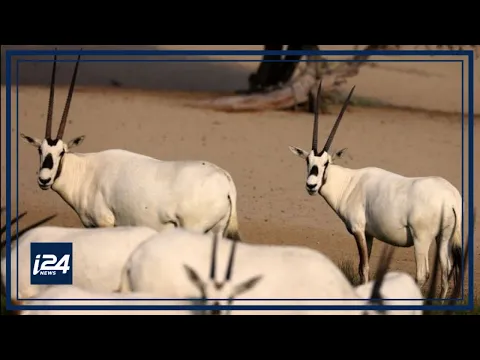
Thanks to rigorous genetic management, breeding control, and absolute territory protection, the population not only sustained itself but began to grow slowly. The case exposed an important limitation of theoretical models: they do not always incorporate long-term human interventions.
Here, conservation was not passive. It was active, costly, persistent, and politically complex — and it worked.
From “Nearly Extinct” to Global Project
Survival in the last stronghold transformed the Arabian oryx into a global project. Zoos, reserves, governments, and environmental organizations began to cooperate in a coordinated effort with three central objectives:
- Avoid Genetic Extinction by maintaining sufficient diversity.
- Expand Populations beyond the original stronghold.
- Prepare Controlled Reintroductions in historically occupied areas.
This movement pulled the species from limbo and placed it at the center of global large mammal conservation decisions.
Reintroductions of the Oryx and the Cautious Return to the Desert
With the gradual growth of managed populations, carefully planned reintroductions began. It was not about “releasing animals” but about reconstructing minimum survival conditions: protection against hunting, ecological corridors, and post-release monitoring.
The results showed something crucial: the species still knew how to be wild. The Arabian oryx resumed natural behaviors, movement patterns, and habitat use, proving that forced domestication had not erased its ecological identity.
Why the Arabian Oryx Became a Top Priority
Today, the Arabian oryx is seen as a global test case. If a species once considered condemned, reduced to a single stronghold, managed to endure and expand, others can too, provided that conservation is taken seriously.
It also symbolizes a sensitive point: saving large and charismatic species requires political decision, financial resources, and ongoing vigilance. There are no shortcuts.
The story of the Arabian oryx makes it clear that extinction is not just a natural phenomenon. It is, most of the time, the direct result of human choices. Likewise, survival can be too.
Keeping a species alive in a single stronghold is not victory; it is prolonging the end. Real victory begins when it reoccupies part of its territory, even under permanent protection.
When “Condemned” Stops Being Definitive
The Arabian oryx remains at risk. Any rollback in protection could undo decades of work. Still, its trajectory proves something fundamental: condemned is not synonymous with extinct.
As long as there is political will, applied science, and long-term commitment, even species reduced to the absolute limit can gain a second chance.
In a world accustomed to losing biodiversity, the Arabian oryx is unsettling because it shows that extinction is not always inevitable. Sometimes, it is just the easier path.
Saving this species required going against predictions, costs, and skepticism. The outcome is not a guaranteed happy ending, but perhaps something more important: time. Time for nature to breathe — and for humanity to decide whether it will continue choosing disappearance or preservation.





-

-

-

-

-

20 people reacted to this.