Portuguese
  Spanish


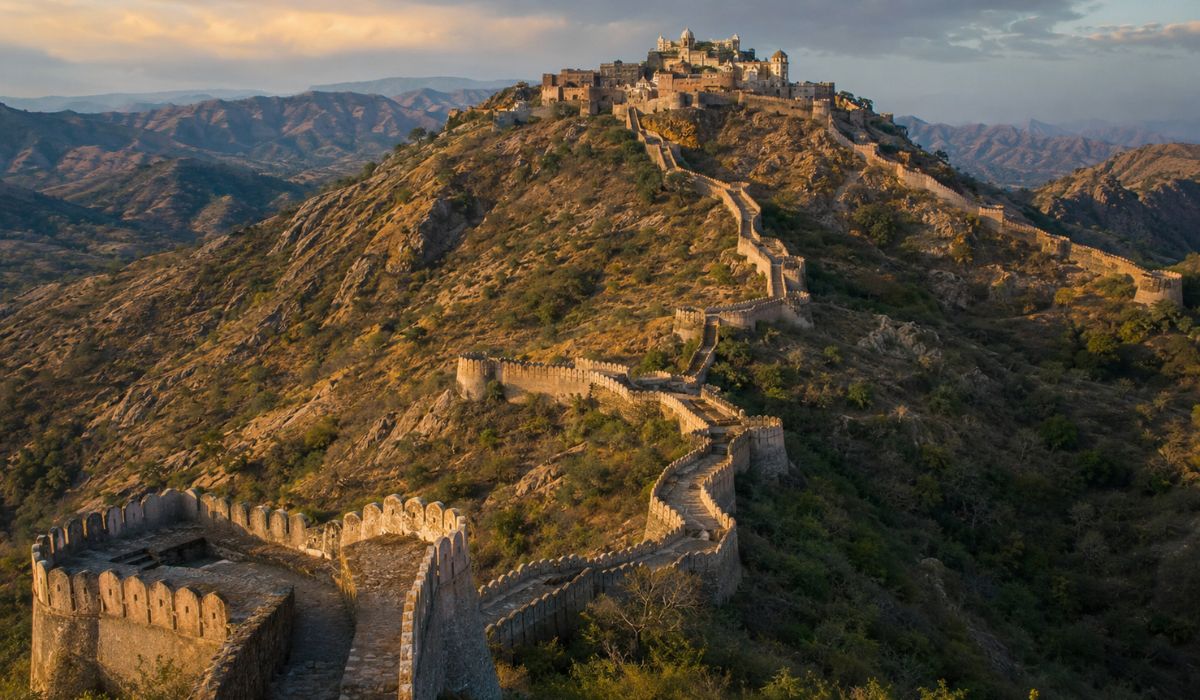


Fortress in Rajasthan brings together extensive wall, temples, palaces, and water systems in a mountain construction associated with Rajput military engineering and UNESCO recognized historical heritage.
Kumbhalgarh Fort, in the state of Rajasthan, in northwest India, is known for a wall that runs for about 36 kilometers through the Aravalli mountains.
Built in the 15th century, the fortification frequently appears in tourism and heritage publications as one of the largest continuous walls associated with a fort, although the comparison with the Great Wall of China involves works of different scale, purpose, and historical context.
Erected under the command of Rana Kumbha, ruler of the Mewar kingdom, the complex was not planned merely as a military barrier.
-
Award-Winning Japanese Restaurant Reveals It Has Preserved Part of the Same Frying Oil for 66 Years

-
American Youth Transforms from Severe Obesity to U.S. Air Force Enlistment, Losing 90 Kilograms in Two Years
-
11-Year-Old Entrepreneur Sells 60 Homemade Sweets Daily, Mastering Cost Calculation, Social Media Promotion, and Client Negotiation Since Age 7

-
Peruvian Mountain’s 5,200 Aligned Holes May Unveil Ancient Indigenous Market for Corn and Cotton


The structure combined defensive, administrative, religious, and shelter functions, with palaces, temples, residential areas, reservoirs, and internal paths distributed within the fortified area.
The fort is part of the Hill Forts of Rajasthan ensemble, recognized as a UNESCO World Heritage Site in 2013.
The inscription brings together six fortifications from the Indian state and highlights the architecture associated with the Rajput principalities, which exercised political and military power in the region between the 8th and 18th centuries.
Kumbhalgarh Wall follows the Aravalli mountains
The Kumbhalgarh wall follows the slopes, ridges, and natural curves of the Aravalli, one of India’s oldest mountain ranges.
This adaptation to the terrain had a defensive function: it expanded the field of vision, hindered the advance of enemy troops, and protected access to the fort’s core.
Unlike linear walls erected to mark borders, Kumbhalgarh encircled a mountain citadel.
The objective was to allow resistance during periods of war and offer refuge in an area protected by artificial barriers and natural obstacles.
The Rajasthan tourism secretariat describes the site as a relevant citadel for the rulers of Mewar and highlights the fort’s isolated position on mountainous terrain.
This factor, according to official tourism materials, contributed to reinforcing the defensive capability of the construction.
The thickness of the walls varies depending on the section.
The measurement of 15 meters appears in tourist accounts and promotional texts, but consulted heritage sources more reliably indicate front walls of about 4.5 meters, equivalent to approximately 15 feet.
For this reason, the dimension in meters should be treated with caution.
Still, the extent of the wall is one of the most cited elements about Kumbhalgarh.
In some sections, the structure also served as an elevated circulation route, allowing the movement of guards, messengers, and soldiers along the defenses.
Defense of Kumbhalgarh Fort used gates and altitude
The construction of the fort in the 15th century combined the use of local stone, exploitation of the terrain, and control of the main accesses.
Ramps, bastions, narrow passages, and successive walls helped organize the defense at different points of the complex.
The fortified gates, called pols, played a central role in this system.
More than entrances, they functioned as control points where the advance of invaders could be slowed down and observed by troops positioned in higher areas.
Among the most cited gates in descriptions of the fort are Ram Pol, Hanuman Pol, and Vijay Pol.
The arrangement of these accesses, on inclined and successive paths, forced any attacking force to advance along predictable routes and at a slower speed.
In a mountain fortress, this combination of altitude, physical barriers, and control of passages was an essential part of the defensive strategy.
The highest point of the complex is over 1,100 meters above sea level, which extended observation over the surrounding region.
The topography also helped reduce the effectiveness of direct attacks.
Moving troops had to contend with ascents, curves, narrowings, and exposed areas before reaching the internal points of the fort.
Temples and palaces within the Indian fortress
The Kumbhalgarh wall protected a vast complex, not just an isolated construction.
The interior brought together religious structures, residential areas, palaces, internal paths, and supply systems.
Official Indian tourism records cite 360 temples within the fortress, including Hindu and Jain constructions.
This data frequently appears in descriptions of the site and helps explain why the fort is also analyzed as a cultural landscape.
The presence of temples, palaces, and reservoirs shows that the fortification concentrated military, religious, and administrative functions.
Instead of serving merely as a defense post, Kumbhalgarh housed various activities linked to the power of Mewar.
The site is also associated with the birth of Maharana Pratap, a Rajput ruler remembered in regional history for his resistance to the Mughal Empire.
This relationship reinforces the symbolic weight of the fort for Rajasthan and for the political memory of Mewar.
Among the internal constructions, Badal Mahal, known as the “Palace of Clouds,” is located in the upper part of the complex.
The building is cited in tourist materials as one of the most visited structures within the fort.
Water reservoirs sustained the resistance
In a region marked by a dry climate and variations in water availability, supply was a decisive point for the survival of a fortress.
For this reason, Kumbhalgarh incorporated reservoirs, tanks, and rainwater harvesting systems.
These structures reduced dependence on external sources during periods of siege.
In mountain forts, the ability to resist depended not only on the wall but also on the availability of water, food, and internal circulation routes.
Popular accounts claim that a temporary fall of the fort in the 16th century would have been favored by contamination or sabotage of the water supply.
However, this version does not appear to be reliably confirmed in official sources consulted, and therefore should not be presented as a proven fact.
The most documented historical fact is that forces linked to Emperor Akbar, under the command of Shahbaz Khan, captured Kumbhalgarh after a siege between 1577 and 1578.
This information places the episode in the context of disputes between Mewar and the Mughal Empire.
After this period, the fort reappeared in the regional history of Mewar.
The fortification’s trajectory shows that, despite its reputation for resistance, its control also depended on political, military, and strategic factors that went beyond architecture.
Comparison with the Great Wall of China requires caution
The comparison with the Great Wall of China became common due to the continuous extension of Kumbhalgarh’s wall.
However, the two structures have distinct purposes and belong to different categories of military construction.
The Great Wall of China is a system of border fortifications that, adding its sections, exceeds 21,000 kilometers, according to widely publicized official surveys.
Kumbhalgarh, on the other hand, is a hill fortress, with a wall that surrounds a specific defensive complex.
For this reason, the expression “second largest wall in the world” should be used with reservation.
It appears in tourist materials and reports, but it does not equate to a universal classification applied to all types of walls, ramparts, and defensive systems on the planet.
Even with this observation, the 36 kilometers attributed to Kumbhalgarh’s wall place the fort among the most extensive defensive works associated with a citadel.
The construction follows the relief of the mountains and delimits a fortified area that combined defense, housing, religion, and administration.
A historical reading of the work requires differentiating tourist impact, local tradition, and heritage documentation.
This distinction avoids transforming a popular comparison into an absolute statement without a defined technical criterion.
Rajasthan’s heritage is still less known outside India
Despite Unesco recognition, Kumbhalgarh remains less known internationally than Indian destinations such as the Taj Mahal, the palaces of Jaipur, and the ghats of Varanasi.
Its mountainous location and distance from the most popular tourist routes help explain this lower visibility.
Access usually occurs from cities like Udaipur, in Rajasthan.
The visit attracts those interested in history, architecture, archaeology, and cultural tourism, especially due to the combination of mountain landscape and fortified structures.
For heritage and conservation researchers, Kumbhalgarh is an example of integration between military defense, water management, religious architecture, and territorial occupation.
The wall draws attention due to its length, but the internal complex also explains the historical importance of the fortress.
The case of Kumbhalgarh shows how pre-modern societies used terrain, local materials, and supply systems to sustain large defensive complexes.
Instead of relying solely on high walls, protection involved territorial planning, access control, and resource management.
The Indian wall remains associated with the idea of grandeur because of its scale and its placement in the Aravalli.
At the same time, its history requires caution with direct comparisons and repeated numbers without standardization.