Portuguese
  Spanish


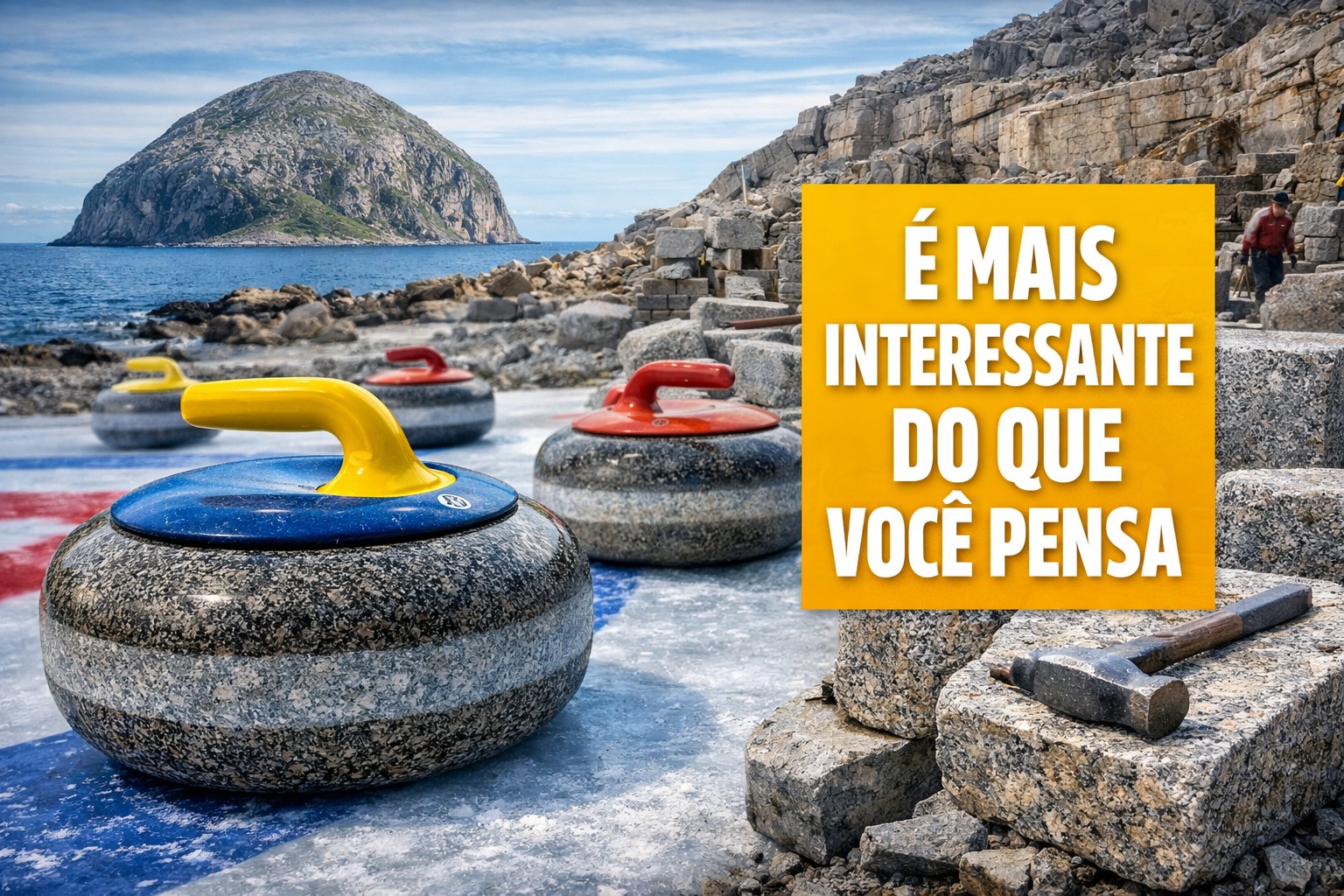


Understand How a Small Uninhabited Island Became Vital for Curling, Revealing the Role of Special Microgranite, the Technical Standards of Official Stones, High Costs and Strict Environmental Rules
Have you ever imagined that one of the most strategic sports in the Winter Olympics directly depends on a small Scottish island? Ailsa Craig, isolated and uninhabited, is responsible for providing the granite considered ideal for the manufacture of curling stones, the central element of the sport.
Precision That Begins in the Rock
Often referred to as “chess on ice,” curling is a game of calculation, control, and sensitivity. Each throw requires millimeter accuracy, making the choice of material a decisive factor. It’s not just about tradition; it’s about technical performance.
Ailsa Craig, located in Scotland, stands out precisely for its unique geological characteristics. The island is a solitary granite massif that resembles a “sugar loaf” emerging from the sea.
-
Burkina Faso Bans NGOs from Photographing Vulnerable People Without Consent and Outlaws Fundraising Campaigns Exploiting Suffering

-
Giant Earthworms up to 2 Meters Long Secretly Sustain Fertility in the Amazon Rainforest
-
Brazil Launches Ambitious Project to Recycle Toothpaste Tubes and Toothbrushes, Aiming to Revolutionize Waste Management

-
The Mystery of Roanoke: Entire Colony Vanished Without a Trace, Leaving Only “Croatoan” as a Clue and Becoming a Historical Legend


Despite having no permanent residents, it plays a fundamental role in competitions around the world.
The Secret Behind the Stones
The manufacture of the stones involves two specific varieties of volcanic rock. The “common green” granite forms the body of the piece, while the “blue hone” makes up the contact surface that slides on the ice. This combination ensures resistance and predictability in movement.
The microgranite extracted from the island is described as the only one capable of providing stable and controlled sliding.
For this reason, Kays Scotland exclusively uses these rocks to meet the standard required in international competitions.
Technology and Standardization
An official stone follows strict norms. According to the rules, its weight varies between 17.24 kg and 19.96 kg. This uniformity ensures equal competition conditions on any rink.
Currently, the industry produces about 2,000 units per year. Each piece undergoes careful polishing to control friction on the ice.
Thus, strategies like blocking the opponent work as planned.
High Cost and Preservation
The investment also draws attention. A single unit can cost around 840 euros. Since a match uses 16 stones, the value of the basic set quickly reaches significant figures.
Extraction at Ailsa Craig occurs under strict environmental regulations. The island is home to important seabird colonies.
Hence, activities follow specific exploitation windows, balancing industrial demand and ecological protection.
With information from NSC Total.