






 Portuguese
  Spanish


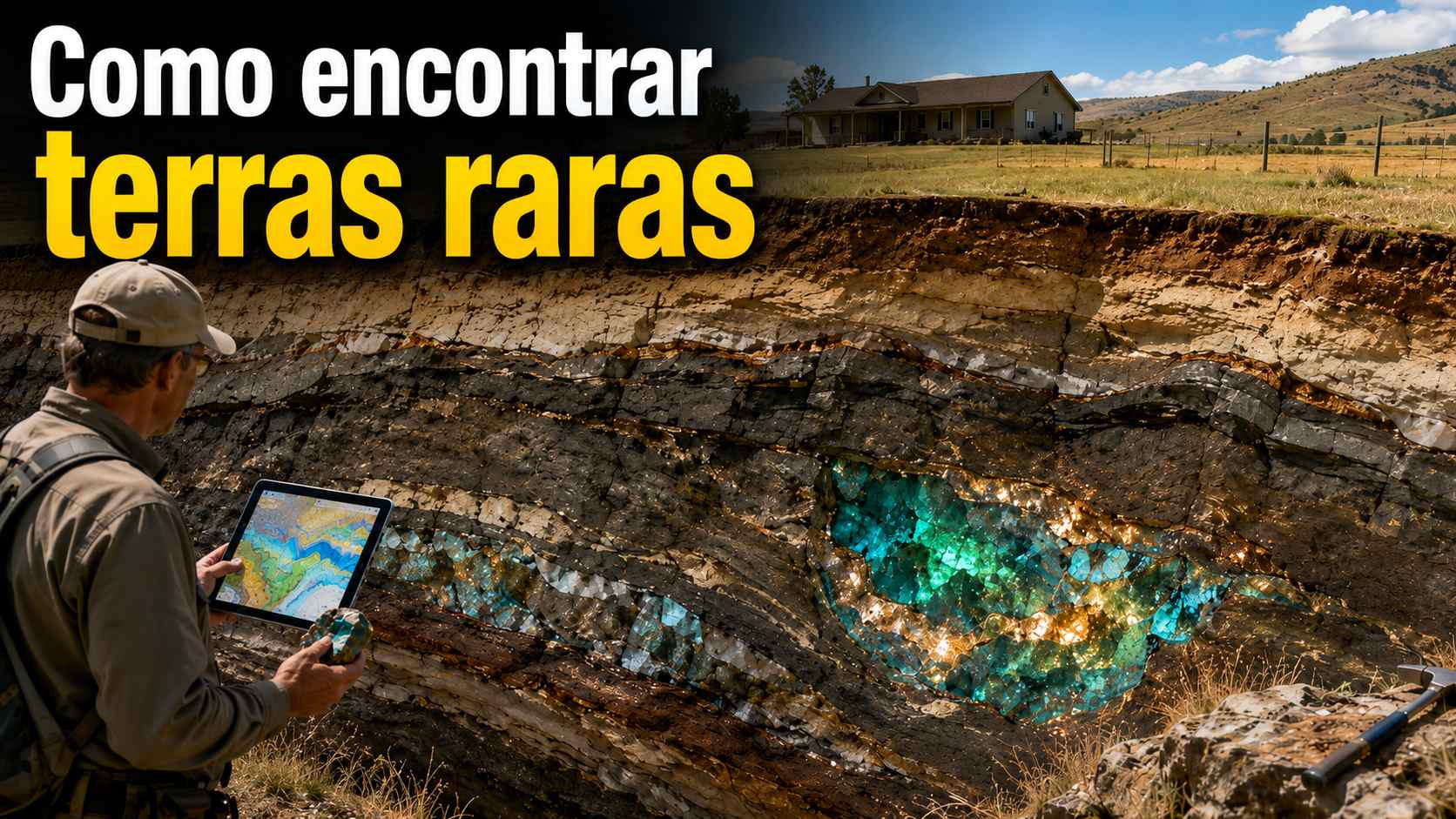


Research from the University of Cambridge links rare earth deposits to lithosphere thickness, creates a new global map to guide mineral prospecting, and gains relevance amid the dispute for inputs used in smartphones, electric vehicles, and wind turbines.
Rare earth deposits can be located more precisely after researchers from the University of Cambridge linked their formation to the thickness of the lithosphere, in a study published in Nature Geoscience on May 22, with 9,000 rock samples analyzed.
The discovery interests chains linked to smartphones, electric vehicles, and wind turbines, technologies dependent on these elements. Oil remains central in the energy matrix, but the transition to clean energy increases the pressure for critical minerals, currently concentrated in a few global suppliers globally.

New atlas links rare earths to the deep structure of continents
The team led by Dr. Emilie Bowman compiled chemical data from rocks in various regions of the planet and cross-referenced this set with seismic information. The goal was to understand why CO2-rich magmas, often associated with rare earths, appear in specific areas.
-
James Webb Telescope Uncovers Unexpected Clues on Mysterious Moon, Potentially Redefining Planetary Origins

-
$1.5 Billion Sleipnir Vessel Transforms Ocean into Floating Construction Site with 12 Hybrid Engines and Capacity to Lift 20,000 Tons

-
23 Years After Tragedy, Brazil’s Alcântara Space Center to Launch New Suborbital Rocket in 2026 with South Korean SEBIT Project Targeting Near-Space Tests
-
Entrepreneur Turns Neighbor’s Coffee Grounds Waste into Eco-Friendly Pellets, Earning Up to $40,000 Monthly in Brazil


The result showed a consistent geological pattern. The rocks do not appear randomly. They concentrate on the steep edges of ancient and thick continental areas, where the lithosphere, the Earth’s outer rigid layer, is thicker.
The work transforms a question previously treated as a geological curiosity into a prospecting tool. CO2-rich igneous rocks, long seen as formations difficult to explain, now provide clues about where to look for relevant deposits.
Professor Sergei Lebedev, a geophysicist on the project, explained that seismic waves from earthquakes allow creating a cross-section image of the lithosphere, similar to using sonar to identify features on the seabed.
From this mapping, researchers observed that lithospheric thickness guides the occurrence of deposits. Regions with thicker lithosphere function as zones capable of concentrating specific magmatic processes, important for forming valuable minerals.
How oil enters the debate on critical minerals
The research does not address oil exploration, but it helps explain the shift in priorities in energy security. While oil and gas remain associated with global supply, rare earths are central pieces in equipment related to electrification.
These elements appear in technologies used in daily life and in clean energy infrastructure. The dependence on external chains creates a concern similar to that observed in strategic fuels, as the supply of minerals can influence industrial and technological autonomy.
Thick lithosphere functions as a geological trap
The mechanism described by the researchers involves the retention of small pockets of molten rock in the deep parts of the crust and lithospheric mantle. Under ancient continental cores, high pressure and lower temperatures prevent widespread melting.
Under these conditions, only small portions of magma form. They remain trapped, absorb dissolved gases such as CO2, and undergo slow evolution. This process favors the gradual concentration of rare chemical components.
The formation of enriched deposits requires more than one stage. After a first event, another tectonic episode needs to remelt these rocks, generating magma for the second time. This sequence increases the concentration of rare earth elements.
The study compares different types of young intraplate continental magmas, less than 200 million years old. Carbonatites, kimberlites, olivine lamproites, ultramafic lamprophyres, melilitites, nephelinites, basanites, and alkaline and subalkaline basalts were analyzed.
The samples were grouped into cells of 1 degree by 1 degree to reduce distortions caused by more studied regions. Then, the data were compared with shear wave velocity anomalies and lithospheric thickness estimates.
Study quantifies the relationship between magma and lithospheric thickness
The pattern found shows a systematic increase in lithospheric thickness as the estimated CO2 content of the magma increases. Basanites, with less than 5% by weight of CO2, appear in thin, non-cratonic lithosphere.
Kimberlites, on the other hand, can reach less than 20% by weight of CO2 and are preferably found in thick cratonic lithosphere. These environments are also known to host diamond deposits.
Carbonatites, associated with economic deposits of phosphate, fluorite, niobium, tantalum, zirconium, and rare earths, appear in thickness bands similar to those of nephelinites, melilitites, and ultramafic lamprophyres.
Research indicates that many carbonatites likely form by liquid immiscibility or fractional crystallization from CO2-rich silicate magmas. These processes occur in the crust as the parental magma cools and crystallizes.
The study also points out that rare earth deposits associated with carbonatites have a spatial distribution similar to that of the carbonatites themselves. This suggests that secondary processes, such as fractional crystallization or hydrothermal alteration, may trigger economic mineralization.
North America shows practical application of the model
The relationship between magma type and lithospheric thickness was exemplified in a transect from the North American craton to the Laramide corridor in the western United States. The region allows for observation of compositional and structural variations.
In Canada, the high-velocity North American craton hosts Cretaceous diamondiferous kimberlites, partly linked to the thick and strongly metasomatized cratonic lithosphere. Further south, the Laramide corridor records another tectonic context.
This corridor, between the low-velocity active margin of southern California and the western extension of the craton in Montana, was affected by low-angle subduction of the Farallon plate between 88 and 68 million years ago.
The devolatilization of the plate led to metasomatization of the overlying continental lithosphere. Subsequently, rollback, detachment of the subducted plate, and continental extension favored partial melting of this lithosphere during the Eocene-Pleistocene, producing CO2-rich magmas in the western United States.
Along the transect, basanites appear preferentially in thin, slow lithosphere near the active margin. Nephelinites, melilitites, and ultramafic lamprophyres occur in intermediate lithosphere, closer to the North American craton.
Lamproites and kimberlites emerge at the craton margins, and the kimberlites advance into thicker and seismically faster internal areas of Canada. The sequence reinforces the use of lithospheric thickness as a predictive indicator.
Next step targets rocks over 200 million years old
The new atlas has a clear temporal limit. The analysis focused on young magmas, postdating the breakup of Pangea, to reduce the effects of ancient tectonic changes and facilitate comparison with modern lithosphere estimates.
The researchers indicate that the next challenge is to investigate rocks over 200 million years old. The task is complex because continents have fragmented, collided, and reorganized over time, erasing some geological clues.
This stage matters because some of the largest known deposits of rare earths, such as Bayan Obo, Mountain Pass, and Mount Weld, formed more than 200 million years ago. Understanding whether the observed relationship has changed over time can expand the model’s reach.
The research offers predictive power about where CO2-rich rocks and associated deposits may form. For countries seeking to reduce external dependency, the benefit lies in guiding mineral exploration based on global geological evidence, for future clean technologies.
Study Summary: Published in the journal Nature Geoscience on May 22, the study by the University of Cambridge analyzed about 9,000 rock samples and seismic data to understand where CO2-rich magmas, often associated with rare earth deposits, form. The research identified that these deposits do not appear randomly: they tend to occur at the edges of ancient and thick continental regions, where the lithosphere acts as a kind of geological trap. The work creates a “new predictive atlas” to guide the search for critical minerals used in technologies such as electric vehicles, wind turbines, and smartphones.
This article was prepared based on information released by Nature Geoscience and IE. The content was supported by AI tools in editorial organization and underwent human review before publication.


