Portuguese
  Spanish


The time capsule linked to the former National Bureau of Standards preserved industrial samples from 1916, photos, publications, and an old newspaper, simply showing how steel, iron, ore, and measurement standards were already essential for factories, laboratories, and engineering over a century ago.
Found after the demolition of old laboratories, a capsule from 1916 contained steel, cast iron, ore, an old newspaper, and clues about how factories avoided measurement errors. The information was released by the National Institute of Standards and Technology, a federal agency in the United States on technical standards.
The box was linked to the former National Bureau of Standards, an institution that preceded the NIST. It was placed in the cornerstone of the Chemistry building on March 23, 1916, on the Washington, D.C. campus.
The discovery is noteworthy because it was not just a historical memento. The capsule preserved reference materials, used as a comparison to check if laboratory and industry measurements were correct.
-
The United Kingdom is transforming dog feces left on trails into gas to light a streetlamp through an unlikely and surprising project that shows how even one of the most rejected wastes in cities can generate energy.

-
Goodbye traditional Air Fryer: Philips surprises with a version featuring two baskets, steam cooking, self-cleaning, 9-liter capacity, recipe synchronization, and technology that makes food crispy on the outside and soft on the inside.
-
Russia has built a colossal radio telescope nearly 600 meters in size, composed of 895 metal panels in a gigantic ring, which uses the Earth’s rotation to capture invisible signals coming from the Sun and the most distant regions of the universe.
-
The United Kingdom launched 146 giant concrete coffins into the sea, towed the structures through the English Channel, and erected a colossal artificial port in front of the Normandy beaches in a few days.


The 1916 capsule held real pieces of the industry, not just old papers
Inside the capsule were photos, publications, a newspaper from 1916, and items related to the technical work of the former agency. Among the most curious objects were samples of materials used by the industry at the time.
These samples included cast iron, Bessemer steel, Sibley iron ore, chrome vanadium steel, sheet brass, and sodium oxalate. In total, there were 6 reference materials.
To understand the importance of this, just think of a reliable ruler. When someone needs to measure something precisely, they use a secure reference. In the industry, these samples had a similar function.
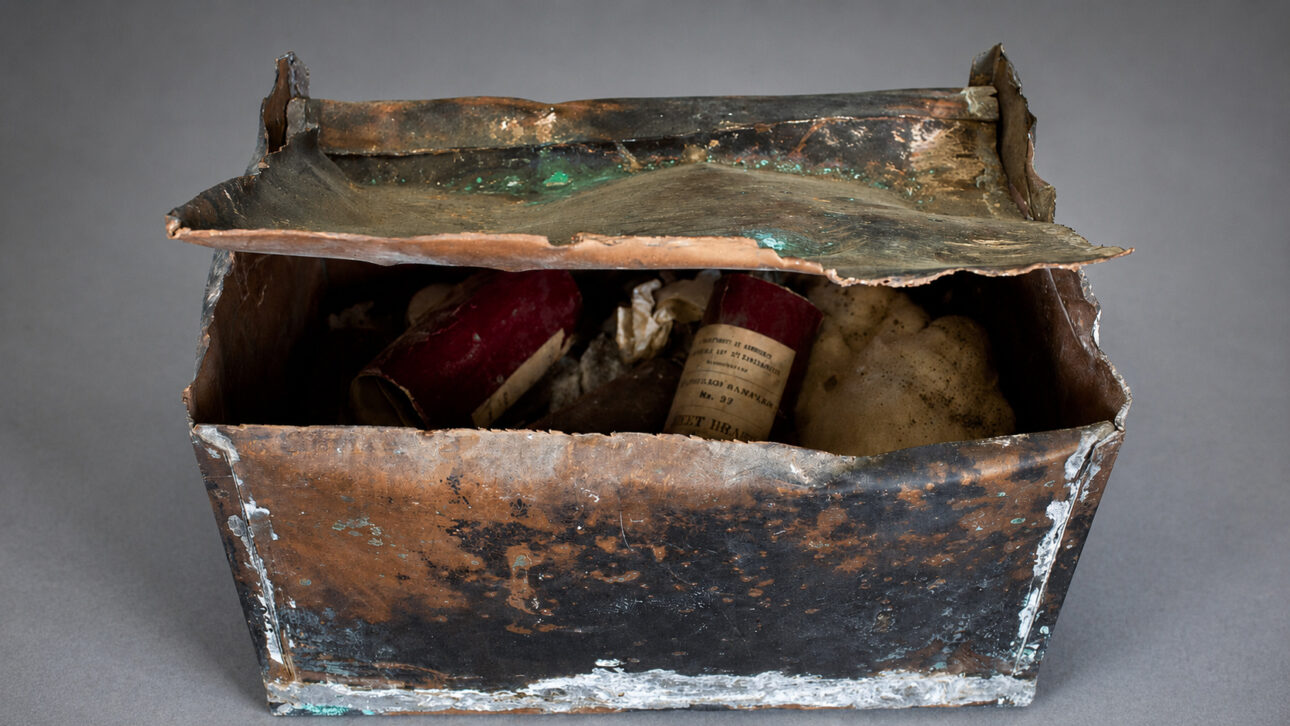
They helped laboratories compare results, check instruments, and reduce errors. Therefore, the capsule serves as a snapshot of how the industry has depended on reliable measurement for over a century.
Why steel, cast iron, and ore were so important for factories and engineering
Steel and iron were at the heart of the industry in 1916. These materials appeared in machines, parts, tools, structures, rails, and equipment used in different productive sectors.
Cast iron was valued for its presence in industrial parts and components. Bessemer steel also symbolized an important stage of large-scale steel production.
The Sibley iron ore showed another part of the production chain. Before the finished metal, there was the raw material extracted and analyzed to become the base of new materials.
Therefore, the capsule did not just hold old objects. It preserved a small sample of what supported factories, works, laboratories, and industrial processes at the beginning of the last century.
Reference materials explain how factories avoided measurement errors
A reference material is a sample with known characteristics. It serves to compare results and help identify if a measurement is correct.
Imagine a scale being checked with a known weight. If the scale reads correctly, the test proceeds with more confidence. If it reads incorrectly, it needs adjustment. In the industry, the logic is similar.
When a laboratory analyzes steel, iron, ore, or chemical products, it needs to trust the result. An incorrect measurement can affect the quality of a part, a mixture, or a material sold.
Therefore, these samples helped provide security to the tests. They were used to calibrate instruments, verify methods, and create more confidence among those who produced, bought, and analyzed materials.
The demand for standard samples was already growing along with the industry
National Institute of Standards and Technology, the United States federal agency on technical standards, detailed that the annual report of 1916 recorded an increase of almost 50% in requests for standard samples compared to the previous year.
This data shows that factories and laboratories were already seeking more security in measurements. The more the industry grew, the greater the need to reliably compare materials.
In simple terms, it was not enough to manufacture. It was necessary to prove that the material had the expected composition and that the test used to evaluate this material was correct.
This type of care helped reduce doubts in purchases, sales, research, and industrial processes. The capsule, therefore, shows an invisible part of production: quality control.
The box spent decades outside the museum before returning to NIST
The old organ left the Washington, D.C. campus until 1970, when it moved to Gaithersburg, Maryland. Afterwards, the southern part of the old campus was repurposed.
In the early 1980s, the Chemistry building and other old laboratories were demolished. During this process, an excavator operator found a sealed metal box.
He did not know what it was. The welded lid was opened, and the capsule remained out of the museum for many years.
The papers arrived at the museum in 1994. The capsule itself, still with the reference materials, arrived at the museum in 2024. Thus, a story that began in 1916 was reunited more than a century later.
How technical standards support modern industry to this day
The story of the capsule helps explain something simple but essential. Before a part is used, before a material enters a project, and before a product circulates, it needs to be measured and tested.
Technical standards serve this purpose. They create a common basis so that laboratories and industries do not rely solely on trial, error, or opinion.
When a reliable sample exists, different people can compare their results. This improves quality, reduces failures, and increases confidence in materials used in the industry.
The 1916 capsule shows that this care is not new. The foundation of engineering also lies in samples, measurements, controls, and references that almost never appear to the public. Found after the demolition, it revealed a little-known part of industrial history. The box contained steel, cast iron, ore, old newspaper, and materials used to compare measurements in a time of strong technical advancement.
More than a century later, the find helps remind us that large factories and projects depend on silent details. Measuring correctly may seem simple, but it is one of the foundations of safety, quality, and confidence in the industry.
If a time capsule were assembled today to represent the Brazilian industry, what materials should be included to tell our story in the future? Share your opinion in the comments.