Portuguese
  Spanish


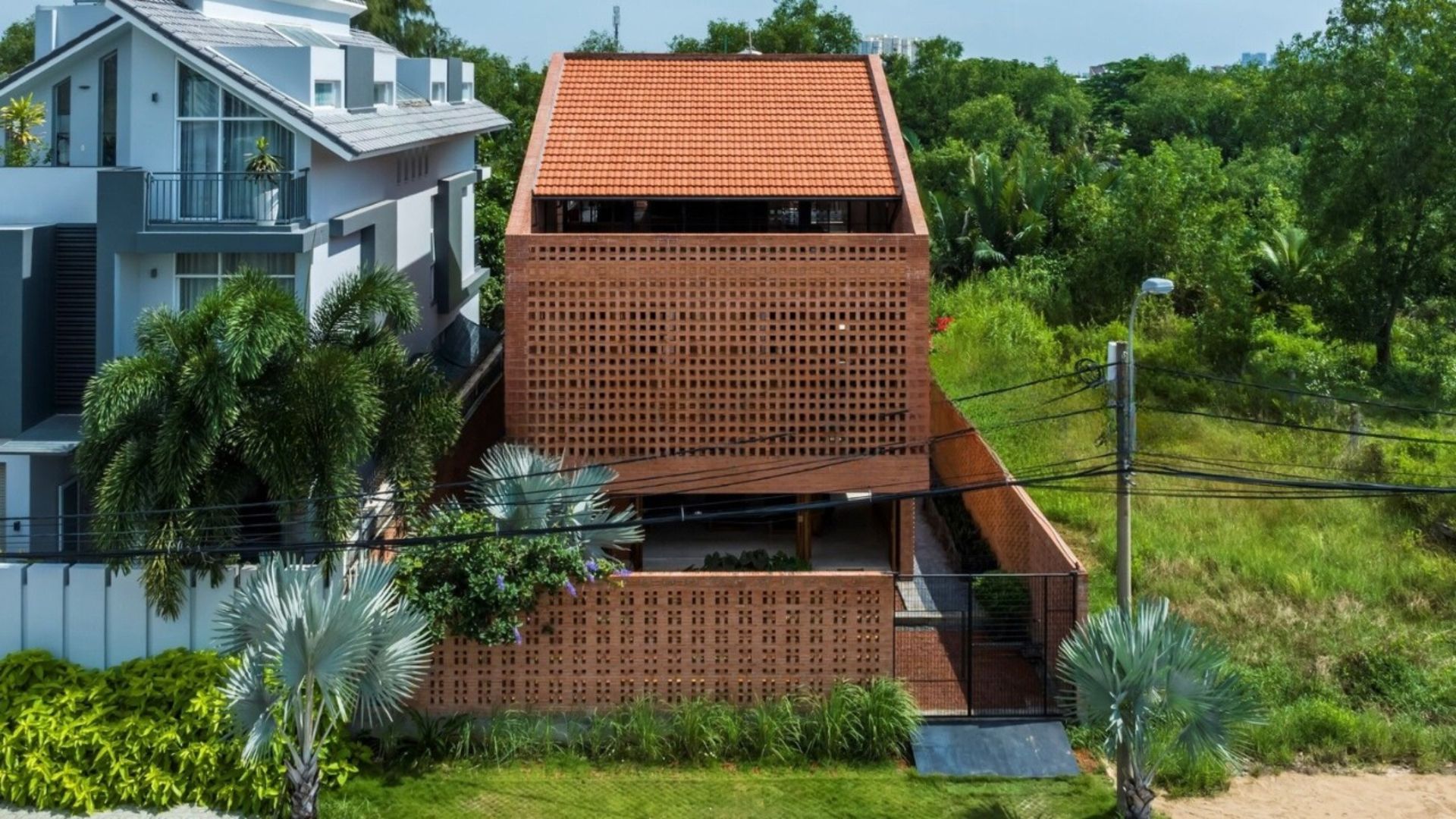


The Nhà Bè house, designed by the Tropical Space office and completed in 2022 on the outskirts of Ho Chi Minh City, Vietnam, occupies a plot of 12 by 25 meters. The perforated brick facade filters the strong sunlight and allows the natural passage of wind.
The Nhà Bè house in Vietnam transforms the facade into a thermal comfort tool. Instead of solid walls, the project adopts a cladding of perforated ceramic bricks that filters sunlight, lets the wind in, and offers privacy from street views. The project was signed by the Tropical Space office, with architects Nguyen Hai Long and Tran Thi Ngu Ngon, and was completed in 2022 in the residential neighborhood of Phú Xuân, in Nhà Bè, a peripheral district of Ho Chi Minh City. The house was designed to accommodate four adult sisters and their mother, with the mission of bringing the family together and facilitating daily care for the matriarch.
The central reason for the project is the tropical climate of Southeast Asia, which combines strong sun, intense heat, and high humidity for much of the year. Instead of isolating from the environment with a closed box of opaque walls, the Nhà Bè house uses the porous facade as a mediator between interior and exterior. The plot is 12 meters wide by 25 meters long, and the built area totals 8 by 18 meters distributed over the ground floor, an upper floor, and an attic used for ancestor worship, according to Vietnamese tradition.
How the brick facade filters light and heat

The main structure of the house is made of reinforced concrete, with slabs also in concrete. But the external envelope is what gives identity to the project: perforated ceramic bricks in different shades of orange, arranged in layers that envelop the entire building.
-
Brazilian Fishing Couple Spends 4 Years Building Solar-Powered Floating Home on the Paraguay River, Now a Navy-Approved Vessel with Leisure Area and Tour Demand

-
While the World Opens New Airports and High-Speed Trains, Brazil Rushes to Complete Projects Stalled for 40 Years
-
Brazil Invests in Massive Waterway to Transport Soybeans by Barge, Reducing Costly Truck Reliance
-
Bridge Rebuilt in Just One Year Reconnects Two Brazilian States


The system works like a porous skin. The sunlight does not enter directly and aggressively: it passes through the gaps between the bricks, arrives filtered, and creates shadow patterns that change throughout the day. The wind coming from the nearby irrigation channel crosses the facade, enters the internal spaces, and finds a central void that helps expel hot air through the upper part of the house, in a natural ventilation system that dispenses with the constant use of appliances.
The central void that connects the family

In the heart of the house, the architects created a large empty space with plants, which functions as the heart of the project. This void spans the three levels of the building and organizes all internal circulation around it.
The result goes beyond thermal comfort. The central void is also a meeting point for the residents: the staircase passes through there, paths cross there, and each family member can see the others even when on different floors. The strategy transforms what could be a cold sequence of rooms into a house with a shared center, where interaction happens naturally throughout the day.
The mother’s room on the ground floor and the four floors above


The distribution of the rooms was designed to facilitate family routine. On the ground floor are the living room, reading area, kitchen, and dining area, all connected to the front and back gardens of the property.
The mother’s room was also positioned on the ground floor, a choice that avoids stairs and brings the matriarch closer to the family’s common areas. On the upper floor are the four bedrooms of the adult daughters, each with a private bathroom, ensuring that each resident has their own space without breaking the unity of the house. Above all, under the sloped roof, is the attic used for ancestor worship, a space that reinforces memory, family rituals, and continuity between generations.
The price of the porous facade
The solution adopted in Nhà Bè House brings clear advantages of thermal comfort, natural ventilation, and privacy. But it has an evident downside, which the architects themselves recognize as part of the project.
The rooms are darker than they would be in a completely open house. The house gains protection against heat and street views but loses the intense brightness of a conventional building with large windows facing the outside. There is also an additional maintenance concern: a skin of perforated brick can accumulate dust, moisture, and dirt over time, especially in a tropical climate, requiring periodic cleaning to preserve the original beauty of the facade.
Nhà Bè House shows how ceramic brick can cease to be just a finishing material and transform into a complete system of climate control and privacy. The Vietnamese project combines architecture, tropical climate, and family life in a solution that makes the house breathe through the walls.
And you, what do you think about this idea? Would you live in a house with a porous facade that filters the sun and wind? Do you believe that projects like this could work in the Brazilian tropical climate? Leave your comment, share your opinion, and tag someone who loves architecture.