






 Portuguese
  Spanish


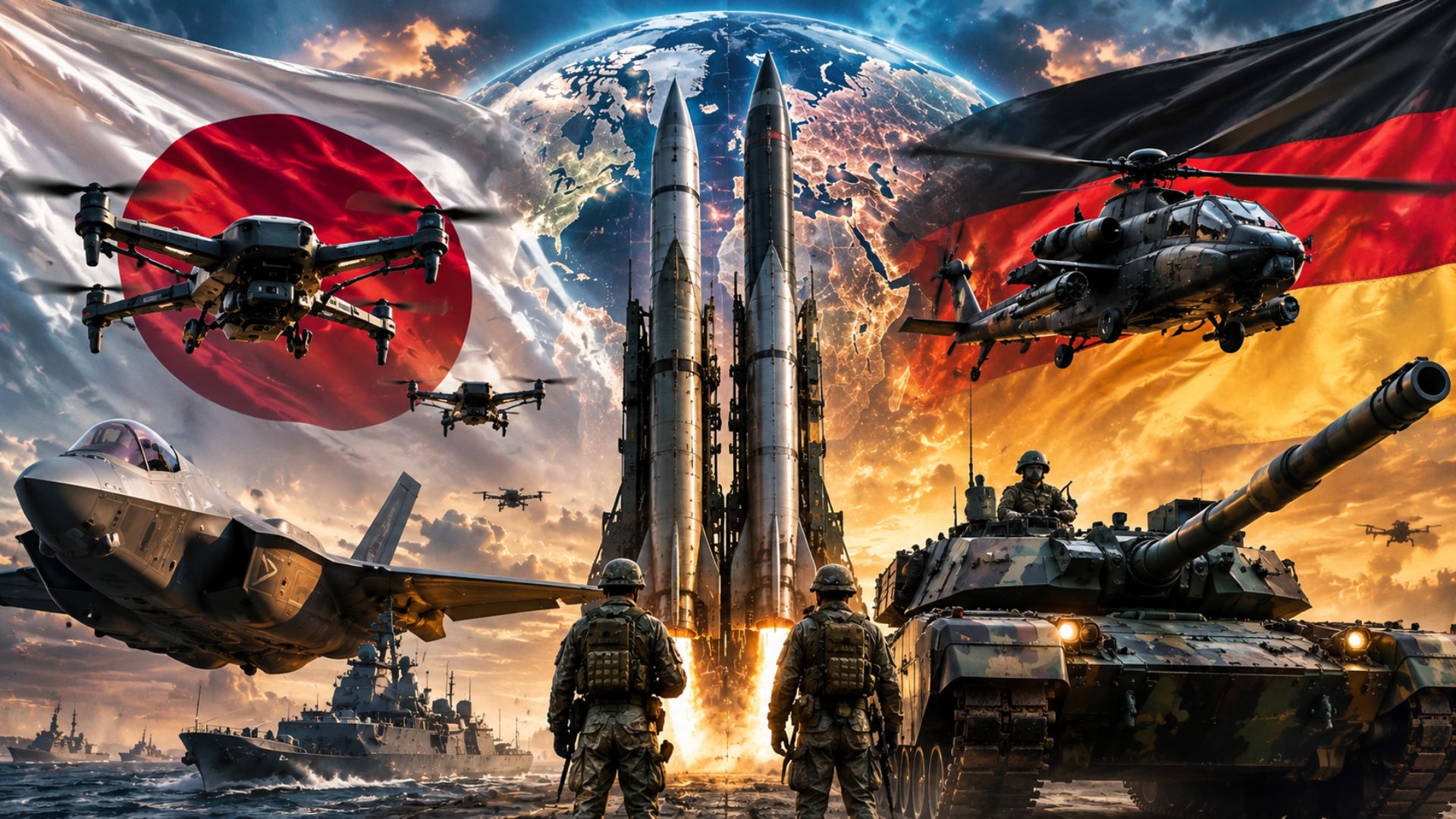

Military pressures in the Indo-Pacific, war in Ukraine, and uncertainties about the American commitment accelerate a sensitive change in two powers defeated in 1945, which now increase defense spending and seek new forms of strategic cooperation.
Germany and Japan are increasing their military spending and strengthening defense partnerships amid rising tensions with China, Russia, and North Korea, as well as doubts about the United States’ willingness to maintain post-war security commitments. The change involves two powers defeated in World War II, which rebuilt their economies under strong dependence on American protection and maintained, for decades, a political stance associated with military restraint, diplomacy, and limited use of force. In Japan, the cabinet approved a record defense budget exceeding 9 trillion yen, about US$ 58 billion, for the fiscal year 2026, according to the Associated Press. In Germany, the government of Friedrich Merz approved guidelines for the 2027 budget that increase defense spending in the central budget from 82.7 billion euros in 2026 to 105.8 billion euros in 2027, according to Reuters.
Military rearmament gains strength without repeating the past
The rapprochement between Berlin and Tokyo does not mean a revival of the Axis formed in the 1940s, but indicates a defensive cooperation between United States allies seeking to reduce vulnerabilities in a more unstable international scenario. In this new environment, Germany tries to strengthen its defense capability in the face of Russia’s war against Ukraine, while Japan increases its vigilance in a region pressured by China, North Korea, and disputes involving Taiwan. During a visit to Japan, German Defense Minister Boris Pistorius discussed bilateral cooperation with Japanese Minister Shinjiro Koizumi and advocated for closer ties between countries committed to a rules-based international order, according to the German Ministry of Defense. The cooperation also includes areas of military technology, with discussions on drones, counter-drone systems, helicopters, and defense industrial projects, topics mentioned by the German government when addressing Pistorius’s agenda in the Indo-Pacific.
Japan strengthens defense against China
The Japanese shift occurs within a gradual process of revising the stance adopted after 1945, when the pacifist Constitution limited the use of force and consolidated the Self-Defense Forces as a structure aimed at protecting the territory. According to the Associated Press, Japan’s 2026 budget represents a 9.4% increase compared to 2025 and is part of a five-year program to raise defense spending to the equivalent of 2% of the Gross Domestic Product. Part of the resources will be allocated to strengthening long-range missiles, unmanned systems, and coastal defense, in line with the budget planning presented by the Ministry of Defense of Japan. The Japanese government states that the country faces the most severe and complex security environment of the post-war period, with mentions of China’s military activity, North Korea’s nuclear and missile programs, and military cooperation between Russia, China, and North Korea. This assessment appears in an official speech by Prime Minister Sanae Takaichi, published by the Prime Minister’s Office of Japan, in which the government advocates strengthening defense capabilities without abandoning the declared commitment to a peaceful trajectory.
-
A Dutchman created a ‘box’ that makes trees grow in the desert almost without water and without irrigation: the invention has already brought seedlings to dozens of countries and achieves up to 90% survival where common planting did not exceed 10%.

-
Abandoned warehouse hid a giant collection of rare computers, with over 2,000 artifacts from the 1930s to the 1980s.

-
She spent 73 years breathing inside an iron lung, survived the aftereffects of polio, and became the last woman in the United States dependent on the equipment before dying at 78 years old.

-
Brazilian students created a $1 filter using pine bark, cotton, and 3D-printed parts to clean cassava wastewater, reduce the toxicity of a hazardous waste, and transform contaminated water into biofertilizer.





China sees risk in Japanese change
The Japanese advancement provokes a reaction from China, which accuses Tokyo of accelerating its military expansion and moving away from the peaceful path officially advocated since the end of World War II. Regional tension increases because Beijing considers Taiwan part of its territory, while Japan and the United States watch with concern the intensification of Chinese military activities in the Pacific and areas near the Japanese archipelago. Even with the strengthening of military capabilities, Japanese authorities avoid presenting the change as an abandonment of constitutional pacifism and argue that the country needs to expand its deterrence to reduce risks in its strategic surroundings.
Germany accelerates spending after war in Ukraine
In Europe, the German transformation gained momentum after the large-scale Russian invasion of Ukraine in February 2022, which exposed military limitations accumulated over decades and led Berlin to revise defense priorities. By including the special defense fund and resources allocated to Ukraine, German defense spending is expected to reach 144.9 billion euros in 2027, equivalent to 3.1% of GDP, as reported by Reuters. Merz stated that recent events show the importance of investing in German defense capability, while Finance Minister Lars Klingbeil said that the numbers could still change according to Ukraine’s needs. This new orientation breaks with part of the tradition of fiscal and military restraint of reunified Germany, which for years maintained defense spending below the expectations of NATO allies and prioritized social, industrial, and infrastructure investments.
US Dependence Weighs on Allies
The reorientation of Germany and Japan also reflects a common concern with the predictability of the United States, a country that remains the main military ally of both, but has been demanding for years that partners take on a larger share of defense costs. Donald Trump pressured European and Asian allies to increase their military spending, reinforcing a discussion that already existed within NATO and also in the Indo-Pacific, where Washington seeks to contain Chinese military expansion without bearing the regional burden alone. Therefore, Berlin and Tokyo seek to expand partnerships with countries of similar profiles, without breaking with the US-led alliance structure and without presenting their changes as an offensive military expansion project. The reorganization of Germany and Japan’s international role is occurring gradually, but it is already altering the position of two powers that have spent decades associated with military restraint and are now investing in defense to deal with regional threats, pressure from allies, and a less predictable global scenario.




