






 Portuguese
  Spanish
  3 min of reading
  0 comments


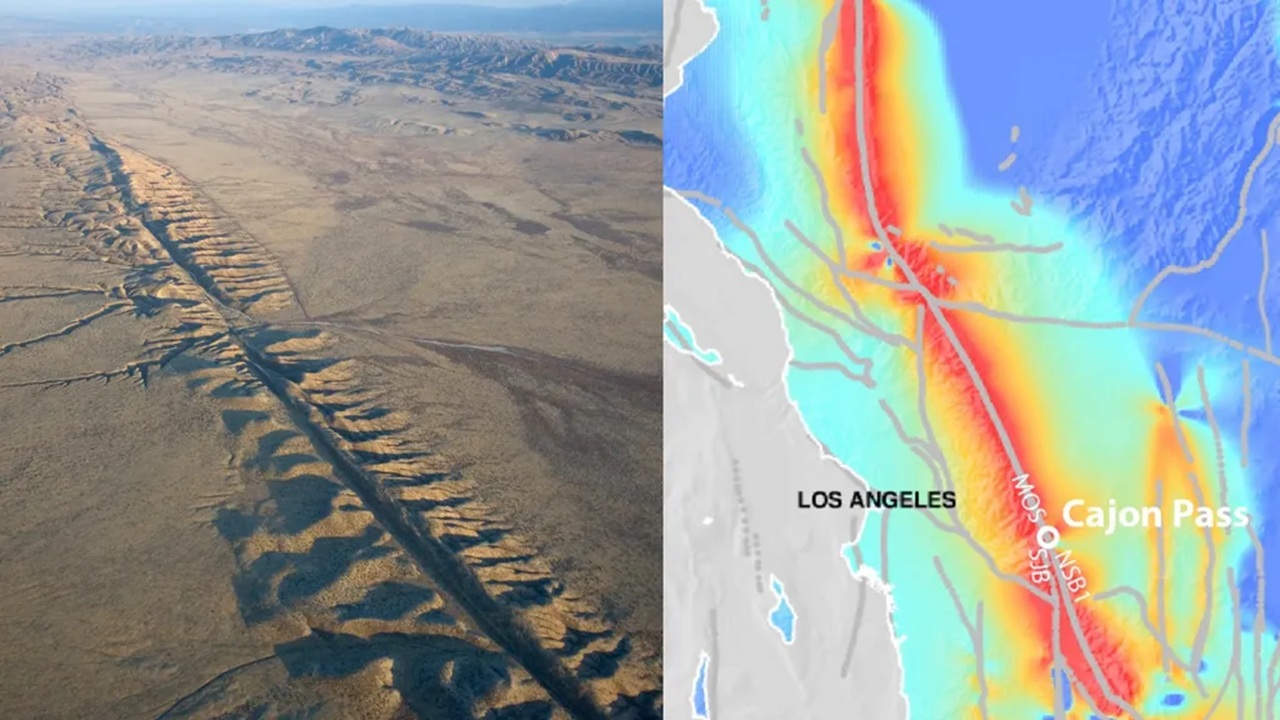
Study points out that the San Andreas and San Jacinto faults have reached the highest level of tectonic stress in 1,000 years, while Cajon Pass appears as a decisive point for the possible propagation of a major earthquake in Southern California.
The earthquake risk in California has returned to the spotlight after a study indicated that the San Andreas and San Jacinto faults have reached the highest levels of tectonic stress in the last 1,000 years.
The research points out that several segments are at values equal to or higher than the highest recorded in the last millennium. This accumulation does not set a date for the next earthquake, but indicates a critically stressed system.
The areas cited as exposed include Los Angeles, San Bernardino, Riverside, and the Coachella Valley. The alert involves the possibility of a rupture capable of crossing more than one system.
-
Scientists have mapped for the first time the largest biological network on the planet, formed by underground fungi with an extension of 110 quadrillion km that transport 4 billion tons of CO₂ to the soil per year.

-
Where does the light go when you turn off the lamp? The answer involves invisible particles called photons, which disappear in fractions of a second inside the room but can travel billions of years through space to reach our eyes.

-
Light particle that shouldn’t be split surprises physicists
-
New oral medication for hair loss surprises in tests with more than 500 participants, uses extended-release minoxidil, shows hair growth four times greater than the placebo, and now raises expectations about when it might reach the market.



Liliane Burkhard stated that the region could support a wide rupture involving both systems.
Cajon Pass could pave the way
Cajon Pass is the point where the San Jacinto fault separates from the main trace of the San Andreas. Researchers describe the area as a “gateway” for earthquakes.
This section can either prevent or facilitate the passage of ruptures between the faults. The behavior depends on how similar the stress levels are when the rupture begins.
In the current scenario, San Andreas and San Jacinto appear to have comparable and elevated tensions. Therefore, a rupture could advance through more than one section.
If the rupture involves the two branches of the San Andreas connected at Cajon Pass, it would be joint. If it also reaches the San Jacinto, the study classifies the scenario as tripartite.
History reinforces concern
In the last 1,000 years, the San Andreas and San Jacinto faults have caused 36 earthquakes with a magnitude equal to or greater than 6.4. The last major event in Southern California occurred in 1857.
In that year, a magnitude 7.9 earthquake ruptured 330 kilometers of the San Andreas fault between Parkfield and Cajon Pass. The rupture, however, did not cross Cajon Pass.
A similar mega-event in 1812 managed to pass through this connection. This shows that the advance through Cajon Pass has happened before and could occur again.
Almost 170 years have passed since the 1857 earthquake. Today, the region is more built-up and populated, making the understanding of scenarios relevant.
Model reconstructed 1,000 years
Burkhard and colleagues created a model that replicates 1,000 years of earthquakes in the San Andreas and San Jacinto systems.
The team used tree rings and age data of displaced sediments to reconstruct the regional seismic history. Then, they input the information into simulations of tectonic stress accumulation, release, and propagation.
The results were published on June 3 in the Journal of Geophysical Research: Solid Earth. The chance of each scenario and the timing of a possible rupture remain unknown.
Even without prediction, Burkhard highlighted that physical models help to better visualize scenarios for hazard assessment, infrastructure, and emergency preparedness. The study suggests application to other junctions.
Do you think regions prone to earthquakes should use studies like this to review constructions, emergency routes, and evacuation plans more frequently? Share your opinion and say which preparation measure seems most urgent in densely populated areas.






Be the first to react!