






 Portuguese
  Spanish
  6 min of reading
  0 comments


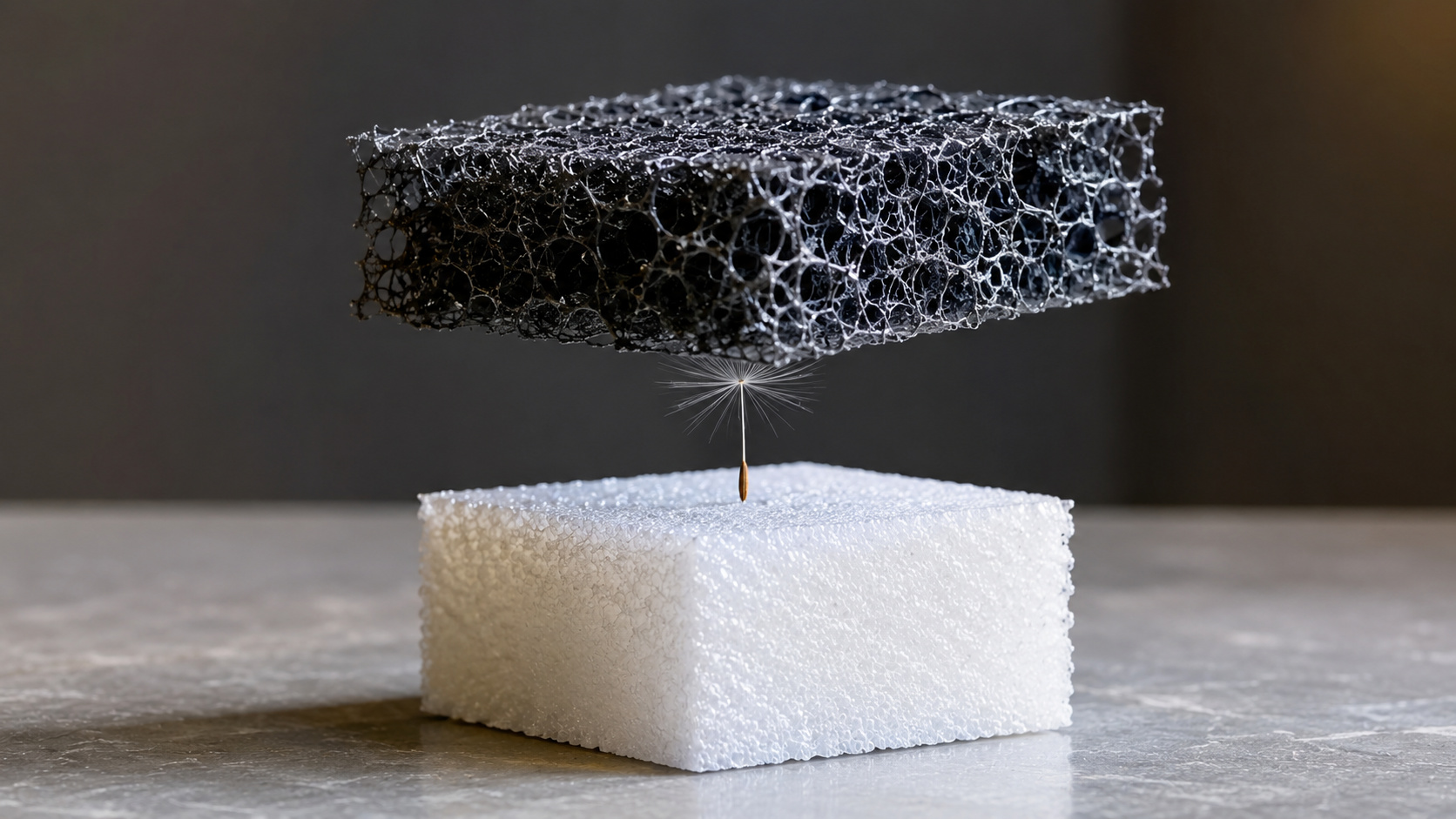
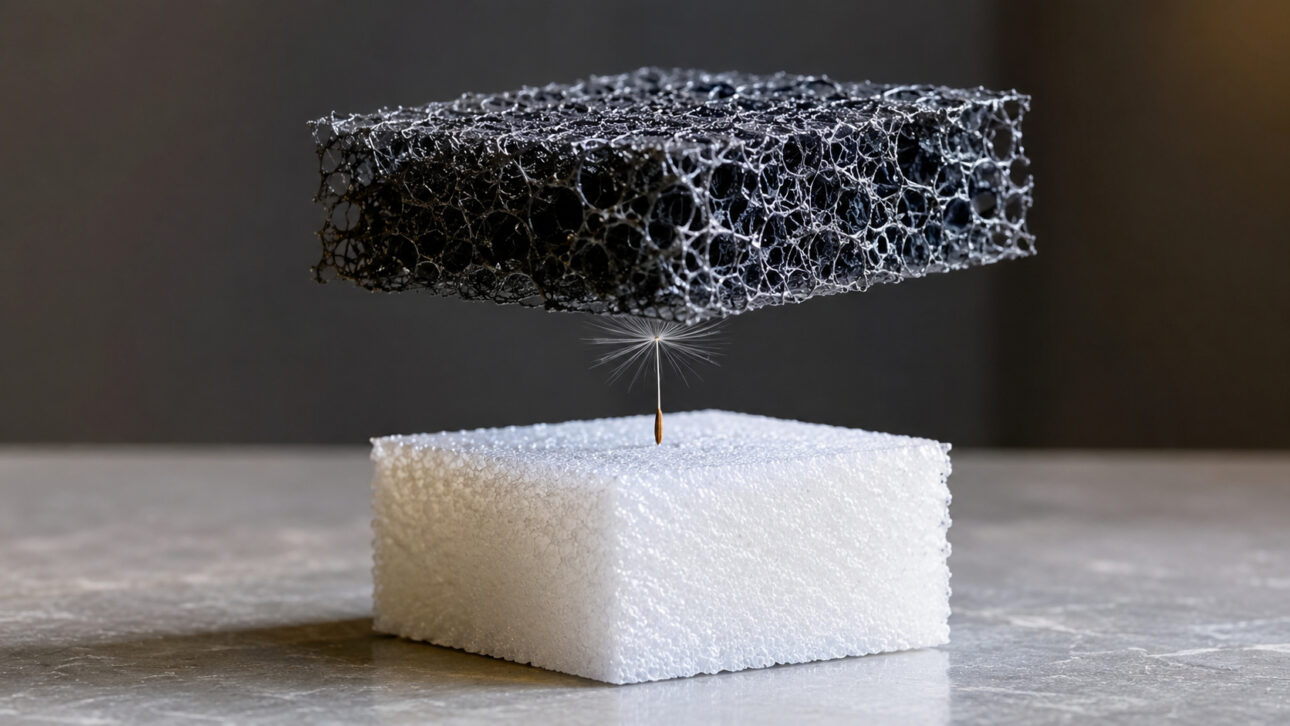
Aerographite is an ultra-lightweight carbon material with 0.2 mg per cubic centimeter, 75 times lighter than styrofoam and capable of becoming more resistant under compression.
According to ScienceDaily, based on research from the University of Kiel, aerographite is a three-dimensional network of porous carbon tubes intertwined on a nano and micro scale that achieved a density of just 0.2 milligrams per cubic centimeter. The material was developed in partnership between the University of Kiel and the Hamburg University of Technology and presented as a record of lightness among solid materials in its category.
What made aerographite so relevant was not just the almost non-existent weight. According to the same scientific release and the article published in Advanced Materials, the material is black, stable, conductive, ductile, non-transparent and combines extreme lightness with unusual mechanical strength, something rare among ultra-lightweight materials.
Aerographite is 75 times lighter than styrofoam and challenges the logic of ultra-lightweight materials
The lightness of aerographite draws attention because very light materials tend to lose structural performance easily.
-
For the first time, researchers find the fuel of the first stars in galaxies formed only 700 million years after the Big Bang.

-
Silent invasion in the Amazon raises alarm: 82 exotic animals and 59 plants threaten native species, crops, and the forest’s balance, while authorities rush to prevent something worse caused by invasive species.

-
USA prepares a 408 kg time capsule with synthetic DNA, national treasures, and a secret message to reveal to Americans in 2276 what it was like to live in the country in 2026.

-
At just 15 years old, prodigy Laurent Simons completed a PhD in quantum physics, masters equations used by NASA, solves advanced problems, and redefines the limits of human intelligence.





In the case of this carbon foam, the relationship between extremely low mass and mechanical strength is precisely what makes it so different. According to ScienceDaily, the material clearly outperformed other similar ones by combining very low density with physical properties that are hard to find in the same set.


This contrast is important to understand why aerographite became a milestone in material science. In general, the lighter a structure is, the more fragile it tends to be. Aerographite broke this expectation by showing that a material almost empty inside can still maintain remarkable stability and elasticity.
In practice, it is not just a density record holder. It is an example of how the microscopic architecture of matter can be designed to generate properties that seem contradictory when viewed through the logic of conventional materials.
Material can be compressed up to 95% and return to its original shape without damage
The most impressive property of aerographite is its behavior under mechanical stress. According to ScienceDaily, the material can be compressed up to 95% and then return to its original shape without suffering structural damage. This fact alone would already place it in an unusual position among modern ultralight materials.
But the most surprising result goes beyond that. Professor Rainer Adelung from the University of Kiel stated that, to a certain extent, aerographite becomes even more solid and stronger after compression. This response reverses the typical behavior of most known materials, which tend to weaken and lose stability when subjected to repeated stress.
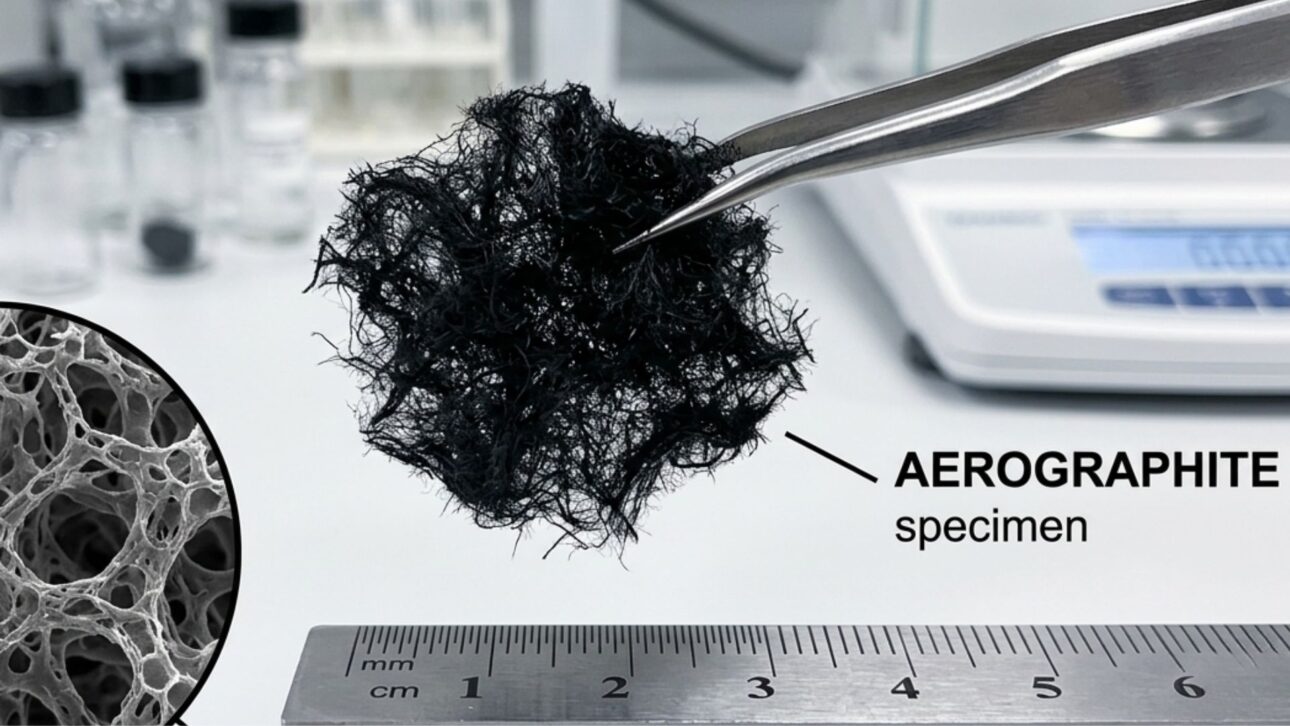
This is one of the points that keep the material relevant more than a decade after its presentation. It impresses not only for being light but for maintaining a rare mechanical behavior precisely where other record-breaking materials tend to fail.
Network of hollow carbon tubes explains why aerographite weighs so little
The secret of aerographite lies in its structure. According to ScienceDaily, the material is formed by an interconnected network of carbon microtubes with extremely thin and porous walls. This means that most of the volume occupied by the piece is, in practice, empty space, while the mass is concentrated in a minimal carbon mesh organized with high precision.
This architecture makes the material appear as a macroscopic solid but with a density much lower than more traditional foams and aerogels. Instead of relying solely on chemical composition, the performance of aerographite heavily depends on how this network was designed and connected.
It is precisely this logic of structural engineering on a microscopic scale that has made aerographite a reference. The breakthrough did not come from discovering a new element, but from organizing carbon into an extremely lightweight and functional architecture.
Sacrificial zinc oxide mold was the key to manufacturing aerographite
The fabrication of aerographite depends on an ingenious process described in the ScienceDaily release and the Advanced Materials article. First, researchers create a zinc oxide structure that functions as a porous mold. On this mold, they grow the carbon network that will give rise to the final material.

Then, this initial mold is removed. What remains is just the hollow carbon structure, supporting itself in the space previously occupied by the zinc oxide. Professor Rainer Adelung himself summarized the process with a simple metaphor: it’s like a vine that grows around a tree and continues to stand after the tree disappears.
This method, known as the use of a sacrificial mold, allows for the creation of a material with extremely low mass and great structural complexity at the same time. Without this intermediate step, it would be much more difficult to construct a three-dimensional network that is so light and stable.
Aerographite combines compression, tension, electrical conduction, and light absorption
Another point highlighted by ScienceDaily is that aerographite is not limited to resisting compression well. The material also exhibits excellent tensile strength, something especially uncommon among ultralight materials. This means it withstands both being squeezed and being pulled better.
Moreover, it is electrically conductive and absorbs light very intensely, giving it a deep black appearance. This combination of properties greatly increases the scientific and technological interest around the material because it makes it useful in scenarios where extreme lightness needs to coexist with electrical functionality and mechanical stability.
Instead of being just a laboratory curiosity, aerographite has come to be regarded as a potential platform for real applications in areas that require low weight and high performance at the same time.
Batteries, lightweight electronics, satellites, and conductive materials are among the possible applications
According to ScienceDaily, one of the most promising applications of aerographite appears in lithium-ion battery electrodes and in systems related to energy storage. Since the material has very low mass and conducts electricity, it can help reduce the overall weight of devices that rely on lightweight and efficient internal components.
The report also mentions potential for use in satellites, lightweight electronics, structures subject to vibration, and synthetic materials that need to gain conductivity without significantly increasing mass. In aerospace contexts, for example, every weight reduction is valuable, which makes aerographite especially attractive for future research.
This range of applications helps explain why the material remains relevant even years after its initial introduction. Aerographite was not only marked as the lightest for a period, but as an important case of material engineering based on extreme structural architecture.
Why aerographite remains important more than a decade later
Aerographite was introduced to the public in 2012, but it continues to be cited as a reference because it did not represent just an isolated record. According to ScienceDaily and the article from Advanced Materials, the material combined in a single system qualities that rarely appear together: ultra-low density, mechanical strength, elasticity, electrical conductivity, and structural stability.
This keeps it important because it shows a paradigm shift in material science. Instead of just seeking naturally lightweight substances, researchers began to design the very architecture of matter to create new properties. Aerographite is one of the clearest examples of this shift.
In the end, the material became famous not only for being extremely light but for proving that a structure almost made of void can still be functional, resistant, and technologically useful. It is this combination that sustains its relevance to this day.





Be the first to react!