






 Portuguese
  Spanish
  3 min of reading
  0 comments


Theoretical experiment accepted in Physical Review Letters shows that cutting the wave of a photon does not only produce the chance of zero or one remaining particle: calculations indicate a quantum mixture that can include states from zero to infinite photons.
When attempting to split a photon, physicists encountered an unexpected result: the theoretical cutting of the light particle can generate a complex mixture of states, ranging from zero to infinite photons, in a phenomenon linked to quantum mechanics.
What it means to try to cut a photon
The photon is described as an elementary packet of light. This means it is not made up of smaller parts, like a common object that could be physically divided.
The question arises from the wave-particle duality, a central principle of quantum mechanics. In this view, the photon behaves both as a particle and as a wave, depending on how it is observed.
-
New oral medication for hair loss surprises in tests with more than 500 participants, uses extended-release minoxidil, shows hair growth four times greater than the placebo, and now raises expectations about when it might reach the market.

-
Europa, Jupiter’s icy moon, intrigues scientists after radar indicates an unusual brightness in the ice and raises new suspicions about what might be hidden in the deep layers of this distant world.
-
At 10 years old, a prodigy boy who claims to have learned to read as a baby is already explaining how the brain works to over a million followers and left the famous Dr. Sanjay Gupta speechless.

-
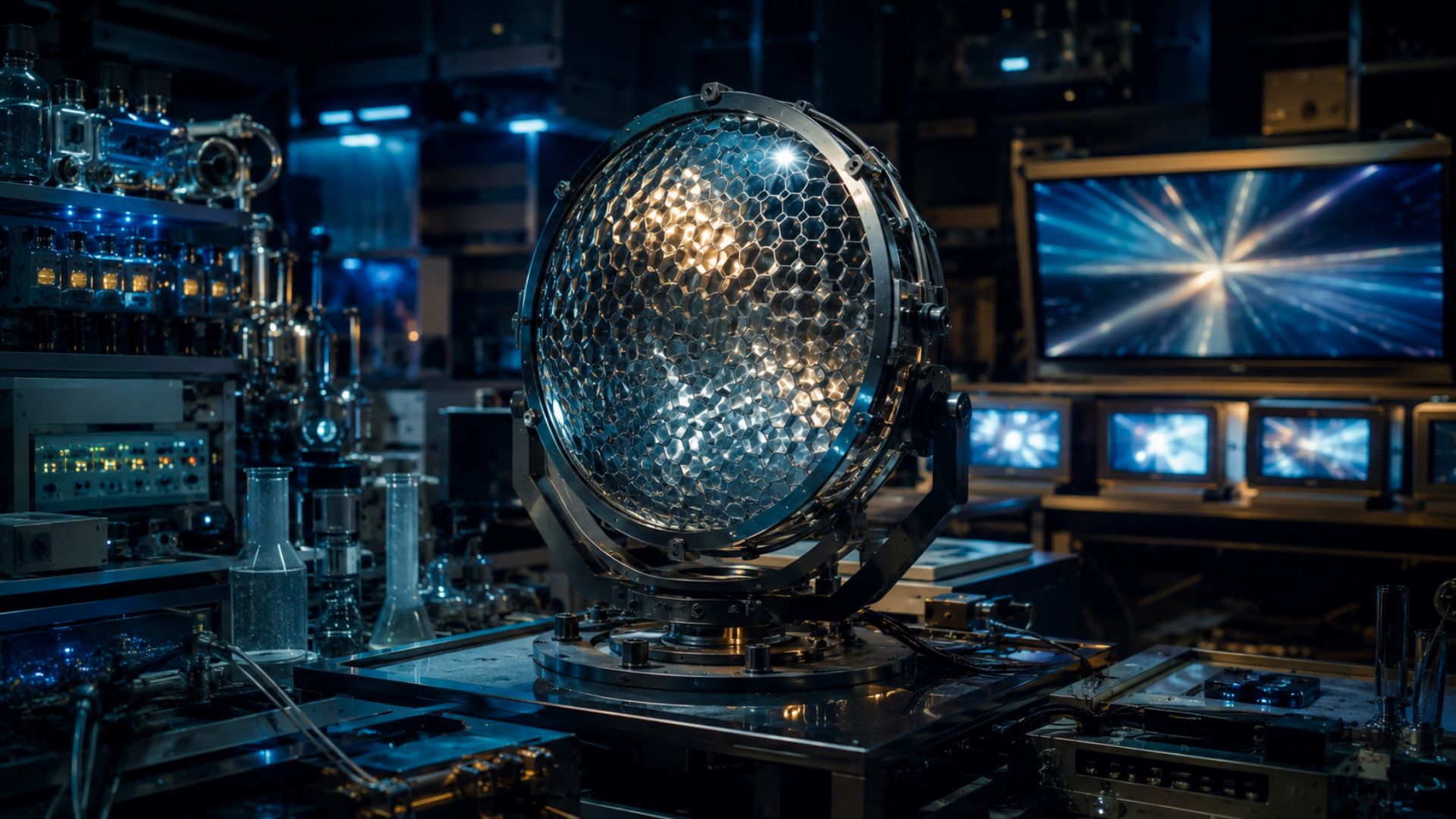
Hidden in a secret laboratory in Tokyo for over 25 years, an impossible lens made of 2,500 microlenses that saw like insect eyes promised to blow the minds of those watching TV.



With theoretical calculations, the team analyzed what would happen if a photon passed through a shutter and this device was closed while the wave associated with the photon was still traversing the system.
In the simulation, the procedure would cut the final part of the wave. The expected result would be simple: a certain probability of no photon remaining and a certain probability of a single photon remaining.
Divided photon creates a mixture from zero to infinity
The study, accepted in Physical Review Letters, indicated that the situation is more complex. By cutting the photon, the calculations pointed to a mixture of quantum states, including a state with an infinite number of photons.
This possibility does not mean that infinite photons appear in a realistic experiment. The expected quantity becomes infinite only if the shutter is closed infinitely fast, an idealized condition.
At realistic speeds, even the presence of a thousand photons would be extremely unlikely. Still, the result shows that the cut alters the probabilities associated with the quantum state of light, according to the calculations made by the team, in a purely theoretical analysis.
Local measurement shows a quantum paradox
The point that most surprised the researchers appears when the cut photon is measured from different sides of the shutter. On one side, the system may seem to be in a state of a single photon.
On the other hand, the measurement may indicate a vacuum, that is, the absence of photons. Globally, however, the complete state remains as a mixture ranging from zero to infinity.
This contrast raises questions about how to describe particles. A complex global state may, locally, seem simple, depending on the point of view used in the measurement.
Path to Rethinking Interactions Between Particles
The team considers how this reasoning could apply to other quantum particles, such as electrons. The goal is to advance towards a clearer description of interactions between particles.
Today, the infinite extension of particles creates theoretical difficulties because it suggests interactions for infinite time. This affects causality, the relationship between cause and effect.
Theoretical photons with a cut tail could help make this causal link clearer. There is still work ahead, but the result opens a path to rethink quantum interactions.
The study shows why quantum physics challenges intuitive ideas about matter, light, and measurement. For those who follow science, it’s worth commenting: does this discovery change your way of imagining a particle or make the quantum world even harder to visualize?








Be the first to react!